
在感染新冠病毒的养老院居民的房间内空气中和表面上检测到 SARS-CoV-2。
Detection of SARS-CoV-2 in Air and on Surfaces in Rooms of Infected Nursing Home Residents.
机构信息
Institute for Risk Assessment Sciences, Utrecht University, Utrecht, The Netherlands.
Julius Center for Health Sciences and Primary Care, University Medical Center Utrecht, Utrecht University, Utrecht, The Netherlands.
出版信息
Ann Work Expo Health. 2023 Jan 12;67(1):129-140. doi: 10.1093/annweh/wxac056.
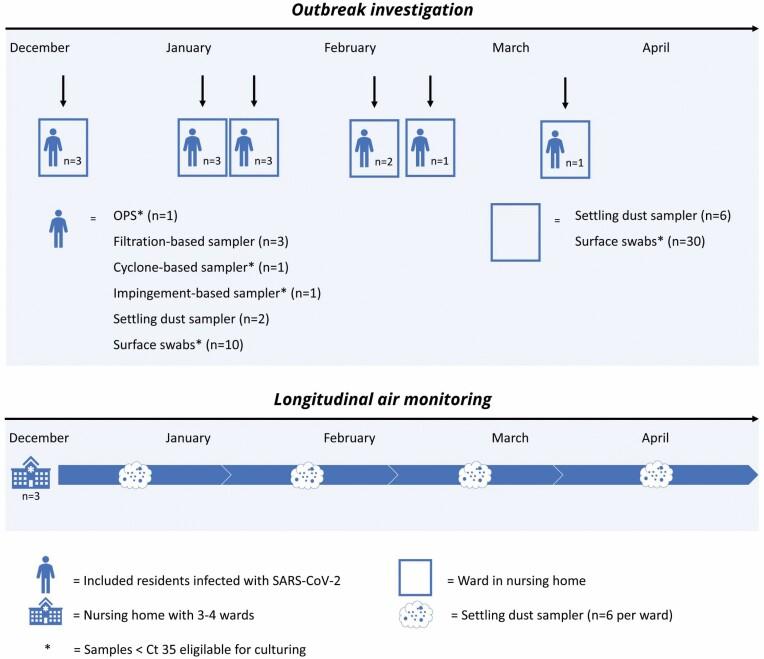
There is an ongoing debate on airborne transmission of Severe Acute Respiratory Syndrome Coronavirus 2 (SARS-CoV-2) as a risk factor for infection. In this study, the level of SARS-CoV-2 in air and on surfaces of SARS-CoV-2 infected nursing home residents was assessed to gain insight in potential transmission routes. During outbreaks, air samples were collected using three different active and one passive air sampling technique in rooms of infected patients. Oropharyngeal swabs (OPS) of the residents and dry surface swabs were collected. Additionally, longitudinal passive air samples were collected during a period of 4 months in common areas of the wards. Presence of SARS-CoV-2 RNA was determined using RT-qPCR, targeting the RdRp- and E-genes. OPS, samples of two active air samplers and surface swabs with Ct-value ≤35 were tested for the presence of infectious virus by cell culture. In total, 360 air and 319 surface samples from patient rooms and common areas were collected. In rooms of 10 residents with detected SARS-CoV-2 RNA in OPS, SARS-CoV-2 RNA was detected in 93 of 184 collected environmental samples (50.5%) (lowest Ct 29.5), substantially more than in the rooms of residents with negative OPS on the day of environmental sampling (n = 2) (3.6%). SARS-CoV-2 RNA was most frequently present in the larger particle size fractions [>4 μm 60% (6/10); 1-4 μm 50% (5/10); <1 μm 20% (2/10)] (Fischer exact test P = 0.076). The highest proportion of RNA-positive air samples on room level was found with a filtration-based sampler 80% (8/10) and the cyclone-based sampler 70% (7/10), and impingement-based sampler 50% (5/10). SARS-CoV-2 RNA was detected in 10 out of 12 (83%) passive air samples in patient rooms. Both high-touch and low-touch surfaces contained SARS-CoV-2 genome in rooms of residents with positive OPS [high 38% (21/55); low 50% (22/44)]. In one active air sample, infectious virus in vitro was detected. In conclusion, SARS-CoV-2 is frequently detected in air and on surfaces in the immediate surroundings of room-isolated COVID-19 patients, providing evidence of environmental contamination. The environmental contamination of SARS-CoV-2 and infectious aerosols confirm the potential for transmission via air up to several meters.
关于严重急性呼吸系统综合症冠状病毒 2(SARS-CoV-2)作为感染风险因素的空气传播仍存在争议。在这项研究中,评估了 SARS-CoV-2 感染的养老院居民的空气和表面上的 SARS-CoV-2 水平,以深入了解潜在的传播途径。在爆发期间,使用三种不同的主动和一种被动空气采样技术在感染患者的房间中采集空气样本。采集居民的咽拭子(OPS)和干燥表面拭子。此外,在病房的 4 个月期间,还收集了纵向被动空气样本。使用 RT-qPCR 检测 RNA,针对 RdRp 和 E 基因。对 OPS、两个主动空气采样器的样本和 Ct 值≤35 的表面拭子进行细胞培养,以检测是否存在传染性病毒。总共收集了 360 个空气样本和 319 个来自患者房间和公共区域的表面样本。在 10 名居民的房间中,OPS 检测到 SARS-CoV-2 RNA,在采集环境样本当天 OPS 检测为阴性的 2 名居民(3.6%)的 184 个采集环境样本中,有 93 个(50.5%)(最低 Ct 值 29.5)检测到 SARS-CoV-2 RNA。在较大粒径分数中(>4μm,60%(6/10);1-4μm,50%(5/10);<1μm,20%(2/10))(Fisher 精确检验 P=0.076),最常发现 SARS-CoV-2 RNA 存在。在房间水平上,使用基于过滤的采样器 80%(8/10)和基于旋风的采样器 70%(7/10),以及基于撞击的采样器 50%(5/10),发现 RNA 阳性空气样本的比例最高。在 12 个(83%)患者房间的被动空气样本中检测到 SARS-CoV-2 RNA。在 OPS 阳性的居民的房间中,高接触和低接触表面都含有 SARS-CoV-2 基因组[高接触表面 38%(21/55);低接触表面 50%(22/44)]。在一个主动空气样本中,检测到了体外传染性病毒。总之,在 COVID-19 患者隔离房间的周围环境中,经常在空气中和表面上检测到 SARS-CoV-2,这提供了环境污染的证据。SARS-CoV-2 的环境污染和传染性气溶胶证实了通过空气传播数米的潜力。
 Zotero 插件