
2-羟基黄酮在疼痛和炎症啮齿动物模型中的疗效:涉及阿片类和 GABA 能抗伤害机制。
Efficacy of 2-Hydroxyflavanone in Rodent Models of Pain and Inflammation: Involvement of Opioidergic and GABAergic Anti-Nociceptive Mechanisms.
机构信息
Department of Pharmacy, University of Peshawar, Peshawar 25000, Pakistan.
Department of Pharmacy, Faculty of Biological Sciences, University of Malakand, Chakdara 18000, Pakistan.
出版信息
Molecules. 2022 Aug 25;27(17):5431. doi: 10.3390/molecules27175431.
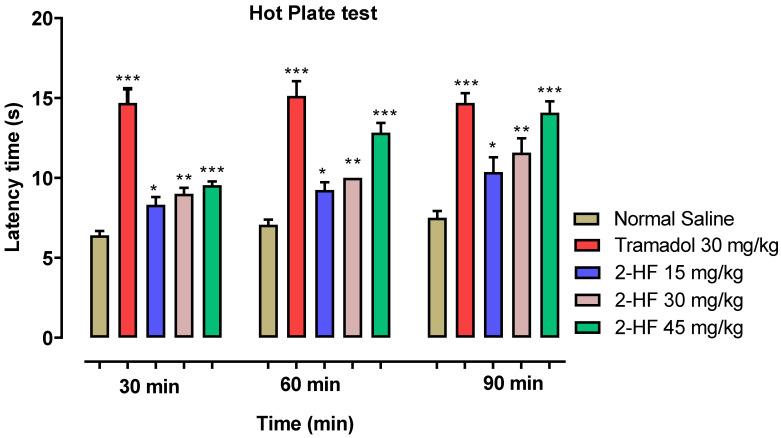
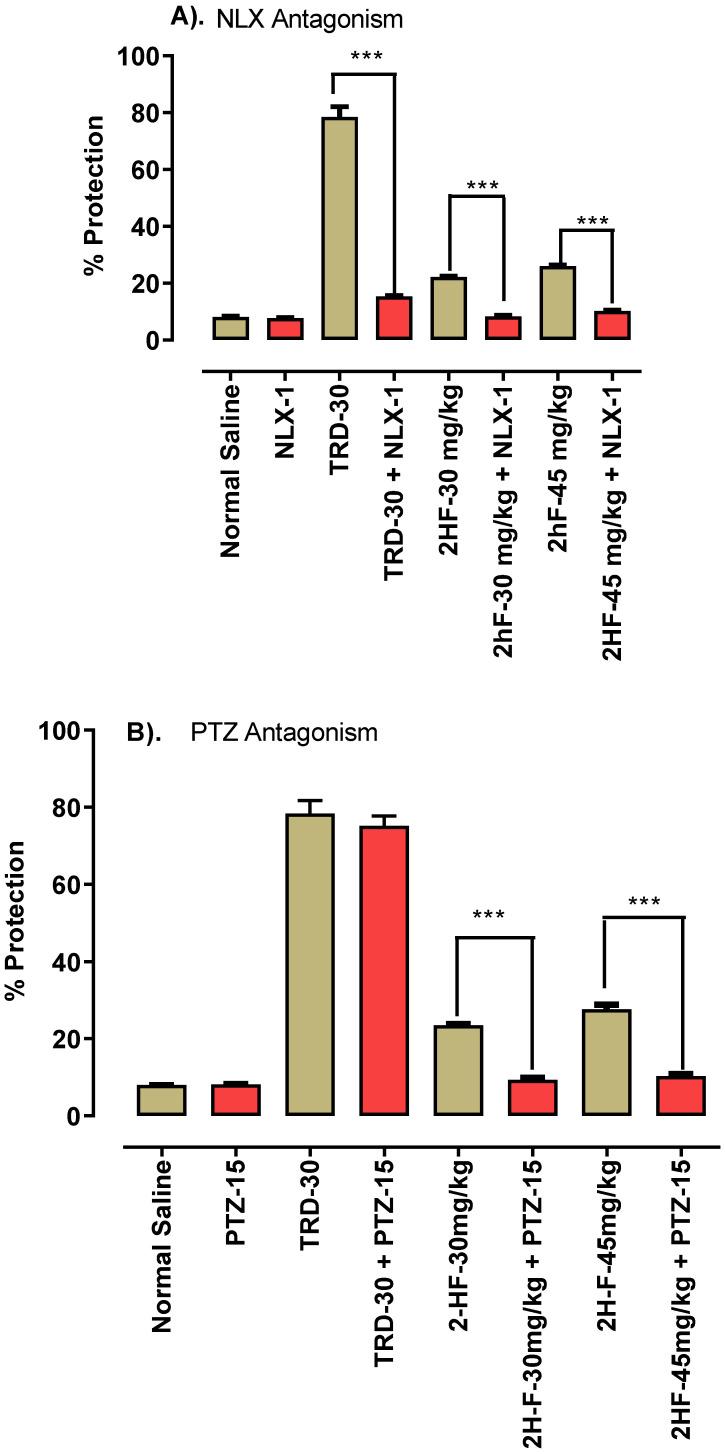
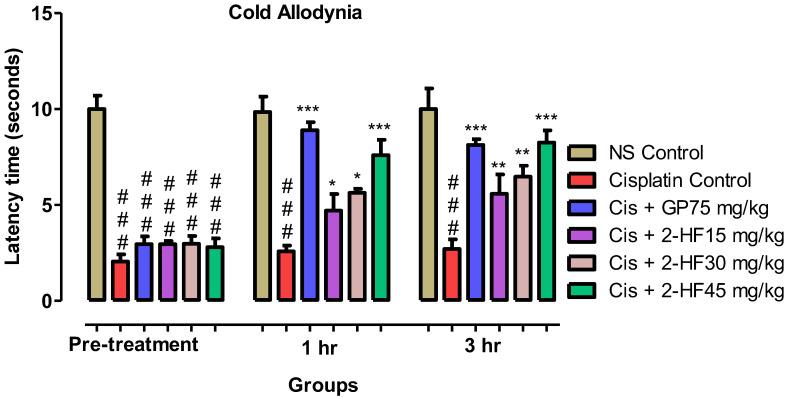
The current work examined the pharmacological potential of a selected flavanone derivative 2-hydroxyflavanone as a promising remedy for the treatment and management of pain. The selected flavanone derivative (2-HF) was evaluated for its analgesic and anti-inflammatory potentials following standard pharmacological protocols including hot plate, acetic acid-induced writhing and tail immersion tests. Naloxone and pentylenetetrazol were used to evaluate the potential implication of GABAergic and opioidergic mechanisms. The anti-inflammatory potential of 2-HF was confirmed using carrageenan-, serotonin- and histamine-induced paw edema models as well as a xylene-induced ear edema model. Furthermore, the anti-neuropathic potential of 2-HF was tested using a cisplatin-induced neuropathic pain model. Our sample, at the tested concentrations of 15, 30 and 45 mg kg, showed considerable analgesic, anti-inflammatory effects, as well as efficacy against neuropathic pain. Naloxone and pentylenetetrazol at 1 and 15 mg kg antagonized the anti-nociceptive activities of 2-hydroxyflavanone indicating the involvement of opioidergic and GABAergic mechanisms. In the static allodynia model, combination of gabapentin 75 mg kg with 2-HF at 15, 30, 45 mg kg doses exhibited considerable efficacy. In cold allodynia, 2-hydroxyflavanone, at doses of 15, 30 and 45 mg kg and in combination with gabapentin (75 mg kg), demonstrated prominent anti-allodynic effects. The paw withdrawal latency was considerably increased in gabapentin + cisplatin treated groups. Moreover, cisplatin + 2-hydroxyflavanone 15, 30, 45 mg kg showed increases in paw withdrawal latency. Likewise, considerable efficacy was observed for 2-hydroxyflavanone in thermal hyperalgesia and dynamic allodynia models. Our findings suggest that 2-hydroxyflavanone is a potential remedy for pain syndrome, possibly mediated through opioidergic and GABAergic mechanisms.
当前的工作研究了一种选定的黄烷酮衍生物 2-羟基黄烷酮作为治疗和管理疼痛的有希望的药物的药理学潜力。根据包括热板、醋酸诱导的扭体和尾部浸入试验在内的标准药理学方案,评估了选定的黄烷酮衍生物(2-HF)的镇痛和抗炎潜力。纳洛酮和戊四唑用于评估 GABA 能和阿片能机制的潜在意义。使用角叉菜胶、血清素和组胺诱导的爪肿胀模型以及二甲苯诱导的耳肿胀模型证实了 2-HF 的抗炎潜力。此外,还使用顺铂诱导的神经病理性疼痛模型测试了 2-HF 的抗神经病变潜力。我们的样本在 15、30 和 45 mg/kg 的测试浓度下表现出相当的镇痛、抗炎作用,以及对神经病理性疼痛的疗效。纳洛酮和戊四唑在 1 和 15 mg/kg 时拮抗了 2-羟基黄烷酮的抗伤害感受活性,表明涉及阿片能和 GABA 能机制。在静态痛觉过敏模型中,加巴喷丁 75 mg/kg 与 2-HF 15、30、45 mg/kg 剂量联合使用表现出相当的疗效。在冷痛觉过敏中,2-羟基黄烷酮在 15、30 和 45 mg/kg 剂量下与加巴喷丁(75 mg/kg)联合使用表现出明显的抗痛觉过敏作用。加巴喷丁治疗组的爪回缩潜伏期明显增加。此外,顺铂+2-羟基黄烷酮 15、30、45 mg/kg 组的爪回缩潜伏期也有所增加。同样,2-羟基黄烷酮在热痛觉过敏和动态痛觉过敏模型中也表现出相当的疗效。我们的研究结果表明,2-羟基黄烷酮是一种治疗疼痛综合征的潜在药物,可能通过阿片能和 GABA 能机制介导。





 Zotero 插件