
小直径无细胞组织工程血管移植物:实现合适力学性能的生物材料与制造技术
Small Diameter Cell-Free Tissue-Engineered Vascular Grafts: Biomaterials and Manufacture Techniques to Reach Suitable Mechanical Properties.
作者信息
Rodríguez-Soto María A, Polanía-Sandoval Camilo A, Aragón-Rivera Andrés M, Buitrago Daniel, Ayala-Velásquez María, Velandia-Sánchez Alejandro, Peralta Peluffo Gabriela, Cruz Juan C, Muñoz Camargo Carolina, Camacho-Mackenzie Jaime, Barrera-Carvajal Juan Guillermo, Briceño Juan Carlos
机构信息
Department of Biomedical Engineering, Universidad de los Andes, Bogotá 111711, Colombia.
Vascular and Endovascular Surgery Research Group, Fundación Cardio Infantil-Instituto de Cardiología, Bogotá 111711, Colombia.
出版信息
Polymers (Basel). 2022 Aug 23;14(17):3440. doi: 10.3390/polym14173440.
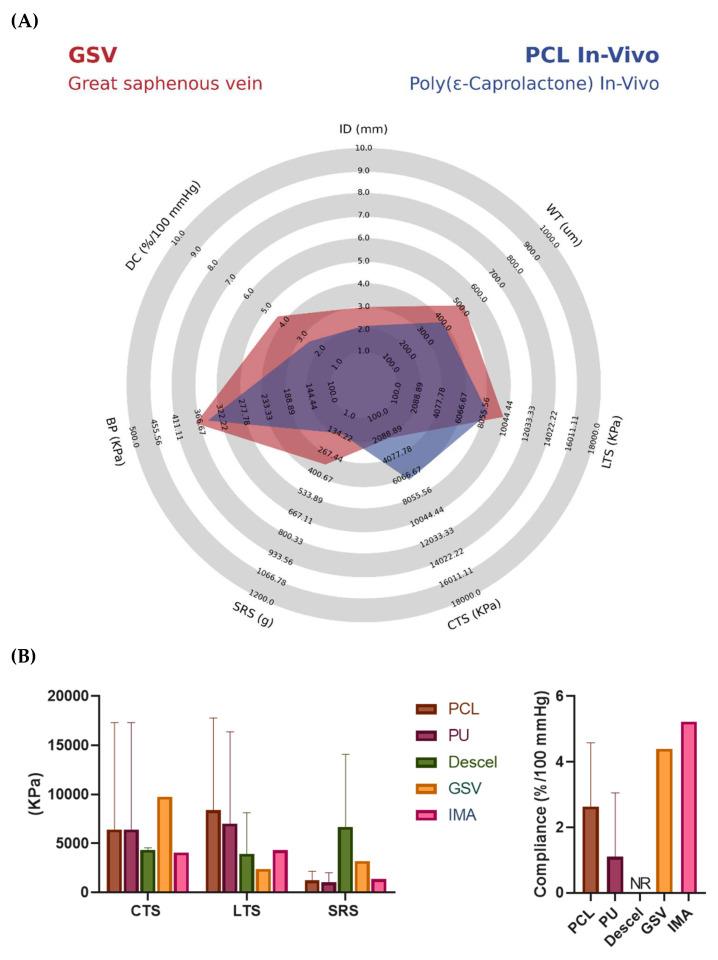
Vascular grafts (VGs) are medical devices intended to replace the function of a blood vessel. Available VGs in the market present low patency rates for small diameter applications setting the VG failure. This event arises from the inadequate response of the cells interacting with the biomaterial in the context of operative conditions generating chronic inflammation and a lack of regenerative signals where stenosis or aneurysms can occur. Tissue Engineered Vascular grafts (TEVGs) aim to induce the regeneration of the native vessel to overcome these limitations. Besides the biochemical stimuli, the biomaterial and the particular micro and macrostructure of the graft will determine the specific behavior under pulsatile pressure. The TEVG must support blood flow withstanding the exerted pressure, allowing the proper compliance required for the biomechanical stimulation needed for regeneration. Although the international standards outline the specific requirements to evaluate vascular grafts, the challenge remains in choosing the proper biomaterial and manufacturing TEVGs with good quality features to perform satisfactorily. In this review, we aim to recognize the best strategies to reach suitable mechanical properties in cell-free TEVGs according to the reported success of different approaches in clinical trials and pre-clinical trials.
血管移植物(VGs)是旨在替代血管功能的医疗器械。市场上现有的血管移植物在小直径应用中通畅率较低,导致血管移植物失效。这种情况是由于在手术条件下与生物材料相互作用的细胞反应不足,产生慢性炎症,且缺乏再生信号,从而可能发生狭窄或动脉瘤。组织工程血管移植物(TEVGs)旨在诱导天然血管再生以克服这些限制。除了生化刺激外,生物材料以及移植物的特定微观和宏观结构将决定在脉动压力下的具体行为。TEVG必须支持血流并承受施加的压力,允许再生所需的生物力学刺激具有适当的顺应性。尽管国际标准概述了评估血管移植物的具体要求,但挑战仍然在于选择合适的生物材料并制造具有良好质量特征的TEVG以使其令人满意地发挥作用。在本综述中,我们旨在根据临床试验和临床前试验中不同方法报道的成功经验,确定在无细胞TEVG中实现合适机械性能的最佳策略。



 Zotero 插件