
心理韧性:一种情感调节框架。
Psychological Resilience: An Affect-Regulation Framework.
作者信息
Troy Allison S, Willroth Emily C, Shallcross Amanda J, Giuliani Nicole R, Gross James J, Mauss Iris B
机构信息
Popular Comms Institute, Lancaster, Pennsylvania, USA; email:
Department of Psychology, Franklin & Marshall College, Lancaster, Pennsylvania, USA.
出版信息
Annu Rev Psychol. 2023 Jan 18;74:547-576. doi: 10.1146/annurev-psych-020122-041854. Epub 2022 Sep 14.
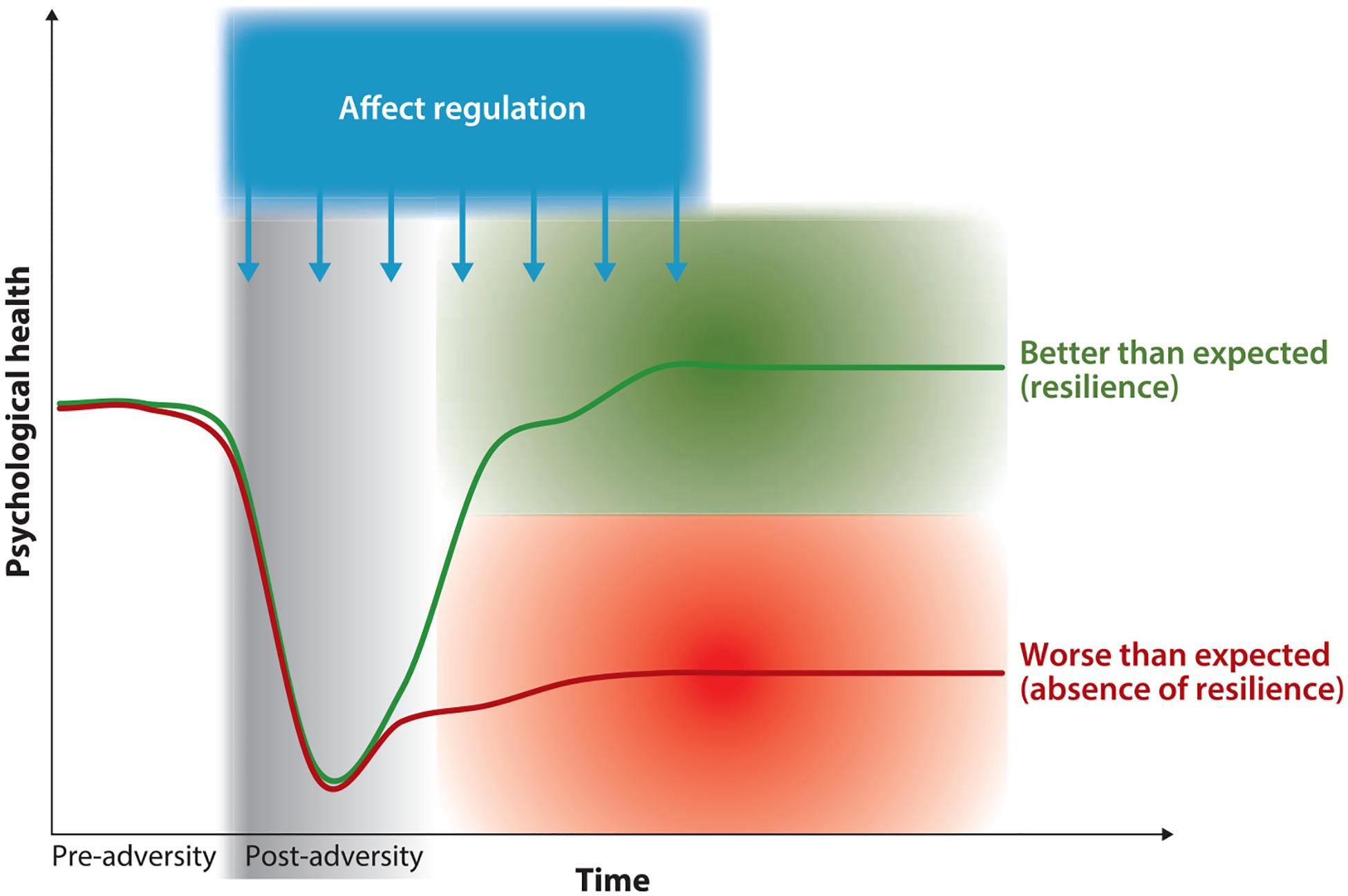
Exposure to adversity (e.g., poverty, bereavement) is a robust predictor of disruptions in psychological functioning. However, people vary greatly in their responses to adversity; some experience severe long-term disruptions, others experience minimal disruptions or even improvements. We refer to the latter outcomes-faring better than expected given adversity-as psychological resilience. Understanding what processes explain resilience has critical theoretical and practical implications. Yet, psychology's understanding of resilience is incomplete, for two reasons: () We lack conceptual clarity, and () two major approaches to resilience-the stress and coping approach and the emotion and emotion-regulation approach-have limitations and are relatively isolated from one another. To address these two obstacles,we first discuss conceptual questions about resilience. Next, we offer an integrative affect-regulation framework that capitalizes on complementary strengths of both approaches. This framework advances our understanding of resilience by integrating existing findings, highlighting gaps in knowledge, and guiding future research.
暴露于逆境(如贫困、丧亲之痛)是心理功能紊乱的一个有力预测指标。然而,人们对逆境的反应差异很大;有些人经历严重的长期紊乱,另一些人则经历极小的紊乱甚至有所改善。我们将后一种结果——在逆境下表现得比预期更好——称为心理复原力。理解哪些过程能够解释复原力具有至关重要的理论和实践意义。然而,心理学对复原力的理解并不完整,原因有二:(1)我们缺乏概念上的清晰度;(2)复原力的两种主要研究方法——压力与应对方法以及情绪与情绪调节方法——都存在局限性,且彼此相对孤立。为了克服这两个障碍,我们首先讨论关于复原力的概念性问题。接下来,我们提供一个综合的情绪调节框架,该框架利用了两种方法的互补优势。这个框架通过整合现有研究结果、突出知识空白以及指导未来研究,推进了我们对复原力的理解。

 Zotero 插件