
奥密克戎流行期有症状人群的无监督自我采样新冠病毒快速抗原检测的诊断准确性:横断面研究。
Diagnostic accuracy of covid-19 rapid antigen tests with unsupervised self-sampling in people with symptoms in the omicron period: cross sectional study.
机构信息
Julius Center for Health Sciences and Primary Care, University Medical Centre Utrecht, Utrecht University, 3584 CG Utrecht, Netherlands.
Cochrane Netherlands, University Medical Centre Utrecht, Utrecht University, Netherlands.
出版信息
BMJ. 2022 Sep 14;378:e071215. doi: 10.1136/bmj-2022-071215.
OBJECTIVE
To assess the performance of rapid antigen tests with unsupervised nasal and combined oropharyngeal and nasal self-sampling during the omicron period.
DESIGN
Prospective cross sectional diagnostic test accuracy study.
SETTING
Three public health service covid-19 test sites in the Netherlands, 21 December 2021 to 10 February 2022.
PARTICIPANTS
6497 people with covid-19 symptoms aged ≥16 years presenting for testing.
INTERVENTIONS
Participants had a swab sample taken for reverse transcription polymerase chain reaction (RT-PCR, reference test) and received one rapid antigen test to perform unsupervised using either nasal self-sampling (during the emergence of omicron, and when omicron accounted for >90% of infections, phase 1) or with combined oropharyngeal and nasal self-sampling in a subsequent (phase 2; when omicron accounted for >99% of infections). The evaluated tests were Flowflex (Acon Laboratories; phase 1 only), MPBio (MP Biomedicals), and Clinitest (Siemens-Healthineers).
MAIN OUTCOME MEASURES
The main outcomes were sensitivity, specificity, and positive and negative predictive values of each self-test, with RT-PCR testing as the reference standard.
RESULTS
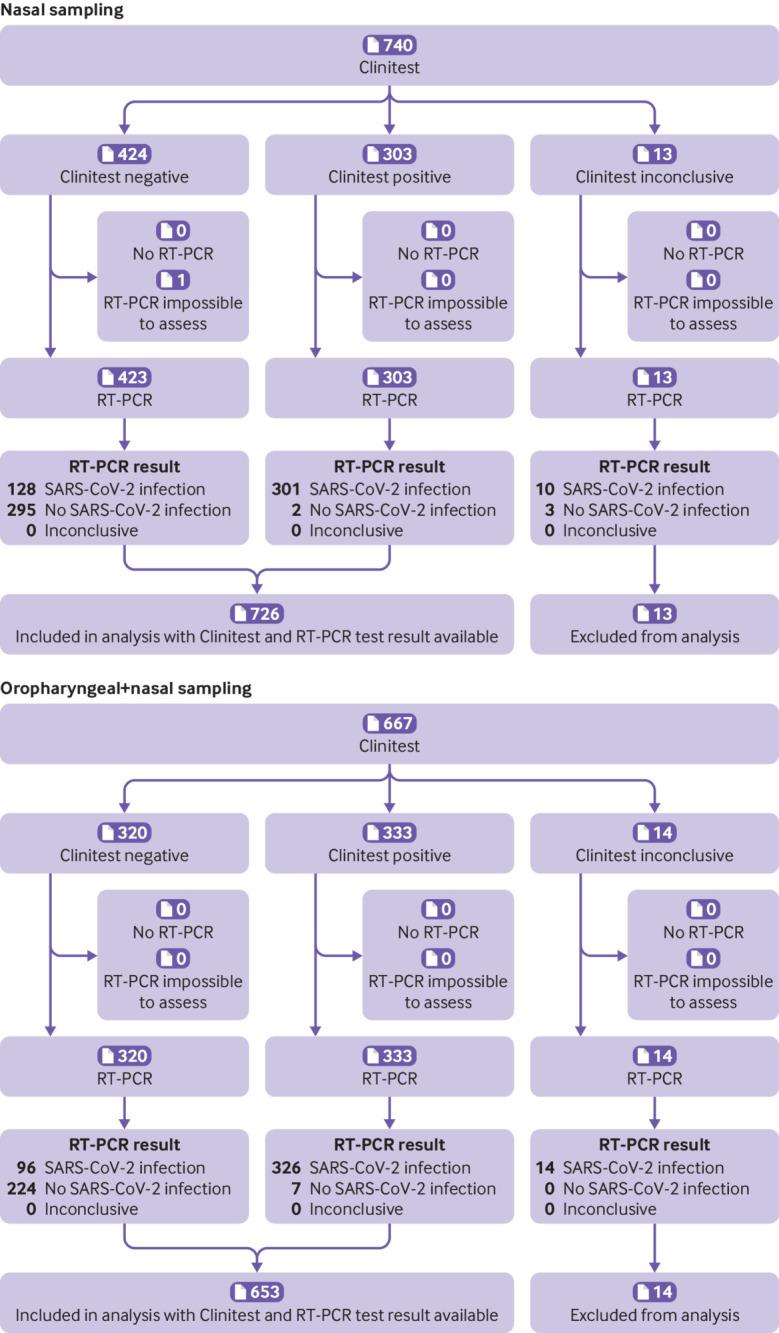
During phase 1, 45.0% (n=279) of participants in the Flowflex group, 29.1% (n=239) in the MPBio group, and 35.4% ((n=257) in the Clinitest group were confirmatory testers (previously tested positive by a self-test at own initiative). Overall sensitivities with nasal self-sampling were 79.0% (95% confidence interval 74.7% to 82.8%) for Flowflex, 69.9% (65.1% to 74.4%) for MPBio, and 70.2% (65.6% to 74.5%) for Clinitest. Sensitivities were substantially higher in confirmatory testers (93.6%, 83.6%, and 85.7%, respectively) than in those who tested for other reasons (52.4%, 51.5%, and 49.5%, respectively). Sensitivities decreased from 87.0% to 80.9% (P=0.16 by χ test), 80.0% to 73.0% (P=0.60), and 83.1% to 70.3% (P=0.03), respectively, when transitioning from omicron accounting for 29% of infections to >95% of infections. During phase 2, 53.0% (n=288) of participants in the MPBio group and 44.4% (n=290) in the Clinitest group were confirmatory testers. Overall sensitivities with combined oropharyngeal and nasal self-sampling were 83.0% (78.8% to 86.7%) for MPBio and 77.3% (72.9% to 81.2%) for Clinitest. When combined oropharyngeal and nasal self-sampling was compared with nasal self-sampling, sensitivities were found to be slightly higher in confirmatory testers (87.4% and 86.1%, respectively) and substantially higher in those testing for other reasons (69.3% and 59.9%, respectively).
CONCLUSIONS
Sensitivities of three rapid antigen tests with nasal self-sampling decreased during the emergence of omicron but was only statistically significant for Clinitest. Sensitivities appeared to be substantially influenced by the proportion of confirmatory testers. Sensitivities of MPBio and Clinitest improved after the addition of oropharyngeal to nasal self-sampling. A positive self-test result justifies prompt self-isolation without the need for confirmatory testing. Individuals with a negative self-test result should adhere to general preventive measures because a false negative result cannot be ruled out. Manufacturers of MPBio and Clinitest may consider extending their instructions for use to include combined oropharyngeal and nasal self-sampling, and other manufacturers of rapid antigen tests should consider evaluating this as well.
目的
评估在 omicron 期间,未经监督的鼻拭子和联合鼻咽拭子或鼻拭子自我采样的快速抗原检测的性能。
设计
前瞻性横断面诊断准确性研究。
设置
荷兰三个公共卫生服务新冠病毒检测点,2021 年 12 月 21 日至 2022 年 2 月 10 日。
参与者
6497 名有新冠病毒症状且年龄≥16 岁的患者就诊。
干预措施
参与者接受了逆转录聚合酶链反应(RT-PCR,参考检测)的拭子样本,并接受了一种快速抗原检测,使用未经监督的鼻自我采样(在 omicron 出现时,当 omicron 占感染的比例超过 90%时,第一阶段)或随后使用联合鼻咽和鼻自我采样(第二阶段;当 omicron 占感染的比例超过 99%时)。评估的测试是 Flowflex(Acon Laboratories;仅第一阶段)、MPBio 和 Clinitest(Siemens-Healthineers)。
主要观察结果
主要结果是每种自我检测的敏感性、特异性、阳性和阴性预测值,以 RT-PCR 检测为参考标准。
结果
在第一阶段,Flowflex 组中 45.0%(n=279)、MPBio 组中 29.1%(n=239)和 Clinitest 组中 35.4%(n=257)的参与者是确证检测者(之前自行进行过自我检测阳性)。鼻自我采样的总体敏感性分别为 Flowflex 79.0%(95%置信区间 74.7%至 82.8%)、MPBio 69.9%(65.1%至 74.4%)和 Clinitest 70.2%(65.6%至 74.5%)。确证检测者的敏感性明显高于其他原因检测者(分别为 93.6%、83.6%和 85.7%),而后者的敏感性分别为 52.4%、51.5%和 49.5%。当从 omicron 占感染的 29%过渡到占>95%的感染时,敏感性分别从 87.0%降至 80.9%(P=0.16 卡方检验)、80.0%降至 73.0%(P=0.60)和 83.1%降至 70.3%(P=0.03)。在第二阶段,MPBio 组中有 53.0%(n=288)的参与者和 Clinitest 组中有 44.4%(n=290)的参与者是确证检测者。联合鼻咽和鼻自我采样的总体敏感性分别为 MPBio 83.0%(78.8%至 86.7%)和 Clinitest 77.3%(72.9%至 81.2%)。当联合鼻咽和鼻自我采样与鼻自我采样比较时,确证检测者的敏感性略高(分别为 87.4%和 86.1%),而其他原因检测者的敏感性明显更高(分别为 69.3%和 59.9%)。
结论
三种快速抗原检测的鼻自我采样敏感性在 omicron 出现时降低,但仅对 Clinitest 具有统计学意义。敏感性似乎受到确证检测者比例的显著影响。在联合鼻咽和鼻自我采样后,MPBio 和 Clinitest 的敏感性有所提高。阳性自我检测结果证明可以在无需确证检测的情况下进行自我隔离。自我检测结果为阴性的个体应坚持采取一般预防措施,因为不能排除假阴性结果。MPBio 和 Clinitest 的制造商可能会考虑将其使用说明扩展到联合鼻咽和鼻自我采样,其他快速抗原检测制造商也可能会考虑进行评估。




 Zotero 插件