
重度嗜酸性粒细胞性哮喘患者从一种生物制剂转换为贝那利珠单抗治疗:ANANKE研究分析
Switching from one biologic to benralizumab in patients with severe eosinophilic asthma: An ANANKE study analysis.
作者信息
Caruso Cristiano, Cameli Paolo, Altieri Elena, Aliani Maria, Bracciale Pietro, Brussino Luisa, Caiaffa Maria Filomena, Canonica Giorgio Walter, Centanni Stefano, D'Amato Maria, Del Giacco Stefano, De Michele Fausto, Pastorello Elide Anna, Pelaia Girolamo, Rogliani Paola, Romagnoli Micaela, Schino Pietro, Caminati Marco, Vultaggio Alessandra, Zullo Alessandro, Rizzoli Sara, Boarino Silvia, Vitiello Gianfranco, Menzella Francesco, Di Marco Fabiano
机构信息
Dipartimento di Scienze Mediche e Chirurgiche, Fondazione Policlinico A. Gemelli, IRCCS, Università Cattolica del Sacro Cuore, Rome, Italy.
Respiratory Diseases and Lung Transplantation, Department of Medical and Surgical Sciences and Neurosciences, Siena University Hospital, Siena, Italy.
出版信息
Front Med (Lausanne). 2022 Sep 2;9:950883. doi: 10.3389/fmed.2022.950883. eCollection 2022.
BACKGROUND
Severe asthma is a heterogeneous inflammatory disease driven by eosinophilic inflammation in the majority of cases. Despite biologic therapy patients may still be sub-optimally controlled, and the choice of the best biologic is a matter of debate. Indeed, switching between biologics is common, but no official guidelines are available and real-world data are limited.
MATERIALS AND METHODS
In this analysis of the Italian, multi-center, observational, retrospective study, ANANKE. Patients with severe eosinophilic asthma treated with benralizumab were divided in two groups based on history of previous biologic therapy (biologic-experienced [suboptimal response] vs naïve). Baseline clinical and laboratory characteristics were collected in the 12 months prior to benralizumab treatment. Change over time in blood eosinophils, annualized exacerbation rate (AER), asthma control (ACT), lung function and oral corticosteroid (OCS) use following benralizumab initiation were collected in the two groups.
RESULTS
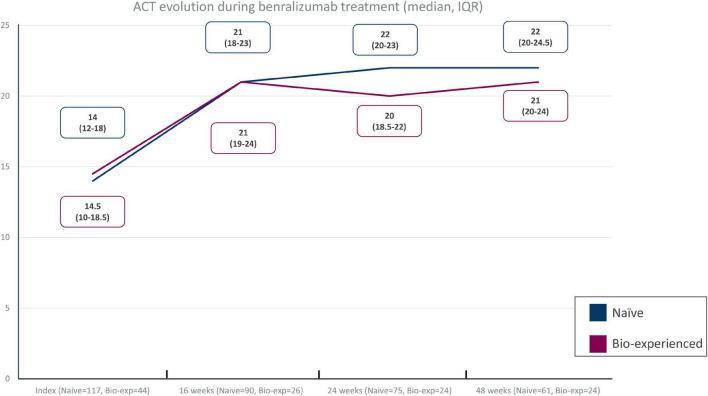
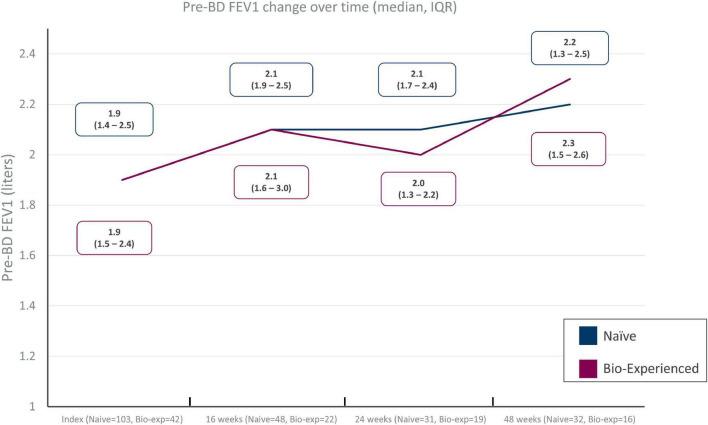
A total of 147 biologic-naïve and 58 biologic-experienced (34 omalizumab, 19 mepolizumab, and 5 omalizumab-mepolizumab) patients were enrolled. Biologic-experienced patients were more likely to be atopic and have a higher AER despite more frequent OCS use. Similar reductions in AER (>90% in both groups), OCS use (≥49% reduction in dosage and ≥41% able to eliminate OCS), ACT improvement (≥7 points gained in 48 weeks) and lung function (≥300 mL of FEV improvement in 48 weeks) were observed after benralizumab introduction within the two groups. There were no registered discontinuations of benralizumab for safety reasons.
CONCLUSION
In this analysis, patients who were switched to benralizumab because of suboptimal control with a previous biologic therapy were more likely to be atopic and more often treated with omalizumab. Benralizumab is effective in both naïve patients and those previously treated with a biologic.
背景
重度哮喘是一种异质性炎症性疾病,在大多数情况下由嗜酸性粒细胞炎症驱动。尽管采用了生物疗法,但患者的病情仍可能控制不佳,而最佳生物制剂的选择仍存在争议。事实上,在生物制剂之间切换很常见,但目前尚无官方指南,且真实世界的数据有限。
材料与方法
在这项对意大利多中心观察性回顾性研究ANANKE的分析中,接受贝那利珠单抗治疗的重度嗜酸性粒细胞哮喘患者根据既往生物疗法史分为两组(有生物制剂治疗史[反应欠佳]组与初治组)。在开始使用贝那利珠单抗治疗前的12个月内收集基线临床和实验室特征。在两组中收集开始使用贝那利珠单抗后血嗜酸性粒细胞随时间的变化、年化加重率(AER)、哮喘控制情况(ACT)、肺功能以及口服糖皮质激素(OCS)的使用情况。
结果
共纳入147例初治患者和58例有生物制剂治疗史的患者(34例奥马珠单抗、19例美泊利珠单抗和5例奥马珠单抗 - 美泊利珠单抗)。有生物制剂治疗史的患者更易患特应性疾病,且尽管更频繁使用OCS,其AER仍较高。在两组中引入贝那利珠单抗后,观察到AER有相似程度的降低(两组均>90%)、OCS使用减少(剂量降低≥49%且≥41%能够停用OCS)、ACT改善(48周内提高≥7分)以及肺功能改善(48周内FEV改善≥300 mL)。未因安全原因记录到贝那利珠单抗停药情况。
结论
在这项分析中,因既往生物疗法控制不佳而改用贝那利珠单抗的患者更易患特应性疾病,且更常使用奥马珠单抗治疗。贝那利珠单抗对初治患者和既往接受过生物制剂治疗的患者均有效。


 Zotero 插件