
在 ANANKE 研究中,贝那鲁肽治疗 96 周治疗重度嗜酸性粒细胞性哮喘患者的长期疗效数据。
Long-term effectiveness of benralizumab in severe eosinophilic asthma patients treated for 96-weeks: data from the ANANKE study.
机构信息
Dipartimento di Medicina Sperimentale e Clinica, Università degli Studi di Firenze, Florence, Italy.
UO Pneumologia e Pneumologia Riabilitativa, ICS Maugeri, IRCCS Bari, Bari, Italy.
出版信息
Respir Res. 2023 May 20;24(1):135. doi: 10.1186/s12931-023-02439-w.
BACKGROUND
The efficacy of benralizumab has been broadly demonstrated in severe eosinophilic asthma (SEA), but only few real-life studies evaluated its long-term effects. Here we present novel data from the ANANKE study in which a large cohort of SEA patients was treated for up to 96 weeks.
METHODS
ANANKE (NCT04272463) is an observational retrospective Italian study investigating the key characteristics of SEA patients (collected during the 12 months prior to benralizumab initiation) and the clinical outcomes during benralizumab treatment (annual exacerbation rate [AER], lung function, asthma control, OCS use, healthcare resource utilization). A post hoc analysis was also conducted in groups of patients based on history of previous biologic therapy (bio-experienced versus naïve patients). Analyses were descriptive only.
RESULTS
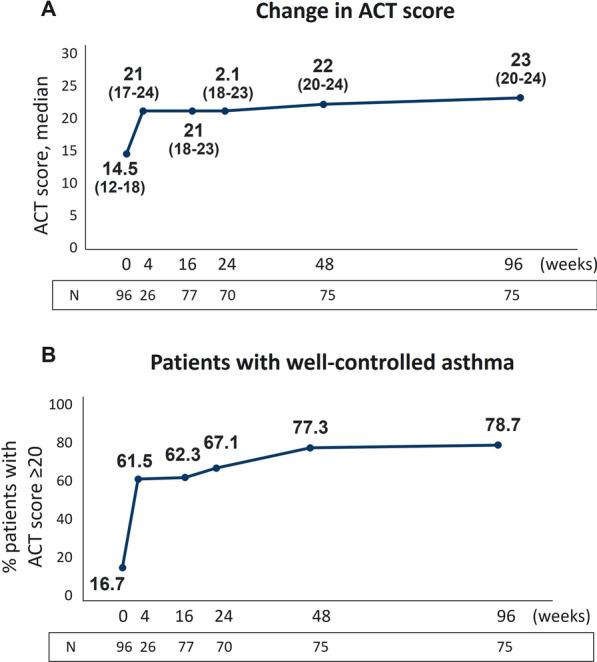
Before benralizumab initiation, evaluable SEA patients (N = 162, 61.1% females, mean age 56.0 ± 12.7) showed a median blood eosinophil count (BEC) of 600 cells/mm (IQR: 430-890). Patients experienced frequent exacerbations (annualized exacerbation rate [AER]: 4.10, severe AER: 0.98), with impaired lung function and poor asthma control (median ACT score: 14) despite 25.3% reported oral corticosteroid (OCS) use. Nasal polyposis was present in 53.1% patients; 47.5% patients were atopic. After 96 weeks since the start of benralizumab, nearly 90% patients were still on treatment; benralizumab dramatically decreased exacerbations (AER: - 94.9%; severe AER: - 96.9%), improved respiratory parameters (median increase in pre-bronchodilator forced expiratory volume [pre-BD FEV1]: + 400 mL) and asthma control (median ACT score: 23) while eliminating OCS in 60% patients. Importantly, benralizumab effects were either maintained or progressively improved over time, accompanied by a nearly complete depletion of BEC. Benralizumab reduced AER both in naïve (any AER: - 95.9%; severe AER: - 97.5%) and bio-experienced patients (any AER: - 92.4%; severe AER: - 94.0%).
CONCLUSIONS
Profound and sustained improvements in all asthma outcomes were observed with benralizumab. The correct identification of patients' eosinophilic-driven asthma phenotype was essential to ensure the achievement of such remarkable results.
TRIAL REGISTRATION
ClinicalTrials.gov Identifier: NCT04272463.
背景
贝那鲁肽在严重嗜酸性粒细胞性哮喘(SEA)中的疗效已得到广泛证实,但只有少数真实世界的研究评估了其长期效果。在此,我们提出了来自 ANANKE 研究的新数据,该研究对多达 162 名 SEA 患者进行了治疗,随访时间长达 96 周。
方法
ANANKE(NCT04272463)是一项回顾性意大利观察性研究,旨在调查 SEA 患者的关键特征(在开始贝那鲁肽治疗前的 12 个月内收集)以及贝那鲁肽治疗期间的临床结局(年加重率[AER]、肺功能、哮喘控制、OCS 使用、医疗资源利用)。还对基于先前生物治疗史的患者组(生物治疗经验与无经验患者)进行了事后分析。分析仅为描述性。
结果
在开始贝那鲁肽治疗前,可评估的 SEA 患者(N=162,61.1%为女性,平均年龄 56.0±12.7)的中位血嗜酸性粒细胞计数(BEC)为 600 个细胞/mm(IQR:430-890)。患者经常发生加重(年化加重率[AER]:4.10,严重加重率[AER]:0.98),尽管 25.3%的患者报告使用口服皮质类固醇(OCS),但肺功能受损且哮喘控制不佳(中位 ACT 评分:14)。53.1%的患者存在鼻息肉;47.5%的患者为特应性。自开始贝那鲁肽治疗后 96 周,近 90%的患者仍在接受治疗;贝那鲁肽显著减少了加重(AER:-94.9%;严重 AER:-96.9%),改善了呼吸参数(支气管扩张剂前用力呼气量[pre-BD FEV1]的中位数增加:+400 mL)和哮喘控制(中位 ACT 评分:23),同时使 60%的患者停用 OCS。重要的是,贝那鲁肽的疗效随着时间的推移保持或逐渐改善,同时 BEC 几乎完全耗尽。贝那鲁肽降低了生物治疗经验和无经验患者的 AER(任何 AER:-95.9%;严重 AER:-97.5%)和生物治疗经验患者的 AER(任何 AER:-92.4%;严重 AER:-94.0%)。
结论
贝那鲁肽治疗使所有哮喘结局均得到显著且持续的改善。正确识别患者的嗜酸性粒细胞性哮喘表型对于确保取得如此显著的结果至关重要。
试验注册
ClinicalTrials.gov 标识符:NCT04272463。



 Zotero 插件