
通过扫描电子显微镜对纳米级细胞外囊泡成像进行比较与优化,以实现基于尺寸的精确分析和形态学分析。
Comparison and optimization of nanoscale extracellular vesicle imaging by scanning electron microscopy for accurate size-based profiling and morphological analysis.
作者信息
Cavallaro Sara, Hååg Petra, Viktorsson Kristina, Krozer Anatol, Fogel Kristina, Lewensohn Rolf, Linnros Jan, Dev Apurba
机构信息
Department of Applied Physics, School of Engineering Sciences, KTH Royal Institute of Technology 10691 Stockholm Sweden
Department of Oncology-Pathology, Karolinska Institutet 17164 Solna Sweden.
出版信息
Nanoscale Adv. 2021 Mar 22;3(11):3053-3063. doi: 10.1039/d0na00948b. eCollection 2021 Jun 1.
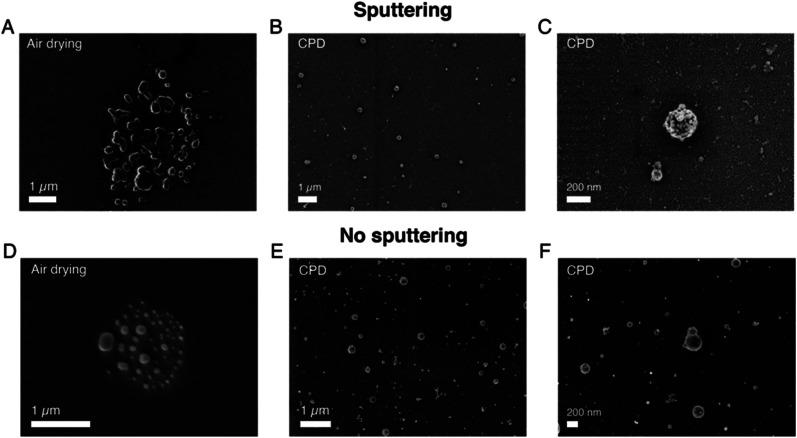
Nanosized extracellular vesicles (EVs) have been found to play a key role in intercellular communication, offering opportunities for both disease diagnostics and therapeutics. However, lying below the diffraction limit and also being highly heterogeneous in their size, morphology and abundance, these vesicles pose significant challenges for physical characterization. Here, we present a direct visual approach for their accurate morphological and size-based profiling by using scanning electron microscopy (SEM). To achieve that, we methodically examined various process steps and developed a protocol to improve the throughput, conformity and image quality while preserving the shape of EVs. The study was performed with small EVs (sEVs) isolated from a non-small-cell lung cancer (NSCLC) cell line as well as from human serum, and the results were compared with those obtained from nanoparticle tracking analysis (NTA). While the comparison of the sEV size distributions showed good agreement between the two methods for large sEVs (diameter > 70 nm), the microscopy based approach showed a better capacity for analyses of smaller vesicles, with higher sEV counts compared to NTA. In addition, we demonstrated the possibility of identifying non-EV particles based on size and morphological features. The study also showed process steps that can generate artifacts bearing resemblance with sEVs. The results therefore present a simple way to use a widely available microscopy tool for accurate and high throughput physical characterization of EVs.
已发现纳米级细胞外囊泡(EVs)在细胞间通讯中起关键作用,为疾病诊断和治疗提供了机会。然而,这些囊泡尺寸低于衍射极限,且在大小、形态和丰度上高度异质,对其物理表征构成了重大挑战。在此,我们提出一种直接可视化方法,通过使用扫描电子显微镜(SEM)对其进行基于形态和大小的准确分析。为实现这一目标,我们系统地研究了各个处理步骤,并制定了一种方案,以提高通量、一致性和图像质量,同时保留EVs的形状。该研究使用从非小细胞肺癌(NSCLC)细胞系以及人血清中分离出的小细胞外囊泡(sEVs)进行,结果与通过纳米颗粒跟踪分析(NTA)获得的结果进行了比较。虽然sEV大小分布的比较表明,对于较大的sEVs(直径>70 nm),两种方法之间具有良好的一致性,但基于显微镜的方法在分析较小囊泡方面表现出更好的能力,与NTA相比,sEV计数更高。此外,我们证明了基于大小和形态特征识别非EV颗粒的可能性。该研究还展示了可能产生与sEVs相似伪像的处理步骤。因此,这些结果提供了一种简单的方法,可利用广泛可用的显微镜工具对EVs进行准确且高通量的物理表征。


 Zotero 插件