
放化疗联合或不联合巩固 durvalumab 治疗 III 期非小细胞肺癌的复发模式和无进展生存期。
Recurrence patterns and progression-free survival after chemoradiotherapy with or without consolidation durvalumab for stage III non-small cell lung cancer.
机构信息
Department of Radiation Oncology and Image-Applied Therapy, Graduate School of Medicine, Kyoto University, 54 Shogoin-Kawahara-cho, Sakyo-ku, Kyoto, 606-8507, Japan.
Department of Radiology, Japanese Red Cross Fukui Hospital, 2-4-1 Tsukimi, Fukui, 918-8501, Japan.
出版信息
J Radiat Res. 2023 Jan 20;64(1):142-153. doi: 10.1093/jrr/rrac057.
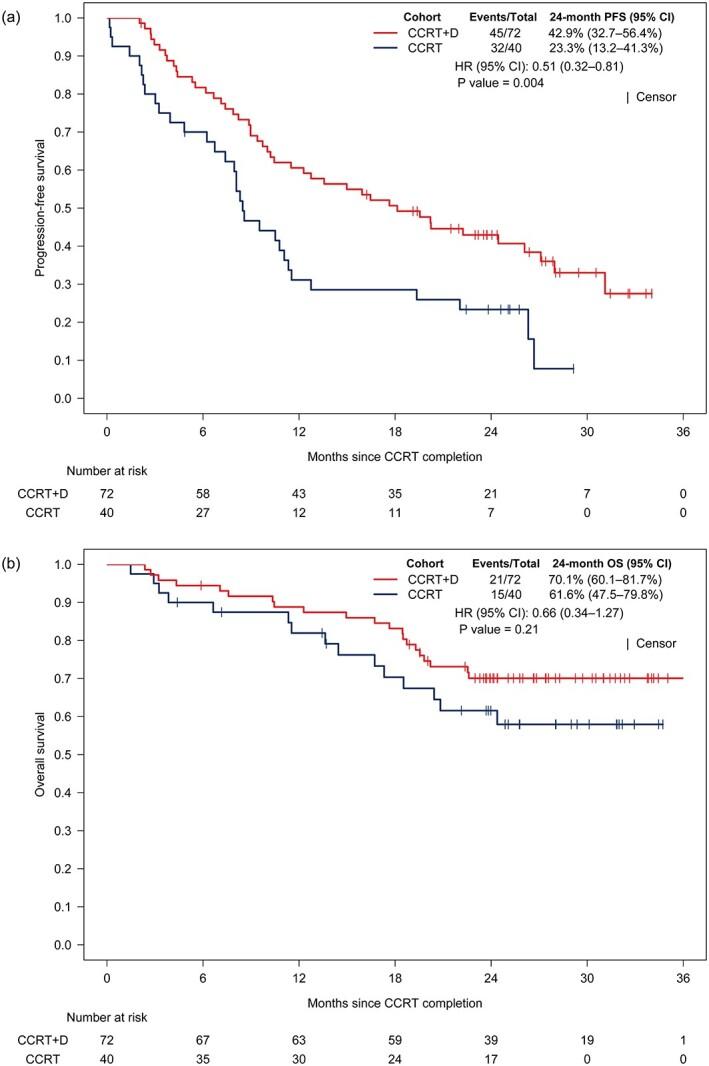
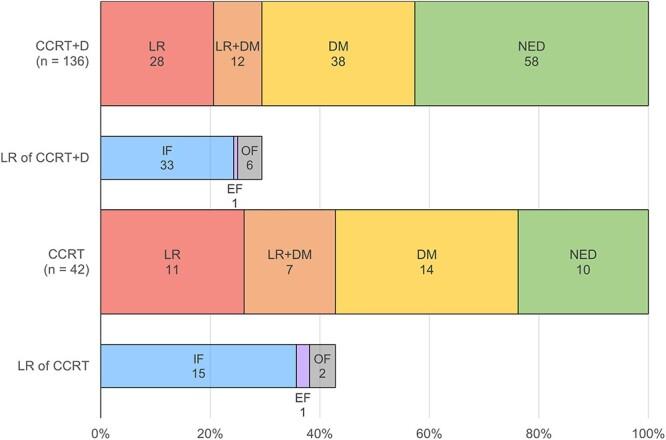
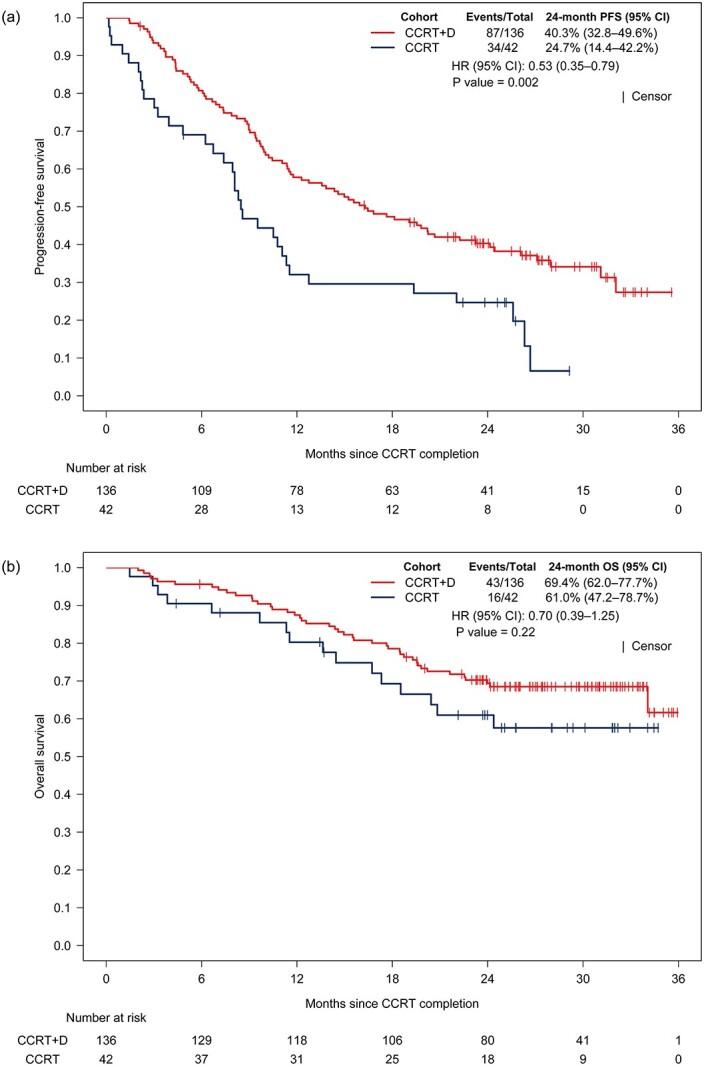
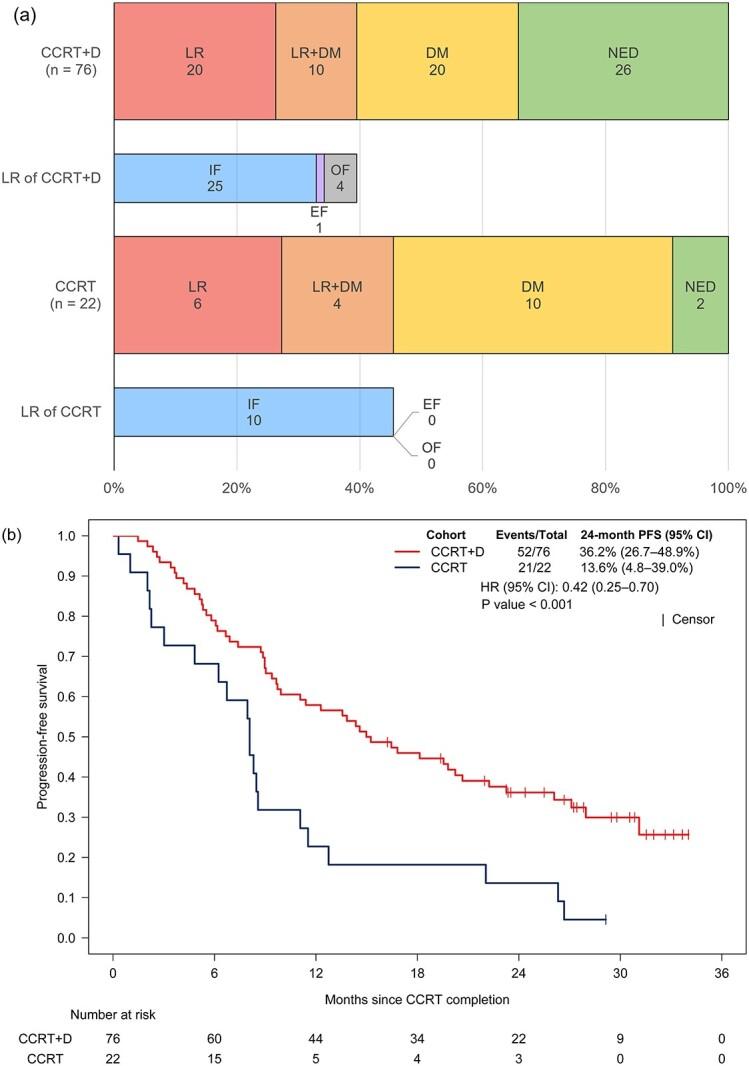
Chemoradiotherapy followed by consolidation durvalumab (CCRT+D) improves survival in patients with stage III non-small-cell lung cancer (NSCLC). We compared recurrence patterns and survival in the CCRT+D and CCRT cohorts. We conducted a multicenter, retrospective study in Japan. Patients who received CCRT for stage III NSCLC were included in this study. Of 178 eligible patients, 136 were in the CCRT+D and 42 were in the CCRT cohorts. Locoregional recurrence (LR), LR plus distant metastases (DM), and DM were observed in 20.6%, 8.8%, 27.9% of the CCRT+D, and 26.2%, 16.7% and 33.3% of the CCRT cohorts, respectively. In-field recurrence was the most common LR pattern in both cohorts. Squamous cell carcinoma and PD-L1 expression < 1%, and female sex and EGFR mutations were significantly associated with an increased risk of LR and DM. In patients with any risk factors for LR, the incidence of LR was similar in the CCRT+D and CCRT (39.5% vs 45.5%). The 24 month progression-free survival (PFS) and overall survival (OS) were 40.3% and 69.4% in the CCRT+D and 24.7% and 61.0% in the CCRT cohorts, respectively. Poor performance status and no consolidation durvalumab were significantly associated with shorter PFS. There was a significant difference in PFS between the CCRT+D and CCRT in the propensity score-matched cohort (HR = 0.51, P = 0.005). In conclusion, consolidation durvalumab decreased both LR and DM, and significantly improved PFS. However, in-field recurrence was still a major problem, as well as DM.
放化疗序贯巩固度伐利尤单抗(CCRT+D)可提高 III 期非小细胞肺癌(NSCLC)患者的生存率。我们比较了 CCRT+D 和 CCRT 两组的复发模式和生存情况。这是一项在日本进行的多中心回顾性研究。入组患者为接受 III 期 NSCLC 放化疗的患者。在 178 例符合条件的患者中,136 例患者接受 CCRT+D,42 例患者接受 CCRT。CCRT+D 组的局部区域复发(LR)、LR 加远处转移(DM)和 DM 的发生率分别为 20.6%、8.8%和 27.9%,CCRT 组分别为 26.2%、16.7%和 33.3%。两组中最常见的 LR 模式均为靶区内复发。鳞状细胞癌和 PD-L1 表达<1%,以及女性和 EGFR 突变与 LR 和 DM 风险增加显著相关。在有任何 LR 风险因素的患者中,CCRT+D 和 CCRT 组的 LR 发生率相似(39.5% vs 45.5%)。CCRT+D 组的 24 个月无进展生存期(PFS)和总生存期(OS)分别为 40.3%和 69.4%,CCRT 组分别为 24.7%和 61.0%。较差的体能状态和未接受巩固度伐利尤单抗治疗与较短的 PFS 显著相关。在倾向评分匹配队列中,CCRT+D 与 CCRT 之间的 PFS 差异有统计学意义(HR=0.51,P=0.005)。结论:巩固度伐利尤单抗降低了 LR 和 DM 的发生率,显著改善了 PFS。然而,靶区内复发仍然是一个主要问题,DM 也是如此。
 Zotero 插件