
外周血T细胞亚群上PD-1/PD-L1表达的变化与阿尔茨海默病的不同阶段相关。
A change of PD-1/PD-L1 expression on peripheral T cell subsets correlates with the different stages of Alzheimer's Disease.
作者信息
Wu Ching-Tse, Chu Cheng-I, Wang Feng-Yu, Yang Hui-Yu, Tseng Wei-Sung, Chang Chuang-Rung, Chang Chien-Chung
机构信息
Institute of Biotechnology, National Tsing Hua University, Hsin-Chu, Taiwan.
Department of Neurology, National Taiwan University Hospital Hsin-Chu Branch, Hsin-Chu, Taiwan.
出版信息
Cell Biosci. 2022 Sep 30;12(1):162. doi: 10.1186/s13578-022-00897-1.
BACKGROUND
Immune checkpoints are a set of costimulatory and inhibitory molecules that maintain self-tolerance and regulate immune homeostasis. The expression of immune checkpoints on T cells in malignancy, chronic inflammation, and neurodegenerative diseases has gained increasing attention.
RESULTS
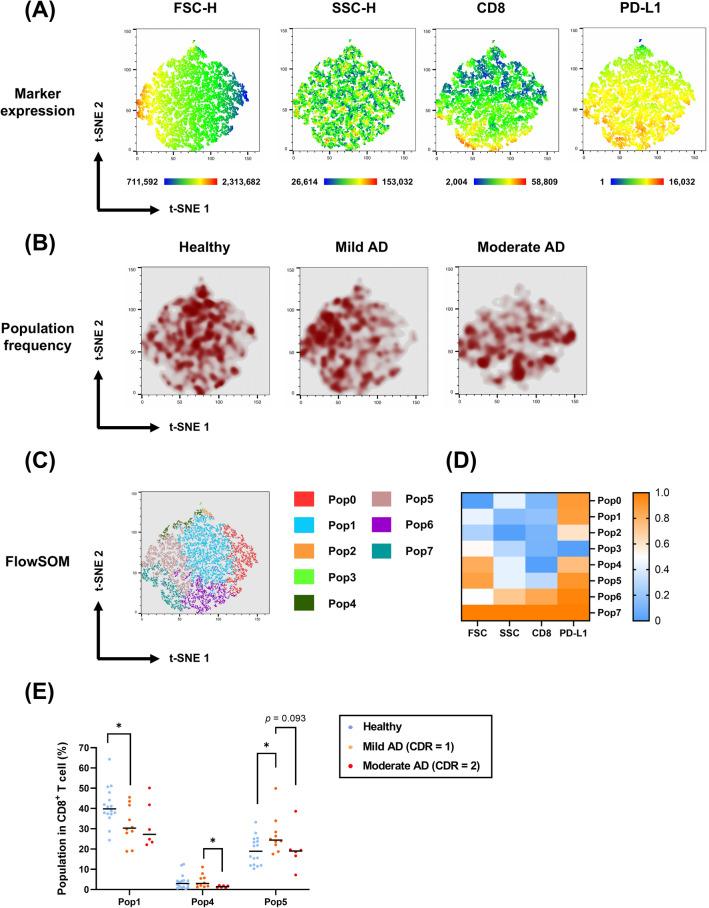
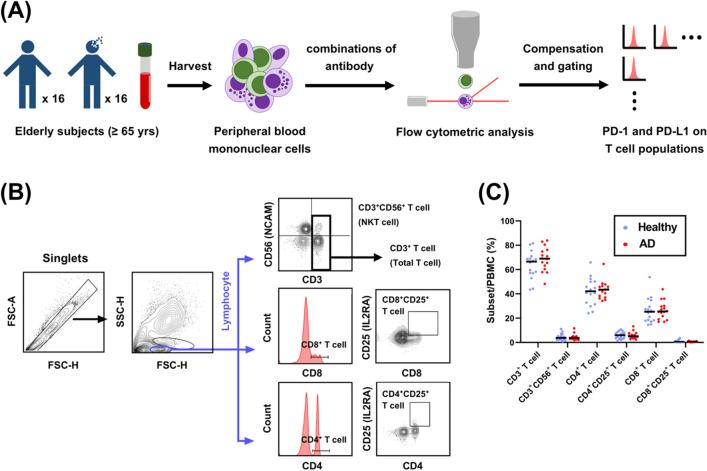
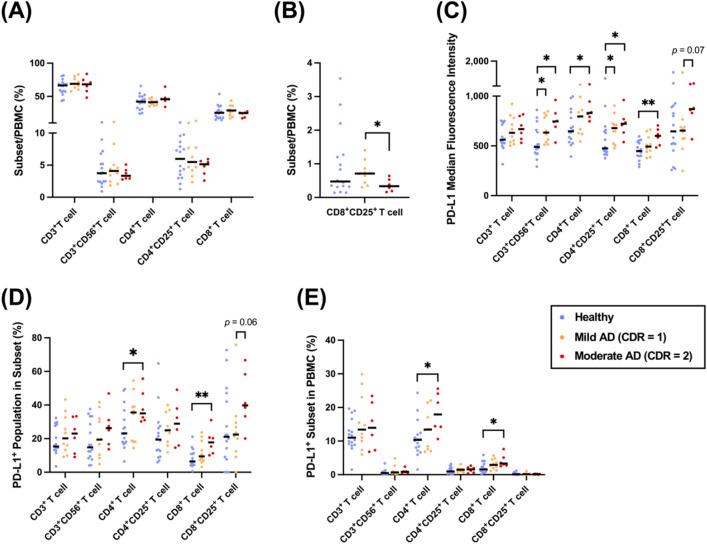
To characterize immune checkpoints in neurodegenerative diseases, we aimed to examine the expression of the immune checkpoint PD-1/PD-L1 in peripheral T cells in different Alzheimer's disease (AD) patients. To achieve this aim, sixteen AD patients and sixteen age-matched healthy volunteers were enrolled to analyze their CD3 T cells, CD3CD56 (neural cell adhesion molecule, NCAM) T cells, CD4/CD8 T cells, and CD4/CD8CD25 (interleukin-2 receptor alpha, IL-2RA) T cells in this study. The expression of PD-1 on T cells was similar between the AD patients and healthy volunteers, but increased expression of PD-L1 on CD3CD56 T cells (natural killer T cells, NKT-like), CD4 T cells (helper T cells, Th), CD4CD25 T cells, and CD8 T cells (cytotoxic T lymphocytes, CTL) was detected in the AD patients. In addition, we found negative correlations between the AD patients' cognitive performance and both CD8 T cells and CD8CD25 T cells. To identify CD8 T-cell phenotypic and functional characteristic differences between the healthy volunteers and AD patients in different stages, a machine learning algorithm, t-distributed stochastic neighbor embedding (t-SNE), was implemented. Using t-SNE enabled the above high-dimensional data to be visualized and better analyzed. The t-SNE analysis demonstrated that the cellular sizes and densities of PD-1/PD-L1 on CD8 T cells differed among the healthy, mild AD, and moderate AD subjects.
CONCLUSIONS
Our results suggest that changes in PD-1/PD-L1-expressing T cells in AD patients' peripheral blood could be a potential biomarker for monitoring disease and shed light on the AD disease mechanism. Moreover, these findings indicate that PD-1/PD-L1 blockade treatment could be a novel choice to slow AD disease deterioration.
背景
免疫检查点是一组共刺激和抑制分子,可维持自身耐受性并调节免疫稳态。免疫检查点在恶性肿瘤、慢性炎症和神经退行性疾病中的T细胞上的表达日益受到关注。
结果
为了表征神经退行性疾病中的免疫检查点,我们旨在检测不同阿尔茨海默病(AD)患者外周血T细胞中免疫检查点PD-1/PD-L1的表达。为实现这一目标,本研究招募了16名AD患者和16名年龄匹配的健康志愿者,分析他们的CD3 T细胞、CD3CD56(神经细胞黏附分子,NCAM)T细胞、CD4/CD8 T细胞以及CD4/CD8CD25(白细胞介素-2受体α,IL-2RA)T细胞。AD患者和健康志愿者T细胞上PD-1的表达相似,但在AD患者中检测到CD3CD56 T细胞(自然杀伤T细胞,类NKT细胞)、CD4 T细胞(辅助性T细胞,Th)、CD4CD25 T细胞和CD8 T细胞(细胞毒性T淋巴细胞,CTL)上PD-L1的表达增加。此外,我们发现AD患者认知能力与CD8 T细胞和CD8CD25 T细胞均呈负相关。为了识别不同阶段健康志愿者和AD患者之间CD8 T细胞表型和功能特征差异,实施了一种机器学习算法,即t分布随机邻域嵌入(t-SNE)。使用t-SNE能够对上述高维数据进行可视化并更好地分析。t-SNE分析表明,健康、轻度AD和中度AD受试者中CD8 T细胞上PD-1/PD-L1的细胞大小和密度存在差异。
结论
我们的结果表明,AD患者外周血中表达PD-1/PD-L1的T细胞变化可能是监测疾病的潜在生物标志物,并有助于揭示AD的发病机制。此外,这些发现表明,阻断PD-1/PD-L1治疗可能是减缓AD疾病恶化的新选择。



 Zotero 插件