
EXOC4 中甲基化模式的改变与卒中预后相关:一项全基因组甲基化关联研究。
Altered methylation pattern in EXOC4 is associated with stroke outcome: an epigenome-wide association study.
机构信息
Stroke Pharmacogenomics and Genetics, IIB-Sant Pau, Institut de Recerca de Sant Pau, Hospital Sant Pau, C/Sant Antoni Mª Claret,167, 08025, Barcelona, Spain.
Neurology, Hospital Universitari MútuaTerrassa/Fundacio Docència i Recerca MutuaTerrassa, Terrassa, Spain.
出版信息
Clin Epigenetics. 2022 Sep 30;14(1):124. doi: 10.1186/s13148-022-01340-5.
BACKGROUND AND PURPOSE
The neurological course after stroke is highly variable and is determined by demographic, clinical and genetic factors. However, other heritable factors such as epigenetic DNA methylation could play a role in neurological changes after stroke.
METHODS
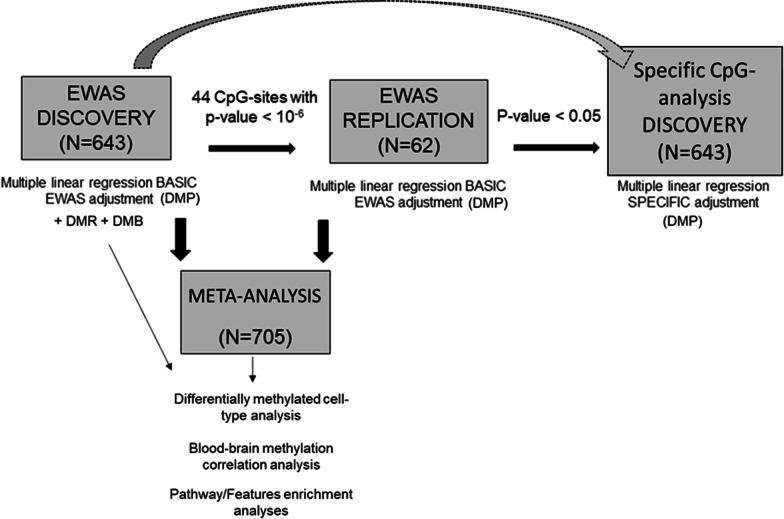
We performed a three-stage epigenome-wide association study to evaluate DNA methylation associated with the difference between the National Institutes of Health Stroke Scale (NIHSS) at baseline and at discharge (ΔNIHSS) in ischaemic stroke patients. DNA methylation data in the Discovery (n = 643) and Replication (n = 62) Cohorts were interrogated with the 450 K and EPIC BeadChip. Nominal CpG sites from the Discovery (p value < 10) were also evaluated in a meta-analysis of the Discovery and Replication cohorts, using a random-fixed effect model. Metabolic pathway enrichment was calculated with methylGSA. We integrated the methylation data with 1305 plasma protein expression levels measured by SOMAscan in 46 subjects and measured RNA expression with RT-PCR in a subgroup of 13 subjects. Specific cell-type methylation was assessed using EpiDISH.
RESULTS
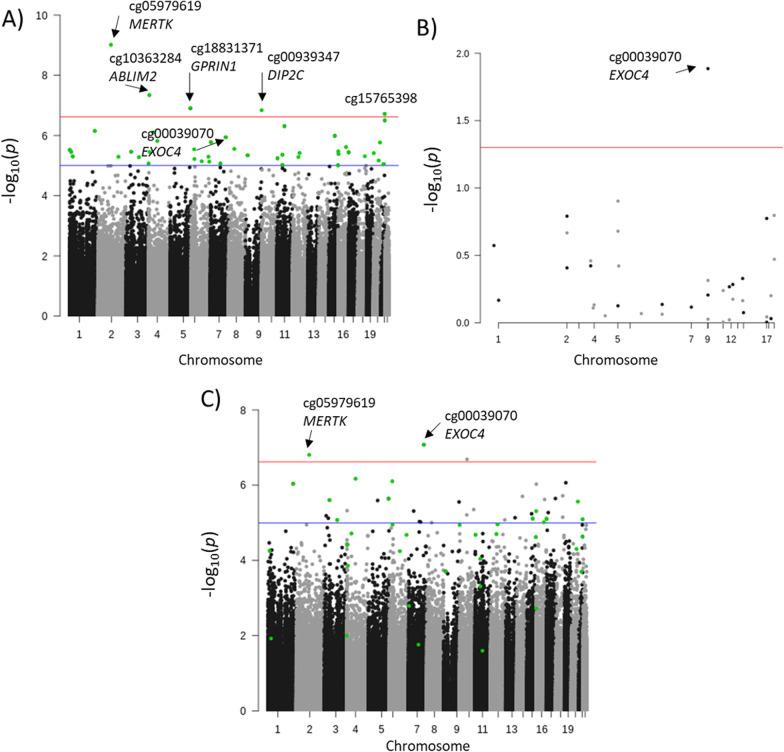
The meta-analysis revealed an epigenome-wide significant association in EXOC4 (p value = 8.4 × 10) and in MERTK (p value = 1.56 × 10). Only the methylation in EXOC4 was also associated in the Discovery and in the Replication Cohorts (p value = 1.14 × 10 and p value = 1.3 × 10, respectively). EXOC4 methylation negatively correlated with the long-term outcome (coefficient = - 4.91) and showed a tendency towards a decrease in EXOC4 expression (rho = - 0.469, p value = 0.091). Pathway enrichment from the meta-analysis revealed significant associations related to the endocytosis and deubiquitination processes. Seventy-nine plasma proteins were differentially expressed in association with EXOC4 methylation. Pathway analysis of these proteins showed an enrichment in natural killer (NK) cell activation. The cell-type methylation analysis in blood also revealed a differential methylation in NK cells.
CONCLUSIONS
DNA methylation of EXOC4 is associated with a worse neurological course after stroke. The results indicate a potential modulation of pathways involving endocytosis and NK cells regulation.
背景与目的
中风后的神经学病程高度可变,由人口统计学、临床和遗传因素决定。然而,其他可遗传因素,如表观遗传 DNA 甲基化,可能在中风后的神经学变化中发挥作用。
方法
我们进行了三个阶段的全基因组关联研究,以评估 DNA 甲基化与缺血性中风患者 NIH 中风量表(NIHSS)基线和出院时的差异(Δ NIHSS)之间的关系。使用 450K 和 EPIC BeadChip 对发现(n=643)和复制(n=62)队列中的 DNA 甲基化数据进行了检测。在发现和复制队列的荟萃分析中,对发现队列中具有统计学意义的 CpG 位点(p 值<10)进行了评估,使用随机固定效应模型。使用 methylGSA 计算代谢途径富集。我们将甲基化数据与 46 例患者中通过 SOMAscan 测量的 1305 种血浆蛋白表达水平以及亚组 13 例患者的 RNA 表达进行了整合。使用 EpiDISH 评估特定细胞类型的甲基化。
结果
荟萃分析显示 EXOC4(p 值=8.4×10)和 MERTK(p 值=1.56×10)中存在全基因组显著关联。只有 EXOC4 的甲基化在发现和复制队列中也存在关联(p 值=1.14×10 和 p 值=1.3×10,分别)。EXOC4 甲基化与长期预后呈负相关(系数=-4.91),并且 EXOC4 表达呈下降趋势(rho=-0.469,p 值=0.091)。荟萃分析的途径富集显示与内吞作用和去泛素化过程相关的显著关联。79 种血浆蛋白与 EXOC4 甲基化相关,差异表达。对这些蛋白质的途径分析显示 NK 细胞激活的富集。血液中的细胞类型甲基化分析也显示 NK 细胞的差异甲基化。
结论
EXOC4 的 DNA 甲基化与中风后神经学病程恶化有关。结果表明,内吞作用和 NK 细胞调节相关途径的潜在调节作用。

 Zotero 插件