
胆固醇在疟原虫入侵和生长中的作用。
The role of cholesterol in invasion and growth of malaria parasites.
机构信息
Research School of Biology, The Australian National University, Canberra ACT, Australia.
Department of Infection Biology, London School of Hygiene & Tropical Medicine, London, United Kingdom.
出版信息
Front Cell Infect Microbiol. 2022 Sep 16;12:984049. doi: 10.3389/fcimb.2022.984049. eCollection 2022.
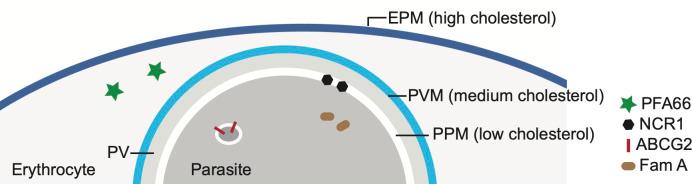
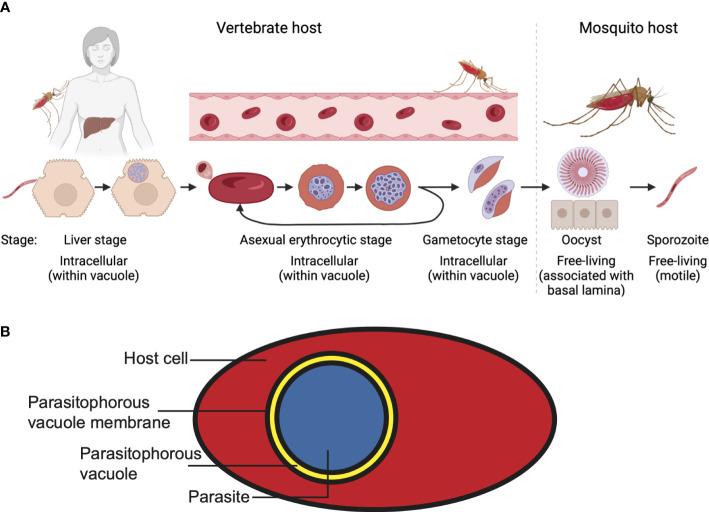
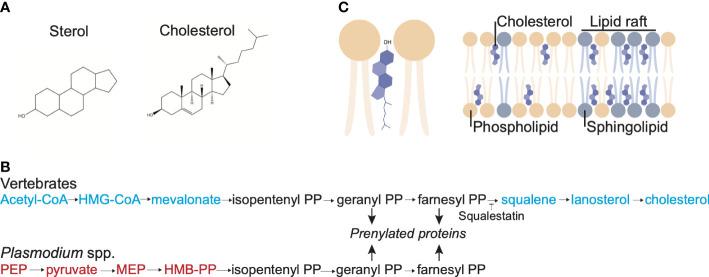
Malaria parasites are unicellular eukaryotic pathogens that develop through a complex lifecycle involving two hosts, an anopheline mosquito and a vertebrate host. Throughout this lifecycle, the parasite encounters widely differing conditions and survives in distinct ways, from an intracellular lifestyle in the vertebrate host to exclusively extracellular stages in the mosquito. Although the parasite relies on cholesterol for its growth, the parasite has an ambiguous relationship with cholesterol: cholesterol is required for invasion of host cells by the parasite, including hepatocytes and erythrocytes, and for the development of the parasites in those cells. However, the parasite is unable to produce cholesterol itself and appears to remove cholesterol actively from its own plasma membrane, thereby setting up a cholesterol gradient inside the infected host erythrocyte. Overall a picture emerges in which the parasite relies on host cholesterol and carefully controls its transport. Here, we describe the role of cholesterol at the different lifecycle stages of the parasites.
疟原虫是一种单细胞真核病原体,通过一个复杂的生命周期来发育,该生命周期涉及两个宿主,即疟蚊和脊椎动物宿主。在整个生命周期中,寄生虫会遇到广泛不同的条件,并以独特的方式生存,从脊椎动物宿主中的细胞内生活方式到蚊子中的完全细胞外阶段。尽管寄生虫的生长依赖于胆固醇,但寄生虫与胆固醇的关系是模糊的:胆固醇对于寄生虫入侵宿主细胞,包括肝细胞和红细胞,以及寄生虫在这些细胞中的发育是必需的。然而,寄生虫本身无法产生胆固醇,似乎会主动从自身质膜中去除胆固醇,从而在受感染的宿主红细胞内建立胆固醇梯度。总的来说,寄生虫依赖于宿主胆固醇,并仔细控制其运输。在这里,我们描述了胆固醇在寄生虫不同生命周期阶段的作用。
 Zotero 插件