
巨噬细胞亚型和外泌体在免疫调节中的作用。
The role of macrophage subtypes and exosomes in immunomodulation.
机构信息
Department of Cell and Molecular Sciences, Faculty of Biological Sciences, Kharazmi University, Tehran, 14911-15719, Iran.
Wadsworth Center, New York State Department of Health, Albany, New Year, USA.
出版信息
Cell Mol Biol Lett. 2022 Oct 3;27(1):83. doi: 10.1186/s11658-022-00384-y.
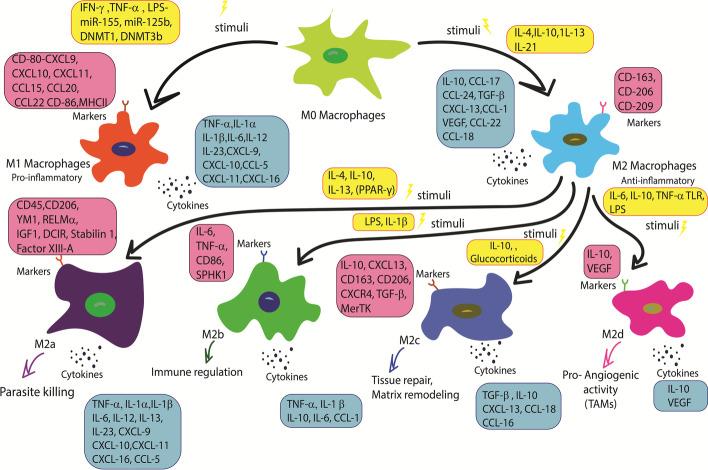
Macrophages are influential members of the innate immune system that can be reversibly polarized by different microenvironment signals. Cell polarization leads to a wide range of features, involving the migration, development, and organization of the cells. There is mounting evidence that macrophage polarization plays a key role in the initiation and development of a wide range of diseases. This study aims to give an overview of macrophage polarization, their different subtypes, and the importance of alternatively activated M2 macrophage and classically activated M1 macrophage in immune responses and pathological conditions. This review provides insight on the role of exosomes in M1/M2-like macrophage polarization and their potential as a promising therapeutic candidate.
巨噬细胞是先天免疫系统中有影响力的成员,它们可以通过不同的微环境信号可逆地极化。细胞极化导致广泛的特征,涉及细胞的迁移、发育和组织。越来越多的证据表明,巨噬细胞极化在多种疾病的发生和发展中起着关键作用。本研究旨在概述巨噬细胞极化及其不同亚型,以及在免疫反应和病理条件下,交替激活的 M2 巨噬细胞和经典激活的 M1 巨噬细胞的重要性。本综述提供了关于外泌体在 M1/M2 样巨噬细胞极化中的作用及其作为一种有前途的治疗候选物的潜力的见解。


 Zotero 插件