
SLAMF7 调节 B 细胞和适应性免疫,从而调节对中枢神经系统自身免疫的易感性。
SLAMF7 modulates B cells and adaptive immunity to regulate susceptibility to CNS autoimmunity.
机构信息
Department of Microbiology and Molecular Genetics, College of Osteopathic Medicine, Michigan State University, 567 Wilson Road, 4108 Biomedical and Physical Sciences Building, East Lansing, MI, 48824, USA.
Department of Pediatrics, College of Osteopathic Medicine, Michigan State University, East Lansing, MI, 48824, USA.
出版信息
J Neuroinflammation. 2022 Oct 3;19(1):241. doi: 10.1186/s12974-022-02594-9.
BACKGROUND
Multiple sclerosis (MS) is a chronic, debilitating condition characterized by CNS autoimmunity stemming from a complex etiology involving both environmental and genetic factors. Our current understanding of MS points to dysregulation of the immune system as the pathogenic culprit, however, it remains unknown as to how the many genes associated with increased susceptibility to MS are involved. One such gene linked to MS susceptibility and known to regulate immune function is the self-ligand immune cell receptor SLAMF7.
METHODS
We subjected WT and SLAMF7 mice to multiple EAE models, compared disease severity, and comprehensively profiled the CNS immune landscape of these mice. We identified all SLAMF7-expressing CNS immune cells and compared the entire CNS immune niche between genotypes. We performed deep phenotyping and in vitro functional studies of B and T cells via spectral cytometry and BioPlex assays. Adoptive transfer studies involving the transfer of WT and SLAMF7 B cells into B cell-deficient mice (μMT) were also performed. Finally, B-T cell co-culture studies were performed, and a comparative cell-cell interaction network derived from scRNA-seq data of SLAMF7 vs. SLAMF7 human CSF immune cells was constructed.
RESULTS
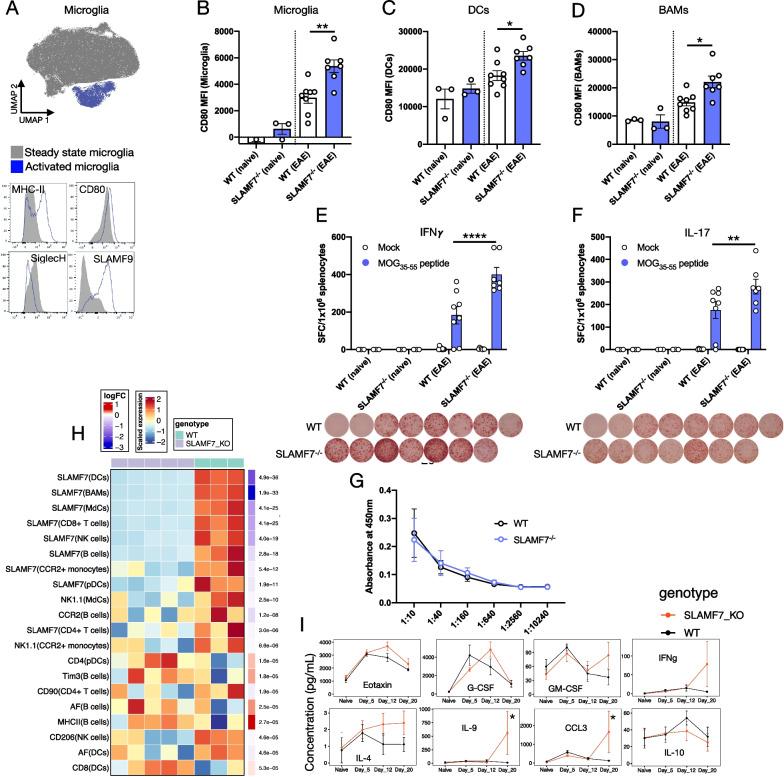
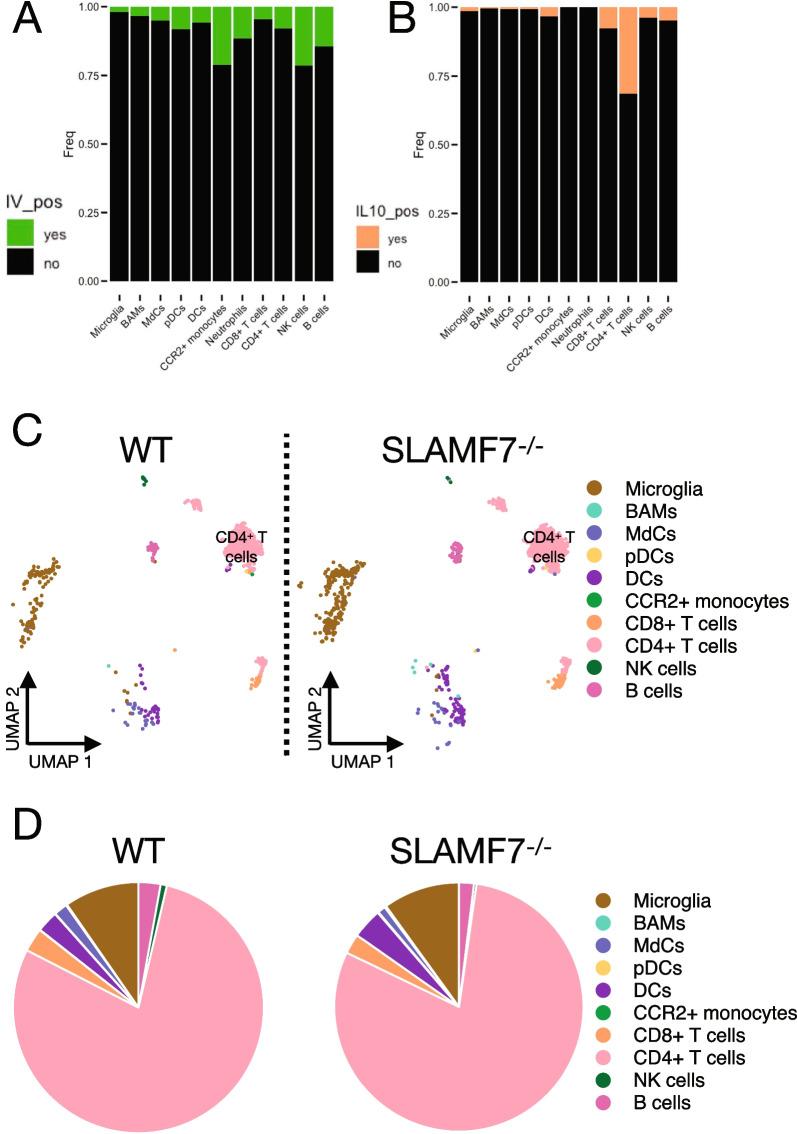
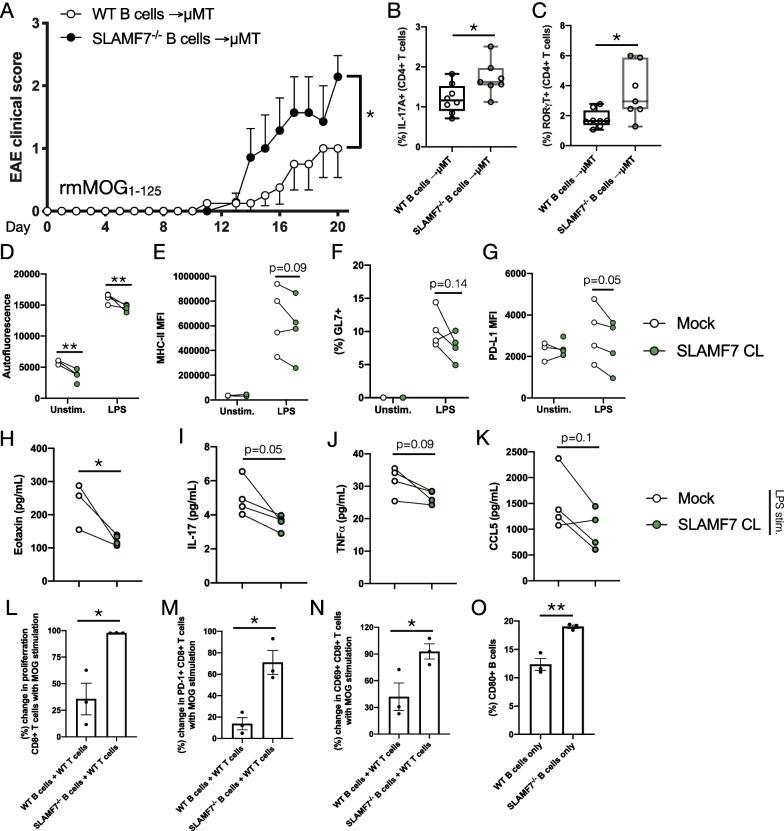
We found SLAMF7 mice to be more susceptible to EAE compared to WT mice and found SLAMF7 to be expressed on numerous CNS immune cell subsets. Absence of SLAMF7 did not grossly alter the CNS immune landscape, but allowed for altered immune cell subset infiltration during EAE in a model-dependent manner. Global lack of SLAMF7 expression increased myeloid cell activation states along with augmented T cell anti-MOG immunity. B cell profiling studies revealed increased activation states of specific plasma and B cell subsets in SLAMF7 mice during EAE, and functional co-culture studies determined that SLAMF7 B cells induce exaggerated T cell activation. Adoptive transfer studies revealed that the increased susceptibility of SLAMF7 mice to EAE is partly B cell dependent and reconstruction of the human CSF SLAMF7-interactome found B cells to be critical to cell-cell communication between SLAMF7-expressing cells.
CONCLUSIONS
Our studies have identified novel roles for SLAMF7 in CNS immune regulation and B cell function, and illuminate underpinnings of the genetic association between SLAMF7 and MS.
背景
多发性硬化症(MS)是一种慢性、使人虚弱的疾病,其特征是中枢神经系统(CNS)自身免疫,这源于涉及环境和遗传因素的复杂病因。我们目前对 MS 的认识指向免疫系统失调是致病元凶,然而,与 MS 易感性相关的众多基因如何参与仍不得而知。与 MS 易感性相关且已知可调节免疫功能的一个这样的基因是自我配体免疫细胞受体 SLAMF7。
方法
我们使 WT 和 SLAMF7 小鼠经历多种 EAE 模型,比较疾病严重程度,并全面描绘这些小鼠的 CNS 免疫图谱。我们鉴定了所有表达 SLAMF7 的 CNS 免疫细胞,并比较了基因型之间的整个 CNS 免疫生态位。我们通过光谱细胞术和 BioPlex 测定对 B 和 T 细胞进行了深入表型和体外功能研究。还进行了涉及将 WT 和 SLAMF7 B 细胞转移到 B 细胞缺陷小鼠(μMT)的过继转移研究。最后,进行了 B-T 细胞共培养研究,并构建了来自 SLAMF7 与 SLAMF7 人 CSF 免疫细胞的 scRNA-seq 数据的比较细胞-细胞相互作用网络。
结果
我们发现与 WT 小鼠相比,SLAMF7 小鼠对 EAE 更为敏感,并且发现 SLAMF7 在许多 CNS 免疫细胞亚群上表达。SLAMF7 的缺失并未明显改变 CNS 免疫图谱,但以模型依赖性方式允许在 EAE 期间改变免疫细胞亚群浸润。SLAMF7 表达的整体缺失增加了骨髓细胞的激活状态以及增强的 T 细胞抗 MOG 免疫。B 细胞分析研究表明,在 EAE 期间,SLAMF7 小鼠中特定的浆细胞和 B 细胞亚群的激活状态增加,功能共培养研究表明 SLAMF7 B 细胞诱导 T 细胞过度激活。过继转移研究表明,SLAMF7 小鼠对 EAE 的易感性增加部分依赖于 B 细胞,并且重建人类 CSF SLAMF7 相互作用组发现 B 细胞对于 SLAMF7 表达细胞之间的细胞-细胞通讯至关重要。
结论
我们的研究确定了 SLAMF7 在 CNS 免疫调节和 B 细胞功能中的新作用,并阐明了 SLAMF7 与 MS 之间遗传关联的基础。



 Zotero 插件