
紧跟凝聚物:无核膜细胞器的保留、增加和丢失
Keeping up with the condensates: The retention, gain, and loss of nuclear membrane-less organelles.
作者信息
Lacroix Emma, Audas Timothy E
机构信息
Department of Molecular Biology and Biochemistry, Simon Fraser University, Burnaby, BC, Canada.
Centre for Cell Biology, Development, and Disease, Simon Fraser University, Burnaby, BC, Canada.
出版信息
Front Mol Biosci. 2022 Sep 20;9:998363. doi: 10.3389/fmolb.2022.998363. eCollection 2022.
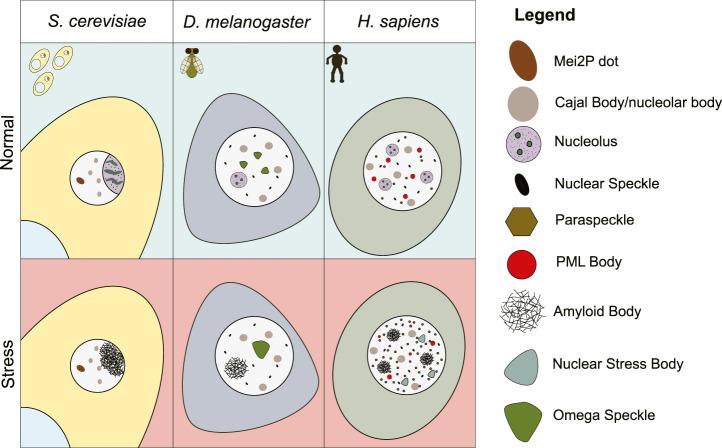
In recent decades, a growing number of biomolecular condensates have been identified in eukaryotic cells. These structures form through phase separation and have been linked to a diverse array of cellular processes. While a checklist of established membrane-bound organelles is present across the eukaryotic domain, less is known about the conservation of membrane-less subcellular structures. Many of these structures can be seen throughout eukaryotes, while others are only thought to be present in metazoans or a limited subset of species. In particular, the nucleus is a hub of biomolecular condensates. Some of these subnuclear domains have been found in a broad range of organisms, which is a characteristic often attributed to essential functionality. However, this does not always appear to be the case. For example, the nucleolus is critical for ribosomal biogenesis and is present throughout the eukaryotic domain, while the Cajal bodies are believed to be similarly conserved, yet these structures are dispensable for organismal survival. Likewise, depletion of the omega speckles reduces viability, despite the apparent absence of this domain in higher eukaryotes. By reviewing primary research that has analyzed the presence of specific condensates (nucleoli, Cajal bodies, amyloid bodies, nucleolar aggresomes, nuclear speckles, nuclear paraspeckles, nuclear stress bodies, PML bodies, omega speckles, NUN bodies, mei2 dots) in a cross-section of organisms (e.g., human, mouse, , , yeast), we adopt a human-centric view to explore the emergence, retention, and absence of a subset of nuclear biomolecular condensates. This overview is particularly important as numerous biomolecular condensates have been linked to human disease, and their presence in additional species could unlock new and well characterized model systems for health research.
近几十年来,真核细胞中已鉴定出越来越多的生物分子凝聚物。这些结构通过相分离形成,并与各种各样的细胞过程相关联。虽然在整个真核生物域中都存在一份既定的膜结合细胞器清单,但对于无膜亚细胞结构的保守性了解较少。这些结构中的许多在整个真核生物中都能看到,而其他一些则仅被认为存在于后生动物或有限的物种子集中。特别是,细胞核是生物分子凝聚物的中心。其中一些核内亚结构域已在广泛的生物体中被发现,这一特征通常归因于其基本功能。然而,情况似乎并非总是如此。例如,核仁对核糖体生物合成至关重要,并且存在于整个真核生物域中,而 Cajal 体被认为同样保守,但这些结构对于生物体的生存并非必需。同样,尽管在高等真核生物中明显不存在ω斑点,但去除ω斑点会降低细胞活力。通过回顾分析特定凝聚物(核仁、Cajal 体、淀粉样体、核仁聚集体、核斑点、核旁斑点、核应激体、PML 体、ω斑点、NUN 体、mei2 点)在一系列生物体(如人类、小鼠、酵母)中的存在情况的初步研究,我们采用以人类为中心的观点来探索一部分核生物分子凝聚物的出现、保留和缺失情况。这一概述尤为重要,因为许多生物分子凝聚物已与人类疾病相关联,但它们在其他物种中的存在可能会为健康研究开启新的、特征明确的模型系统。
 Zotero 插件