
新冠大流行期间中国人群百日咳免疫力和传播率下降:一项横断面血清流行病学研究。
The decline in immunity and circulation of pertussis among Chinese population during the COVID-19 pandemic: A cross-sectional sero-epidemiological study.
机构信息
Department of Epidemiology and Biostatistics at School of Public Health, Zhejiang University School of Medicine, Hangzhou, China; Department of Immunization Program, Zhejiang Provincial Center for Disease Control and Prevention, Hangzhou, China.
Department of Immunization Program, Zhejiang Provincial Center for Disease Control and Prevention, Hangzhou, China.
出版信息
Vaccine. 2022 Nov 15;40(48):6956-6962. doi: 10.1016/j.vaccine.2022.10.020. Epub 2022 Oct 20.
BACKGROUND
In recent years, the resurgence of pertussis has posed a public health challenge in many countries. This study aimed to evaluate the immunity levels against pertussis among populations of different ages in China.
METHODS
We conducted a cross-sectional serological survey in Zhejiang Province, China in 2020. Serum IgG antibodies against pertussis toxin (anti-PT), filamentous hemagglutinin (anti-FHA), and pertactin (anti-PRN) were quantitatively measured. The geometric mean concentration (GMC) of three antibodies was calculated. An anti-PT level < 5 IU/mL was considered undetectable, ≥20 IU/mL as seropositive and ≥80 IU/mL as an indicator of recent infection. Mathematical models were fitted for anti-PT concentrations over time in children after four doses of the pertussis vaccination.
RESULTS
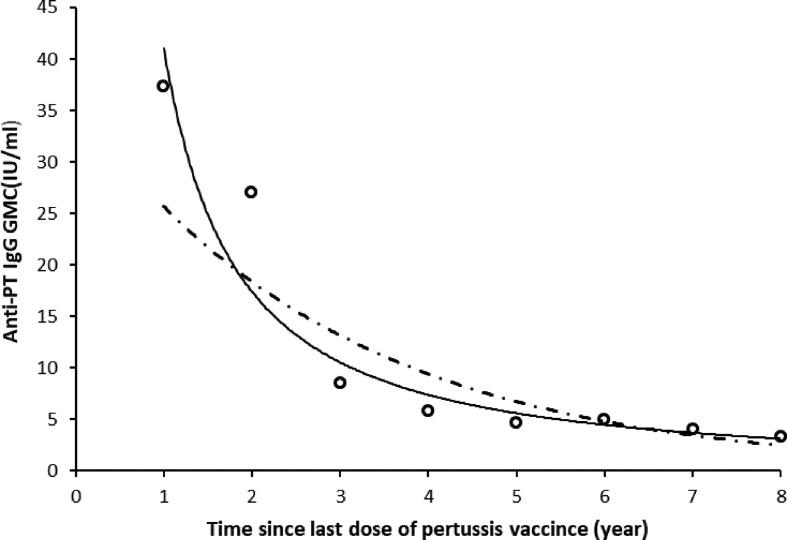
A total of 4459 participants aged 0-59 years were included in the analyses. The overall positivity rate of anti-PT was 29.80% with the highest (81.44%) rate in the 1-2 years old and the lowest (4.72%) in 10-14 years old. The GMCs of anti-PT, anti-FHA and anti-PRN for the whole participants were 9.67 (95%CI: 9.25-10.10),18.93 (18.24-19.67), and 8.99 (8.61-9.38) IU/mL, respectively. Over 50% of subjects aged ≥ 7 years had undetectable anti-PT IgG antibodies (<5IU/mL). The proportions of the populations with anti-PT IgG ≥ 80 IU/mL were approximately 0.9%, 0.3% and 1.1% among the 10-14, 15-29, and 40-59 years old groups, respectively. The power regression equation of the attenuation model after last dose of pertussis vaccine was y = 41.088x (R = 0.935, p < 0.001). The fitted anti-PT concentrations was only 5.60 IU/mL at 5 years following the last vaccination dose.
CONCLUSION
The prevalence of pertussis decreased during the study period in the COVID-19 pandemic; however, there was still a certain proportion of adolescents and adults with evidence of recent infection. The decline in antibody levels after pertussis vaccination was observed, and booster doses are in urgent need in China.
背景
近年来,百日咳在许多国家再次流行,对公共卫生构成了挑战。本研究旨在评估中国不同年龄人群对百日咳的免疫水平。
方法
我们于 2020 年在中国浙江省进行了一项横断面血清学调查。定量测量了针对百日咳毒素(抗-PT)、丝状血凝素(抗-FHA)和 pertactin(抗-PRN)的血清 IgG 抗体。计算了三种抗体的几何平均浓度(GMC)。抗-PT 水平<5IU/mL 被认为不可检测,≥20IU/mL 为阳性,≥80IU/mL 为近期感染的指标。拟合了儿童在接受四剂百日咳疫苗后的抗-PT 浓度随时间的变化的数学模型。
结果
共纳入 4459 名 0-59 岁参与者进行分析。抗-PT 的总阳性率为 29.80%,1-2 岁年龄组最高(81.44%),10-14 岁年龄组最低(4.72%)。整个参与者的抗-PT、抗-FHA 和抗-PRN 的 GMC 分别为 9.67(95%CI:9.25-10.10)、18.93(18.24-19.67)和 8.99(8.61-9.38)IU/mL。超过 50%的≥7 岁的受试者抗-PT IgG 抗体不可检测(<5IU/mL)。10-14、15-29 和 40-59 岁年龄组中,抗-PT IgG≥80IU/mL 的人群比例分别约为 0.9%、0.3%和 1.1%。百日咳疫苗最后一剂后衰减模型的幂回归方程为 y=41.088x(R=0.935,p<0.001)。拟合的抗-PT 浓度在最后一次接种疫苗后 5 年仅为 5.60IU/mL。
结论
在 COVID-19 大流行期间,百日咳的流行率在研究期间有所下降;然而,仍有一定比例的青少年和成年人有近期感染的证据。观察到百日咳疫苗接种后抗体水平下降,中国急需加强剂。


 Zotero 插件