
感染 SARS-CoV-2 与育龄妇女的月经不规律有关。
Infection with SARS-CoV-2 is associated with menstrual irregularities among women of reproductive age.
机构信息
Department of Public Health Sciences, University of Miami Miller School of Medicine, Miami, Florida, United States of America.
Department of Medicine, University of Miami Miller School of Medicine, Miami, Florida, United States of America.
出版信息
PLoS One. 2022 Oct 26;17(10):e0276131. doi: 10.1371/journal.pone.0276131. eCollection 2022.
BACKGROUND
Biological and psychological mechanisms may be responsible for menstrual irregularities occurring among women during the COVID-19 pandemic.
STUDY DESIGN
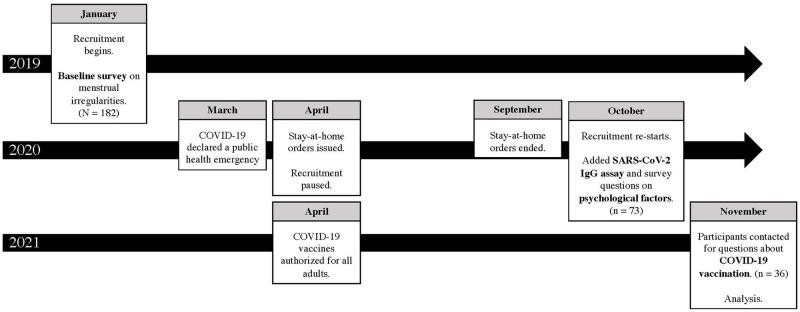
From January 2019 to September 2021, women (18- to 45-years-old and not using hormonal contraception) were recruited in Miami-Dade County, Florida. Cross-sectional, self-report surveys collected data on menstrual irregularities, COVID-19 vaccination, stress, depression, and loneliness. A EUA approved rapid test assay using whole blood measured SARS-CoV-2 IgG antibodies. Chi-square and Fisher's exact tests described menstrual irregularities among women recruited before versus after the start of the COVID-19 pandemic and with detectable versus undetectable SARS-CoV-2 IgG antibodies. A logistic regression examined the relationship between the presence of SARS-CoV-2 IgG antibodies and menstrual irregularities controlling for age, stress, depression, and loneliness.
RESULTS
Among 182 women enrolled, 73 were enrolled after pandemic onset, and 36 provided vaccination data. Having detectable SARS-CoV-2 IgG antibodies was associated with a higher percentage of menstrual irregularities among unvaccinated women (0% vs. 39%, p = .026) and among all women regardless of vaccination status (31% vs. 5%; p = .005). Adjusting for age and psychological variables, the odds of menstrual irregularities were 7.03 times (95% CI [1.39, 35.60]; p = .019) higher among women with detectable antibodies compared to women without detectable antibodies. Neither enrollment date, age, nor psychological factors were associated to menstrual irregularities.
CONCLUSIONS
Biological mechanisms related to SARS-CoV-2 infection may be responsible for irregular menstruation and should be further examined to mitigate the impact of the COVID-19 pandemic on women's health.
背景
生物和心理机制可能导致 COVID-19 大流行期间女性出现月经不规律。
研究设计
2019 年 1 月至 2021 年 9 月,在佛罗里达州迈阿密-戴德县招募了年龄在 18 至 45 岁之间且未使用激素避孕的女性。横断面、自我报告调查收集了月经不规律、COVID-19 疫苗接种、压力、抑郁和孤独的数据。使用全血的 EUA 批准的快速检测试剂盒测量 SARS-CoV-2 IgG 抗体。卡方检验和 Fisher 精确检验描述了 COVID-19 大流行开始前后招募的女性的月经不规律情况,以及 SARS-CoV-2 IgG 抗体可检测与不可检测的情况。逻辑回归分析了 SARS-CoV-2 IgG 抗体的存在与月经不规律之间的关系,控制了年龄、压力、抑郁和孤独等因素。
结果
在纳入的 182 名女性中,73 名在大流行开始后入组,36 名提供了疫苗接种数据。未接种疫苗的女性中,SARS-CoV-2 IgG 抗体可检测与月经不规律的百分比较高(0% vs. 39%,p =.026),无论接种状态如何,所有女性中 SARS-CoV-2 IgG 抗体可检测与月经不规律的百分比也较高(31% vs. 5%;p =.005)。调整年龄和心理变量后,与 SARS-CoV-2 IgG 抗体不可检测的女性相比,抗体可检测的女性月经不规律的几率高 7.03 倍(95% CI [1.39, 35.60];p =.019)。招募日期、年龄和心理因素均与月经不规律无关。
结论
与 SARS-CoV-2 感染相关的生物学机制可能导致月经不规律,应进一步研究以减轻 COVID-19 大流行对女性健康的影响。


 Zotero 插件