
利用传统机器学习和深度学习发现与设计抗菌肽的最新进展
Recent Progress in the Discovery and Design of Antimicrobial Peptides Using Traditional Machine Learning and Deep Learning.
作者信息
Yan Jielu, Cai Jianxiu, Zhang Bob, Wang Yapeng, Wong Derek F, Siu Shirley W I
机构信息
PAMI Research Group, Department of Computer and Information Science, University of Macau, Taipa, Macau, China.
Faculty of Applied Sciences, Macao Polytechnic University, Macau, China.
出版信息
Antibiotics (Basel). 2022 Oct 21;11(10):1451. doi: 10.3390/antibiotics11101451.
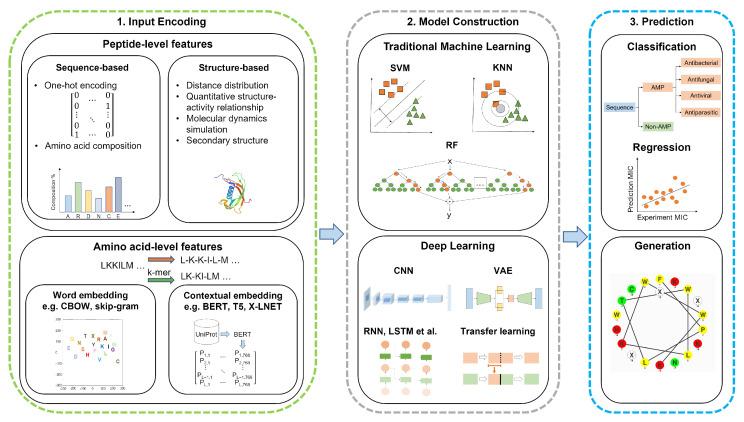
Antimicrobial resistance has become a critical global health problem due to the abuse of conventional antibiotics and the rise of multi-drug-resistant microbes. Antimicrobial peptides (AMPs) are a group of natural peptides that show promise as next-generation antibiotics due to their low toxicity to the host, broad spectrum of biological activity, including antibacterial, antifungal, antiviral, and anti-parasitic activities, and great therapeutic potential, such as anticancer, anti-inflammatory, etc. Most importantly, AMPs kill bacteria by damaging cell membranes using multiple mechanisms of action rather than targeting a single molecule or pathway, making it difficult for bacterial drug resistance to develop. However, experimental approaches used to discover and design new AMPs are very expensive and time-consuming. In recent years, there has been considerable interest in using in silico methods, including traditional machine learning (ML) and deep learning (DL) approaches, to drug discovery. While there are a few papers summarizing computational AMP prediction methods, none of them focused on DL methods. In this review, we aim to survey the latest AMP prediction methods achieved by DL approaches. First, the biology background of AMP is introduced, then various feature encoding methods used to represent the features of peptide sequences are presented. We explain the most popular DL techniques and highlight the recent works based on them to classify AMPs and design novel peptide sequences. Finally, we discuss the limitations and challenges of AMP prediction.
由于传统抗生素的滥用和多重耐药微生物的出现,抗菌药物耐药性已成为一个关键的全球健康问题。抗菌肽(AMPs)是一类天然肽,因其对宿主毒性低、具有包括抗菌、抗真菌、抗病毒和抗寄生虫活性在内的广泛生物活性以及巨大的治疗潜力(如抗癌、抗炎等),有望成为下一代抗生素。最重要的是,抗菌肽通过多种作用机制破坏细胞膜来杀死细菌,而不是靶向单个分子或途径,这使得细菌耐药性难以产生。然而,用于发现和设计新抗菌肽的实验方法非常昂贵且耗时。近年来,人们对使用包括传统机器学习(ML)和深度学习(DL)方法在内的计算机方法进行药物发现产生了浓厚兴趣。虽然有几篇论文总结了计算抗菌肽预测方法,但它们都没有专注于深度学习方法。在这篇综述中,我们旨在调查深度学习方法实现的最新抗菌肽预测方法。首先,介绍抗菌肽的生物学背景,然后介绍用于表示肽序列特征的各种特征编码方法。我们解释最流行的深度学习技术,并重点介绍基于这些技术对抗菌肽进行分类和设计新型肽序列的最新研究。最后,我们讨论抗菌肽预测的局限性和挑战。
 Zotero 插件