
血液系统恶性肿瘤中的自噬
Autophagy in Hematological Malignancies.
作者信息
García Ruiz Olga, Sánchez-Maldonado José Manuel, López-Nevot Miguel Ángel, García Paloma, Macauda Angelica, Hernández-Mohedo Francisca, González-Sierra Pedro Antonio, Martínez-Bueno Manuel, Pérez Eva, Reyes-Zurita Fernando Jesús, Campa Daniele, Canzian Federico, Jurado Manuel, Rodríguez-Sevilla Juan José, Sainz Juan
机构信息
Genomic Oncology Area, GENYO, Centre for Genomics and Oncological Research: Pfizer/University of Granada/Andalusian Regional Government, PTS Granada, 18016 Granada, Spain.
Instituto de Investigación Biosanitaria de Granada (ibs.GRANADA), Complejo Hospitales Universitarios de Granada, Universidad de Granada, 18016 Granada, Spain.
出版信息
Cancers (Basel). 2022 Oct 17;14(20):5072. doi: 10.3390/cancers14205072.
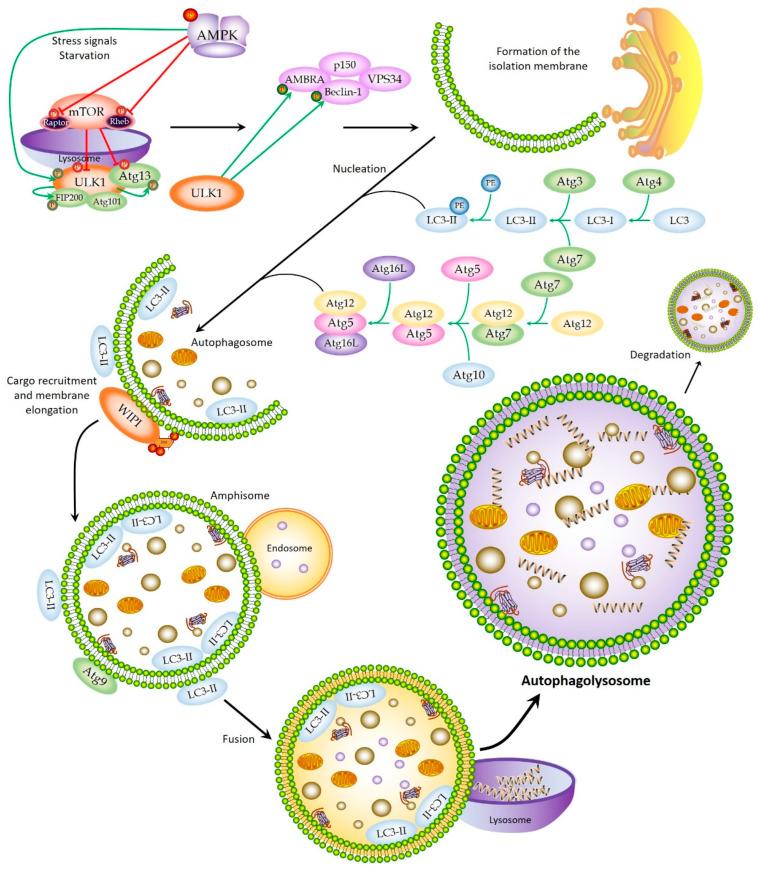
Autophagy is a highly conserved metabolic pathway via which unwanted intracellular materials, such as unfolded proteins or damaged organelles, are digested. It is activated in response to conditions of oxidative stress or starvation, and is essential for the maintenance of cellular homeostasis and other vital functions, such as differentiation, cell death, and the cell cycle. Therefore, autophagy plays an important role in the initiation and progression of tumors, including hematological malignancies, where damaged autophagy during hematopoiesis can cause malignant transformation and increase cell proliferation. Over the last decade, the importance of autophagy in response to standard pharmacological treatment of hematological tumors has been observed, revealing completely opposite roles depending on the tumor type and stage. Thus, autophagy can promote tumor survival by attenuating the cellular damage caused by drugs and/or stabilizing oncogenic proteins, but can also have an antitumoral effect due to autophagic cell death. Therefore, autophagy-based strategies must depend on the context to create specific and safe combination therapies that could contribute to improved clinical outcomes. In this review, we describe the process of autophagy and its role on hematopoiesis, and we highlight recent research investigating its role as a potential therapeutic target in hematological malignancies. The findings suggest that genetic variants within autophagy-related genes modulate the risk of developing hemopathies, as well as patient survival.
自噬是一种高度保守的代谢途径,通过该途径可消化不需要的细胞内物质,如未折叠蛋白或受损细胞器。它在氧化应激或饥饿条件下被激活,对于维持细胞稳态及其他重要功能(如分化、细胞死亡和细胞周期)至关重要。因此,自噬在肿瘤(包括血液系统恶性肿瘤)的发生和发展中起重要作用,造血过程中受损的自噬可导致恶性转化并增加细胞增殖。在过去十年中,已观察到自噬在血液系统肿瘤标准药物治疗反应中的重要性,根据肿瘤类型和阶段显示出完全相反的作用。因此,自噬可通过减轻药物引起的细胞损伤和/或稳定致癌蛋白来促进肿瘤存活,但也可因自噬性细胞死亡而产生抗肿瘤作用。因此,基于自噬的策略必须视具体情况而定,以创建有助于改善临床结果的特定且安全的联合疗法。在本综述中,我们描述了自噬过程及其在造血中的作用,并强调了最近关于其作为血液系统恶性肿瘤潜在治疗靶点作用的研究。研究结果表明,自噬相关基因内的遗传变异可调节血液病的发生风险以及患者的生存率。
 Zotero 插件