
晚期糖基化终产物与 1 型糖尿病年轻患者的糖尿病神经病变有关。
Advanced glycation end-products are associated with diabetic neuropathy in young adults with type 1 diabetes.
机构信息
Department of Complication Research , Steno Diabetes Center Copenhagen, Herlev, Denmark.
Department of Clinical Epidemiology, Steno Diabetes Center Copenhagen, Herlev, Denmark.
出版信息
Front Endocrinol (Lausanne). 2022 Oct 11;13:891442. doi: 10.3389/fendo.2022.891442. eCollection 2022.
AIMS/HYPOTHESIS: Advanced glycation end-products (AGEs) may contribute to the development of diabetic neuropathy. In young adults with type 1 diabetes, we aimed to investigate the association between AGEs and cardiovascular autonomic neuropathy (CAN) and distal symmetric polyneuropathy (DSPN).
METHODS
This cross-sectional study comprised 151 young adults. CAN was assessed by cardiovascular autonomic reflex tests; lying-to-standing test, deep breathing test (E/I), Valsalva manoeuvre, and heart rate variability indices; and the mean square of the sum of the squares of differences between consecutive R-R intervals and standard deviation of normal-to-normal intervals (SDNN), high- (HF) and low-frequency (LF) power, total frequency power, and the LF/HF ratio. DSPN was assessed by light touch, pain and vibration perception threshold (VPT), neuropathy questionnaires, and objective measures. AGEs were analysed in four groups using z-scores adjusted for relevant confounders and multiple testing: i) "glycolytic dysfunction", ii) "lipid peroxidation", iii) "oxidative stress", and iv) "glucotoxicity".
RESULTS
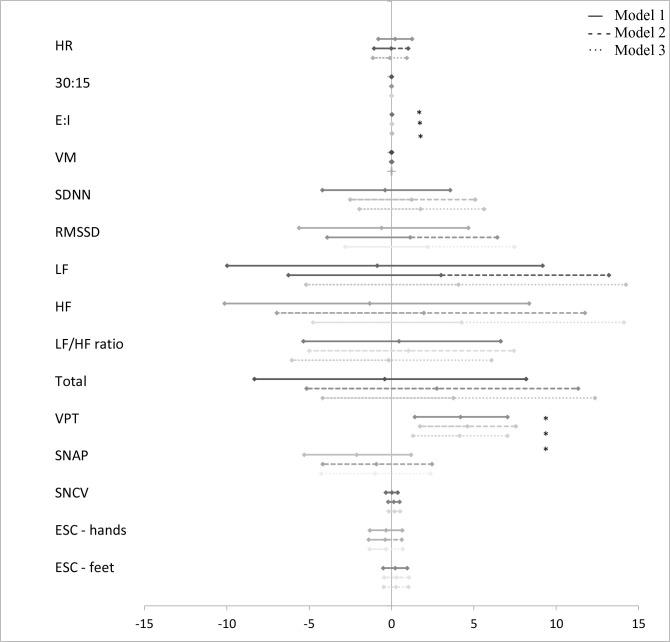
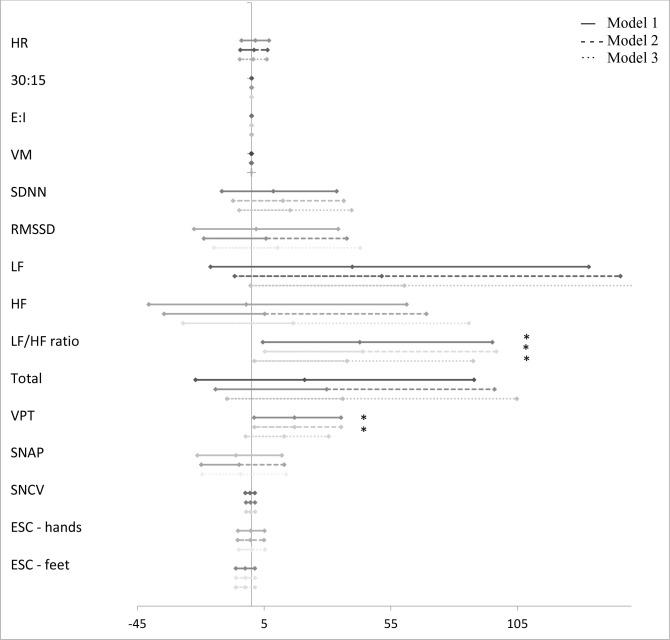
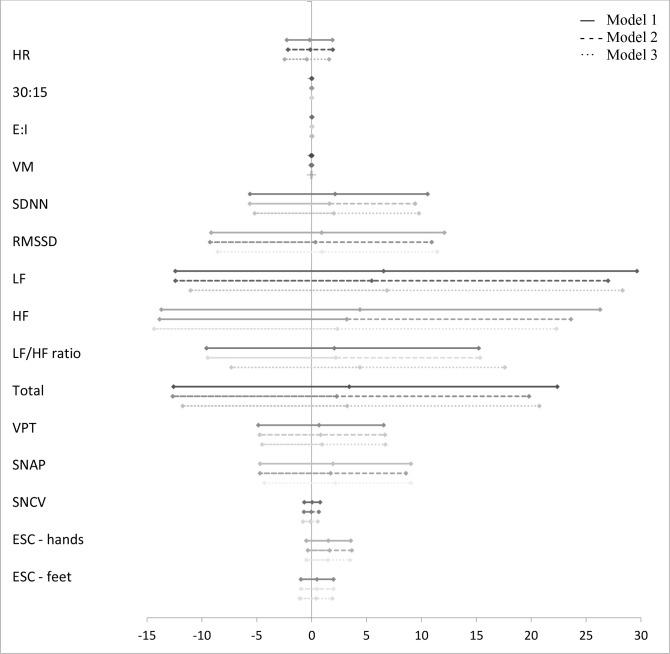
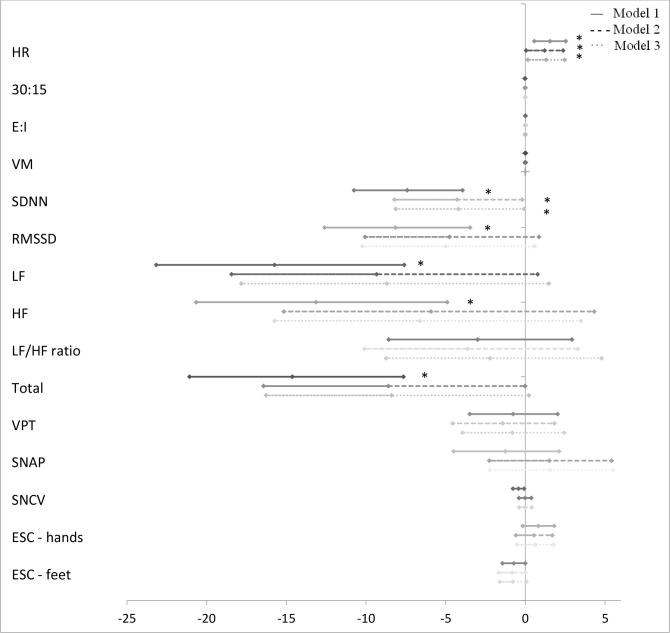
A higher z-score of "glycolytic dysfunction" was associated with higher VPT (4.14% (95% CI 1.31; 7.04), p = 0.004) and E/I (0.03% (95% CI 0.01; 0.05), p = 0.005), "lipid peroxidation" was associated with higher LF/HF ratio (37.72% (95% CI 1.12; 87.57), p = 0.044), and "glucotoxicity" was associated with lower SDNN (-4.20% (95% CI -8.1416; -0.0896), p = 0.047). No significance remained after adjustment for multiple testing.
CONCLUSIONS/INTERPRETATIONS: In young adults with type 1 diabetes, increased levels of AGEs involving different metabolic pathways were associated with several measures of CAN and DSPN, suggesting that AGEs may play a diverse role in the pathogeneses of diabetic neuropathy.
目的/假设:晚期糖基化终产物(AGEs)可能导致糖尿病神经病变的发生。在 1 型糖尿病的年轻患者中,我们旨在研究 AGEs 与心血管自主神经病变(CAN)和远端对称性多发性神经病(DSPN)之间的关系。
方法
本横断面研究纳入了 151 名年轻成年人。通过心血管自主反射测试评估 CAN,包括卧立位试验、深呼吸试验(E/I)、瓦尔萨尔瓦动作和心率变异性指数,以及均方根差和正常-正常间期标准差(SDNN)、高频(HF)和低频(LF)功率、总频率功率和 LF/HF 比值;通过轻触、疼痛和振动感觉阈值(VPT)、神经病问卷和客观测量评估 DSPN。使用经过相关混杂因素和多次检验校正的 z 分数对 AGEs 进行了四组分析:i)“糖酵解功能障碍”,ii)“脂质过氧化”,iii)“氧化应激”和 iv)“糖毒性”。
结果
“糖酵解功能障碍”的 z 分数较高与较高的 VPT(4.14%(95%CI 1.31;7.04),p = 0.004)和 E/I(0.03%(95%CI 0.01;0.05),p = 0.005)相关,“脂质过氧化”与较高的 LF/HF 比值相关(37.72%(95%CI 1.12;87.57),p = 0.044),而“糖毒性”与较低的 SDNN 相关(-4.20%(95%CI -8.1416;-0.0896),p = 0.047)。经多次检验校正后,无统计学意义。
结论
在 1 型糖尿病的年轻患者中,涉及不同代谢途径的 AGEs 水平升高与 CAN 和 DSPN 的多个指标相关,这表明 AGEs 可能在糖尿病神经病变的发病机制中发挥多样化的作用。

 Zotero 插件