
身体活动与久坐行为对心力衰竭患者全因死亡率的综合影响:一项基于国家健康与营养检查调查分析的队列研究
Combined effects of physical activity and sedentary behavior on all-cause mortality in heart failure patients: A cohort study of national health and nutrition examination survey analysis.
作者信息
Zhu Yunhui, Chen Zhebin, Chen Songzan, Fu Guosheng, Wang Yao
机构信息
Key Laboratory of Cardiovascular Intervention and Regenerative Medicine of Zhejiang Province, Department of Cardiology, Sir Run Run Shaw Hospital, School of Medicine, Zhejiang University, Hangzhou, China.
出版信息
Front Cardiovasc Med. 2022 Oct 14;9:1027995. doi: 10.3389/fcvm.2022.1027995. eCollection 2022.
BACKGROUND
Physical activity and sedentary behavior are independently related to the risk of cardiovascular disease. Physical activity is recognized as having a protective effect, while being sedentary seems to be adverse. Nonetheless, the interactions between physical activity and sedentary behavior and the combined effect on the prognosis of heart failure patients remain unclear.
METHODS AND RESULTS
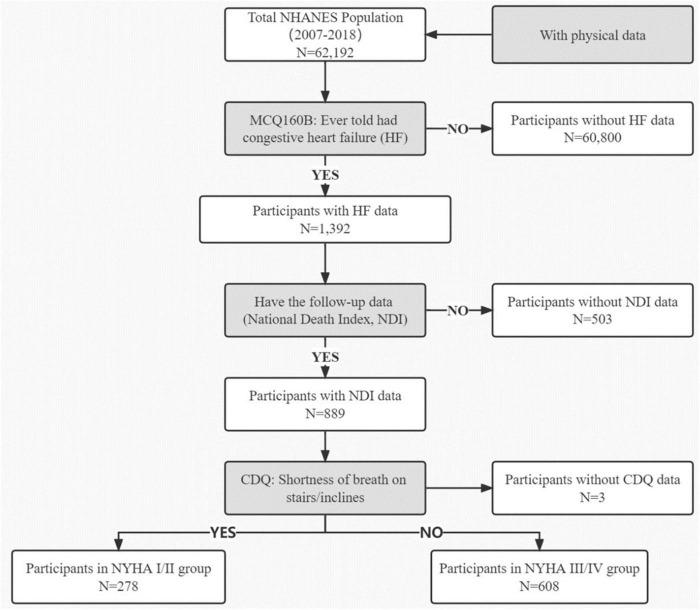
This cohort study included 886 heart failure patients from the National Health and Nutrition Examination Survey (NHANES) 2007-2018. Physical activity and sedentary behavior were assessed by the NHANES questionnaires. The all-caused deaths of enrolled subjects were identified from National Death Index (NDI) database. During a median follow-up of 51 months, 321 (36.2%) deaths from any causes occurred. Multivariable Cox proportional hazards models were used to estimate the hazard ratios (HRs) and 95% confidence interval (CI) for the all-cause mortality in heart failure patients associated with physical activity and sedentary behavior. Physical activity was independently associated with lower mortality [HR = 0.51, 95% CI (0.38-0.68), < 0.001] and sedentary behavior was associated with adverse prognosis [HR = 1.79, 95% CI (1.41-2.28), < 0.001]. Kaplan-Meier survival curve showed that physical activity appeared to attenuate the negative consequences of SB, while sedentary behavior increased the all-cause mortality, particularly those without physical activity.
CONCLUSION
Physical activity has a protective effect on HF patients' prognosis, particularly those with sedentary behavior. Sedentary behavior independently exhibited a negative association in populations without physical activity, while it does not increase mortality in those with moderate physical activity.
背景
体力活动和久坐行为与心血管疾病风险独立相关。体力活动被认为具有保护作用,而久坐似乎具有不良影响。然而,体力活动与久坐行为之间的相互作用以及对心力衰竭患者预后的综合影响仍不明确。
方法与结果
这项队列研究纳入了2007 - 2018年美国国家健康与营养检查调查(NHANES)中的886例心力衰竭患者。通过NHANES问卷评估体力活动和久坐行为。从国家死亡指数(NDI)数据库中确定入组受试者的全因死亡情况。在中位随访51个月期间,发生了321例(36.2%)任何原因导致的死亡。使用多变量Cox比例风险模型来估计与体力活动和久坐行为相关的心力衰竭患者全因死亡率的风险比(HRs)和95%置信区间(CI)。体力活动与较低死亡率独立相关[HR = 0.51,95% CI(0.38 - 0.68),< 0.001],久坐行为与不良预后相关[HR = 1.79,95% CI(1.41 - 2.28),< 0.001]。Kaplan - Meier生存曲线显示,体力活动似乎减弱了久坐行为的负面影响,而久坐行为增加了全因死亡率,尤其是那些没有体力活动的患者。
结论
体力活动对心力衰竭患者的预后有保护作用,特别是对那些有久坐行为的患者。在没有体力活动的人群中,久坐行为独立呈现负相关,而在有适度体力活动的人群中,久坐行为不会增加死亡率。


 Zotero 插件