
疾病相关胃肠道环状单链DNA病毒的宿主预测
Host prediction for disease-associated gastrointestinal cressdnaviruses.
作者信息
Kinsella Cormac M, Deijs Martin, Becker Christin, Broekhuizen Patricia, van Gool Tom, Bart Aldert, Schaefer Arne S, van der Hoek Lia
机构信息
Amsterdam UMC, Laboratory of Experimental Virology, Department of Medical Microbiology and Infection Prevention, University of Amsterdam, Meibergdreef 9, Amsterdam 1105 AZ, The Netherlands.
Amsterdam Institute for Infection and Immunity, Postbus 22660, Amsterdam 1100 DD, The Netherlands.
出版信息
Virus Evol. 2022 Sep 16;8(2):veac087. doi: 10.1093/ve/veac087. eCollection 2022.
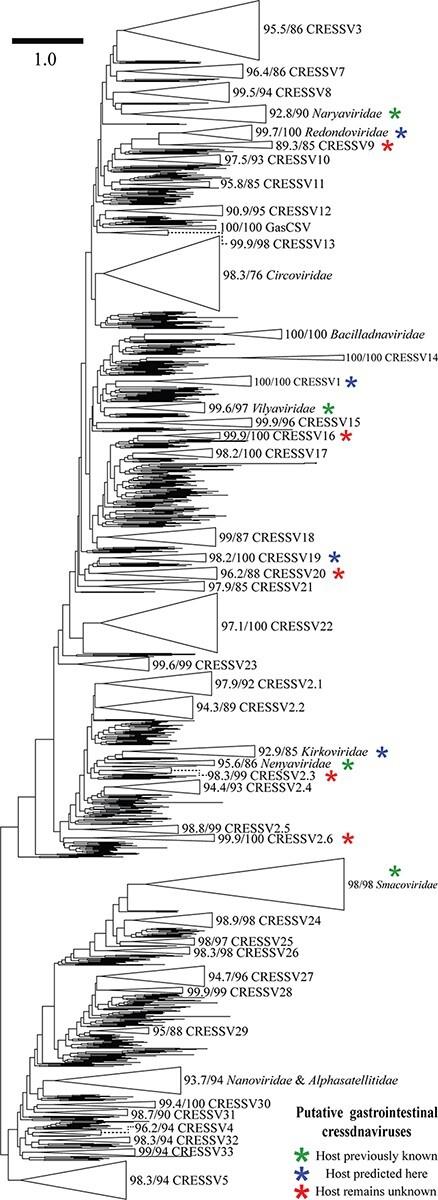
Metagenomic techniques have facilitated the discovery of thousands of viruses, yet because samples are often highly biodiverse, fundamental data on the specific cellular hosts are usually missing. Numerous gastrointestinal viruses linked to human or animal diseases are affected by this, preventing research into their medical or veterinary importance. Here, we developed a computational workflow for the prediction of viral hosts from complex metagenomic datasets. We applied it to seven lineages of gastrointestinal cressdnaviruses using 1,124 metagenomic datasets, predicting hosts of four lineages. The , strongly associated to human gum disease (periodontitis), were predicted to infect , an oral pathogen itself involved in periodontitis. The , originally linked to fatal equine disease, were predicted to infect a variety of parabasalid protists, including in humans. Two viral lineages observed in human diarrhoeal disease (CRESSV1 and CRESSV19, i.e. pecoviruses and hudisaviruses) were predicted to infect spp. and respectively, protists responsible for millions of annual human infections. Our prediction approach is adaptable to any virus lineage and requires neither training datasets nor host genome assemblies. Two host predictions (for the and CRESSV1 lineages) could be independently confirmed as virus-host relationships using endogenous viral elements identified inside host genomes, while a further prediction (for the ) was strongly supported as a virus-host relationship using a case-control screening experiment of human oral plaques.
宏基因组技术推动了数千种病毒的发现,然而由于样本通常具有高度的生物多样性,关于特定细胞宿主的基础数据往往缺失。许多与人类或动物疾病相关的胃肠道病毒都受此影响,阻碍了对其医学或兽医重要性的研究。在此,我们开发了一种计算流程,用于从复杂的宏基因组数据集中预测病毒宿主。我们将其应用于七个胃肠道环状单链DNA病毒谱系,使用了1124个宏基因组数据集,预测了四个谱系的宿主。与人类牙龈疾病(牙周炎)密切相关的[病毒名称未给出],预计会感染[宿主名称未给出],而[宿主名称未给出]本身就是一种与牙周炎有关的口腔病原体。最初与致命马病相关的[病毒名称未给出],预计会感染多种副基底菌类原生生物,包括人类中的[具体原生生物名称未给出]。在人类腹泻疾病中观察到的两个病毒谱系(CRESSV1和CRESSV19,即佩科病毒和胡迪病毒),预计分别感染[具体宿主名称未给出]属和[具体宿主名称未给出],这两种原生生物每年导致数百万人类感染。我们的预测方法适用于任何病毒谱系,既不需要训练数据集,也不需要宿主基因组组装。使用在宿主基因组中鉴定出的内源性病毒元件,可以独立确认两个宿主预测(针对[病毒名称未给出]和CRESSV1谱系)为病毒 - 宿主关系,而通过对人类口腔菌斑的病例对照筛选实验,进一步支持了另一个预测(针对[病毒名称未给出])作为病毒 - 宿主关系。



 Zotero 插件