
T-BET 驱动人类 3 型先天淋巴细胞向功能性 NK 细胞的转化。
T-BET drives the conversion of human type 3 innate lymphoid cells into functional NK cells.
机构信息
Laboratory of Experimental Immunology, Department of Diagnostic Sciences, Ghent University, Ghent, Belgium.
Cancer Research Institute Ghent (CRIG), Ghent, Belgium.
出版信息
Front Immunol. 2022 Oct 18;13:975778. doi: 10.3389/fimmu.2022.975778. eCollection 2022.
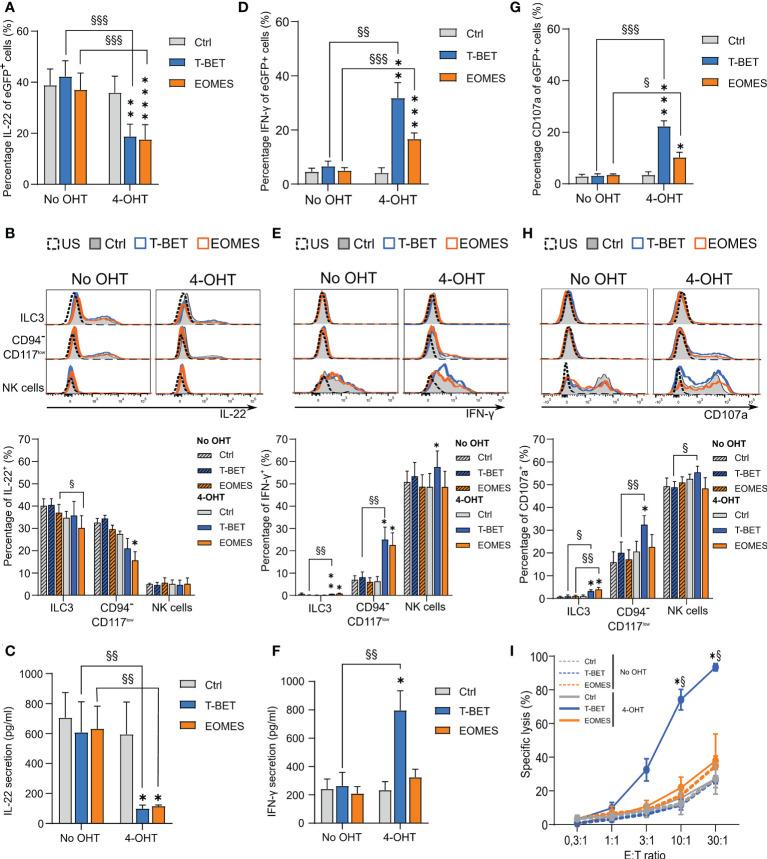
Type 3 innate lymphoid cells (ILC3s) are characterized by RORγt expression and they produce IL-22 upon activation. ILC3s play a role in maintenance of barrier integrity in the intestine. Under inflammatory conditions, the ILC composition of the mucosal tissues is altered due to a high degree of plasticity. It has been extensively demonstrated that both murine and human ILC3s convert into ILC1s to mediate appropriate immune responses. However, plasticity between human ILC3s and NK cells is less well documented. As T-BET and EOMES are key transcription factors in NK cell differentiation, we investigated whether ectopic T-BET or EOMES expression converts human ILC3s into NK cells. ILC3s with ectopic T-BET and EOMES expression downregulate RORγt expression, while T-BET-overexpressing ILC3s additionally upregulate EOMES expression. High E ctopic T-BET expression in ILC3s results in transdifferentiation towards CD94 NK cells, whereas ectopic EOMES overexpression results in dedifferentiation of ILC3s into CD94-CD117 cells but is ineffective in NK cell generation. Dedifferentiating ILC3s from both T-BET and EOMES overexpression cultures upregulate NK cell receptors, perforin and granzyme B. Finally, IL-22 secretion is completely blocked in transdifferentiating ILC3s with both T-BET and EOMES ectopic expression, whereas only T-BET overexpression increases IFN-γ secretion and cytotoxicity. Altogether, these findings demonstrate that human ILC3s can convert into functional NK cells, wherein T-BET, and not EOMES, is the main driver.
3 型先天淋巴细胞(ILC3)的特征是表达 RORγt,并在激活后产生 IL-22。ILC3 在维持肠道屏障完整性方面发挥作用。在炎症条件下,由于高度的可塑性,黏膜组织的 ILC 组成发生改变。已经广泛证明,无论是小鼠还是人类的 ILC3 都会转化为 ILC1 以介导适当的免疫反应。然而,人类 ILC3 和 NK 细胞之间的可塑性尚未得到充分记录。由于 T-BET 和 EOMES 是 NK 细胞分化的关键转录因子,我们研究了异位 T-BET 或 EOMES 表达是否将人类 ILC3 转化为 NK 细胞。表达异位 T-BET 和 EOMES 的 ILC3 下调 RORγt 的表达,而 T-BET 过表达的 ILC3 还上调 EOMES 的表达。ILC3 中高表达异位 T-BET 导致向 CD94 NK 细胞的转分化,而异位 EOMES 过表达导致 ILC3 向 CD94-CD117 细胞的去分化,但对 NK 细胞的生成无效。从 T-BET 和 EOMES 过表达培养物中分化的 ILC3 上调 NK 细胞受体、穿孔素和颗粒酶 B。最后,在转分化的 ILC3 中完全阻断了 IL-22 的分泌,异位表达 T-BET 和 EOMES,而只有 T-BET 过表达增加了 IFN-γ 的分泌和细胞毒性。总之,这些发现表明,人类 ILC3 可以转化为功能性 NK 细胞,其中 T-BET 而不是 EOMES 是主要的驱动因素。


 Zotero 插件