
利用社区参与干预措施提高低收入和中等收入国家的儿童免疫接种率:系统评价和荟萃分析。
Use of community engagement interventions to improve child immunisation in low-income and middle-income countries: a systematic review and meta-analysis.
机构信息
International Initiative for Impact Evaluation, New Delhi, India
International Initiative for Impact Evaluation, London, UK.
出版信息
BMJ Open. 2022 Nov 8;12(11):e061568. doi: 10.1136/bmjopen-2022-061568.
OBJECTIVE
To support evidence informed decision-making, we systematically examine the effectiveness and cost-effectiveness of community engagement interventions on routine childhood immunisation outcomes in low-income and middle-income countries (LMICs) and identify contextual, design and implementation features associated with effectiveness.
DESIGN
Mixed-methods systematic review and meta-analysis.
DATA SOURCES
21 databases of academic and grey literature and 12 additional websites were searched in May 2019 and May 2020.
ELIGIBILITY CRITERIA FOR SELECTING STUDIES
We included experimental and quasi-experimental impact evaluations of community engagement interventions considering outcomes related to routine child immunisation in LMICs. No language, publication type, or date restrictions were imposed.
DATA EXTRACTION AND SYNTHESIS
Two independent researchers extracted summary data from published reports and appraised quantitative risk of bias using adapted Cochrane tools. Random effects meta-analysis was used to examine effects on the primary outcome, full immunisation coverage.
RESULTS
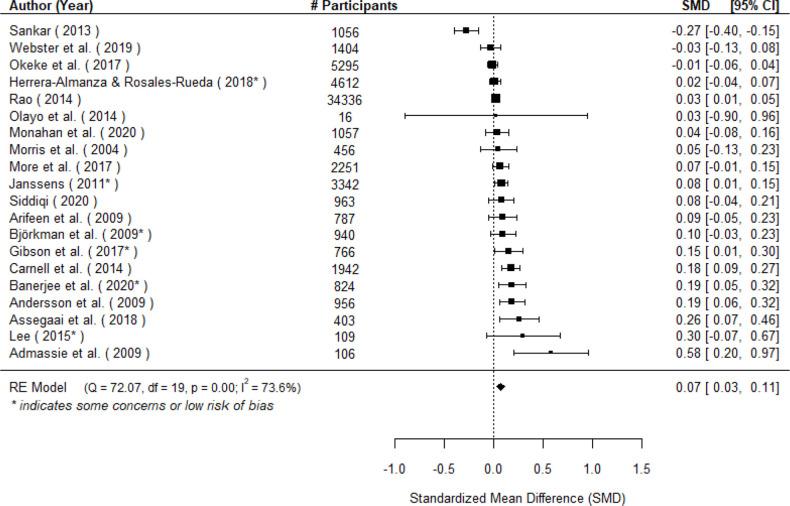
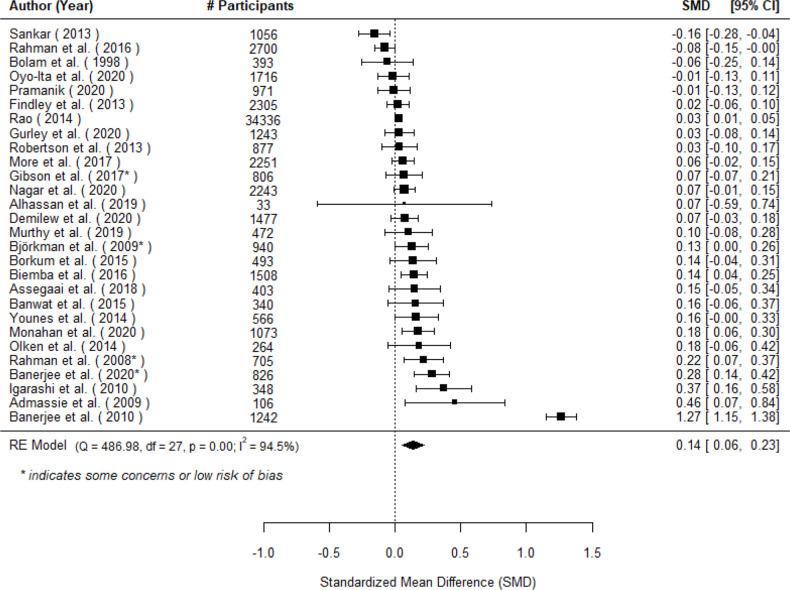
Our search identified over 43 000 studies and 61 were eligible for analysis. The average pooled effect of community engagement interventions on full immunisation coverage was standardised mean difference 0.14 (95% CI 0.06 to 0.23, I=94.46). The most common source of risk to the quality of evidence (risk of bias) was outcome reporting bias: most studies used caregiver-reported measures of vaccinations received by a child in the absence or incompleteness of immunisation cards. Reasons consistently cited for intervention success include appropriate intervention design, including building in community engagement features; addressing common contextual barriers of immunisation and leveraging facilitators; and accounting for existing implementation constraints. The median intervention cost per treated child per vaccine dose (excluding the cost of vaccines) to increase absolute immunisation coverage by one percent was US$3.68.
CONCLUSION
Community engagement interventions are successful in improving outcomes related to routine child immunisation. The findings are robust to exclusion of studies assessed as high risk of bias.
目的
为了支持循证决策,我们系统地考察了社区参与干预对低收入和中等收入国家(LMICs)常规儿童免疫接种结果的有效性和成本效益,并确定了与有效性相关的背景、设计和实施特征。
设计
混合方法系统评价和荟萃分析。
数据来源
2019 年 5 月和 2020 年 5 月,在 21 个学术和灰色文献数据库以及 12 个额外的网站上进行了搜索。
纳入研究的选择标准
我们纳入了考虑到 LMICs 中常规儿童免疫接种相关结果的社区参与干预的实验和准实验性影响评估。没有对语言、出版类型或日期施加限制。
数据提取和综合
两名独立研究人员从已发表的报告中提取汇总数据,并使用经过改编的 Cochrane 工具评估定量风险偏倚。使用随机效应荟萃分析来检验对主要结局(完全免疫接种覆盖率)的影响。
结果
我们的搜索确定了超过 43000 项研究,其中 61 项符合分析条件。社区参与干预对完全免疫接种覆盖率的平均综合效应为标准化均数差 0.14(95%置信区间 0.06 至 0.23,I=94.46)。对证据质量(偏倚风险)最常见的威胁来源是结局报告偏倚:大多数研究使用照顾者报告的儿童接种疫苗的措施,而忽略或不完整的免疫接种卡。干预成功的原因包括适当的干预设计,包括纳入社区参与特征;解决免疫接种的常见背景障碍并利用促进因素;以及考虑到现有的实施限制。每接种一剂疫苗,每治疗一名儿童的干预成本中位数(不包括疫苗成本)增加 1%绝对免疫接种覆盖率为 3.68 美元。
结论
社区参与干预在改善常规儿童免疫接种相关结局方面是成功的。排除被评估为高偏倚风险的研究后,结果仍然稳健。


 Zotero 插件