
基于度伐利尤单抗的免疫治疗期间的肝损伤与患者较差的生存率相关:一项回顾性分析。
Liver injury during durvalumab-based immunotherapy is associated with poorer patient survival: A retrospective analysis.
作者信息
Swanson Linnea A, Kassab Ihab, Tsung Irene, Schneider Bryan J, Fontana Robert J
机构信息
Department of Internal Medicine, University of Michigan, Ann Arbor, MI, United States.
Division of Hematology and Oncology, University of Michigan, Ann Arbor, MI, United States.
出版信息
Front Oncol. 2022 Oct 24;12:984940. doi: 10.3389/fonc.2022.984940. eCollection 2022.
BACKGROUND
Durvalumab is approved for the treatment of lung cancer, advanced biliary tract cancers, and is also being evaluated in many other solid organ tumors. The aim of our study is to define the incidence, etiology, and outcomes of liver injury in consecutive patients receiving durvalumab-based immunotherapy.
PATIENTS AND METHODS
Durvalumab treated patients between 1/2016 - 7/2020 were identified from the electronic medical record. Liver injury was defined as serum AST or ALT ≥ 5x upper limit of normal (ULN), ALP ≥ 2x ULN, bilirubin ≥ 2.5 mg/dl, or INR ≥ 1.5. Potential drug induced liver injury (DILI) cases were adjudicated using expert opinion scoring and confirmed with Roussel Uclaf Causality Assessment Method (RUCAM).
RESULTS
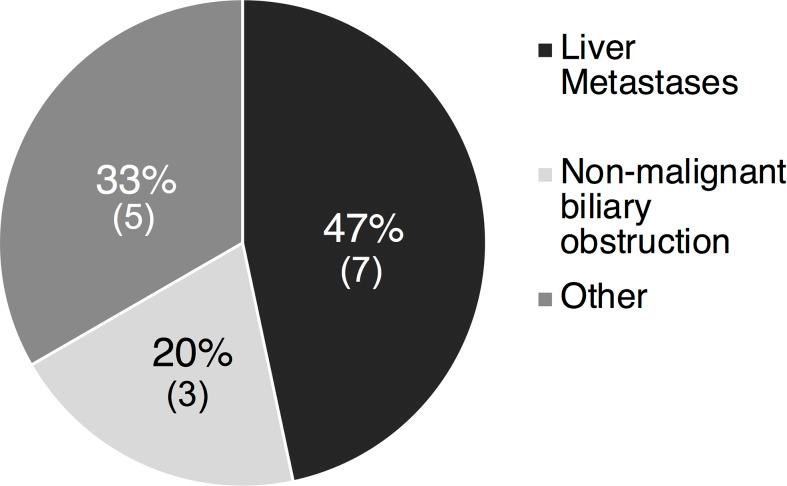
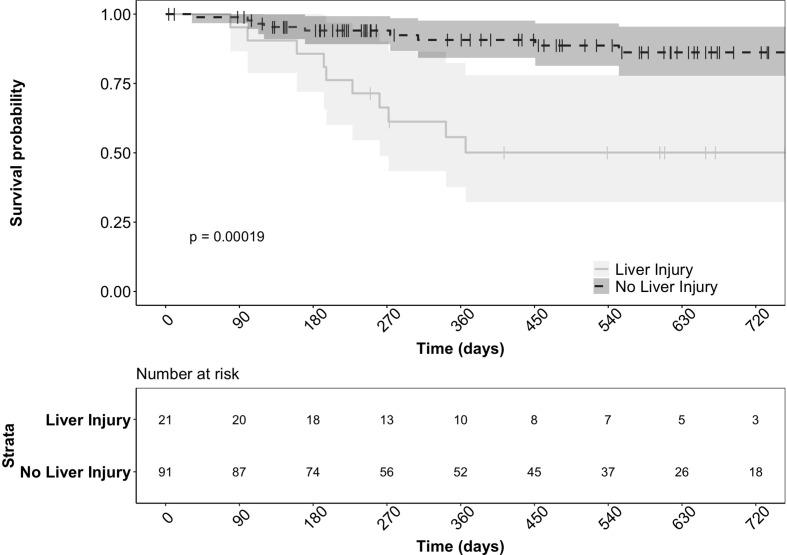
Amongst 112 patients, 58 (52%) had non-small cell lung cancer, the median age was 65 years, and 60% were male. The 21 (19%) liver injury patients were significantly more likely to harbor hepatic metastases (52% vs 17%, p=<0.001), experience tumor progression (67% vs 32%, p=0.01) or die (48% vs 11%, p<0.001) during follow-up compared to the 91 without liver injury. Using multivariate regression analysis, the development of liver injury during treatment as well as baseline hepatic metastases were independently associated with mortality during follow-up. Six of the 21 (29%) liver injury cases were adjudicated as probable DILI with four attributed to durvalumab and two due to other drugs (paclitaxel, pembrolizumab). Durvalumab was permanently discontinued in two DILI patients, three received corticosteroids, and one was successfully rechallenged. Only one patient with DILI developed jaundice, and none required hospitalization. Liver biochemistries normalized in all 6 DILI cases, while they only normalized in 27% of the 15 non-DILI cases (p=0.002). The 6 DILI patients also had a trend towards improved survival compared to those with other causes of liver injury.
CONCLUSION
Liver injury was observed in 19% of durvalumab-treated patients and is associated with a greater likelihood of tumor progression and death during follow-up. The four durvalumab DILI cases were mild and self-limited, highlighting the importance of causality assessment to determine the cause of liver injury in oncology patients receiving immunotherapy.
背景
度伐利尤单抗已被批准用于治疗肺癌、晚期胆管癌,并且也正在许多其他实体器官肿瘤中进行评估。我们研究的目的是确定接受基于度伐利尤单抗的免疫治疗的连续患者中肝损伤的发生率、病因及转归。
患者与方法
从电子病历中识别出2016年1月至2020年7月期间接受度伐利尤单抗治疗的患者。肝损伤定义为血清谷草转氨酶(AST)或谷丙转氨酶(ALT)≥正常上限(ULN)的5倍、碱性磷酸酶(ALP)≥ULN的2倍、胆红素≥2.5mg/dl或国际标准化比值(INR)≥1.5。潜在的药物性肝损伤(DILI)病例采用专家意见评分进行判定,并通过罗塞尔·优克福因果关系评估法(RUCAM)进行确认。
结果
112例患者中,58例(52%)患有非小细胞肺癌,中位年龄为65岁,60%为男性。与91例无肝损伤的患者相比,21例(19%)肝损伤患者在随访期间发生肝转移的可能性显著更高(52%对17%,p<0.001)、经历肿瘤进展的可能性更高(67%对32%,p=0.01)或死亡的可能性更高(48%对11%,p<0.001)。采用多因素回归分析,治疗期间肝损伤的发生以及基线肝转移与随访期间的死亡率独立相关。21例肝损伤病例中有6例(29%)被判定为可能的DILI,其中4例归因于度伐利尤单抗,2例归因于其他药物(紫杉醇、帕博利珠单抗)。2例DILI患者永久停用度伐利尤单抗,3例接受了皮质类固醇治疗,1例成功再次用药。只有1例DILI患者出现黄疸,无一例需要住院治疗。所有6例DILI病例的肝脏生化指标均恢复正常,而15例非DILI病例中只有27%恢复正常(p=0.002)。与其他肝损伤原因的患者相比,6例DILI患者的生存也有改善趋势。
结论
在接受度伐利尤单抗治疗的患者中观察到19%发生肝损伤,并且与随访期间肿瘤进展和死亡的可能性更大相关。4例度伐利尤单抗导致的DILI病例为轻度且自限性,突出了因果关系评估对于确定接受免疫治疗的肿瘤患者肝损伤原因的重要性。

 Zotero 插件