
真核起始因子和 RNA 修饰在癌症中的翻译调控。
Translational Regulation by eIFs and RNA Modifications in Cancer.
机构信息
School of Basic Medical Sciences, Chengdu University of Traditional Chinese Medicine, Chengdu 611137, China.
The Third People's Hospital of Chengdu, Clinical College of Southwest Jiao Tong University, Chengdu 610014, China.
出版信息
Genes (Basel). 2022 Nov 6;13(11):2050. doi: 10.3390/genes13112050.
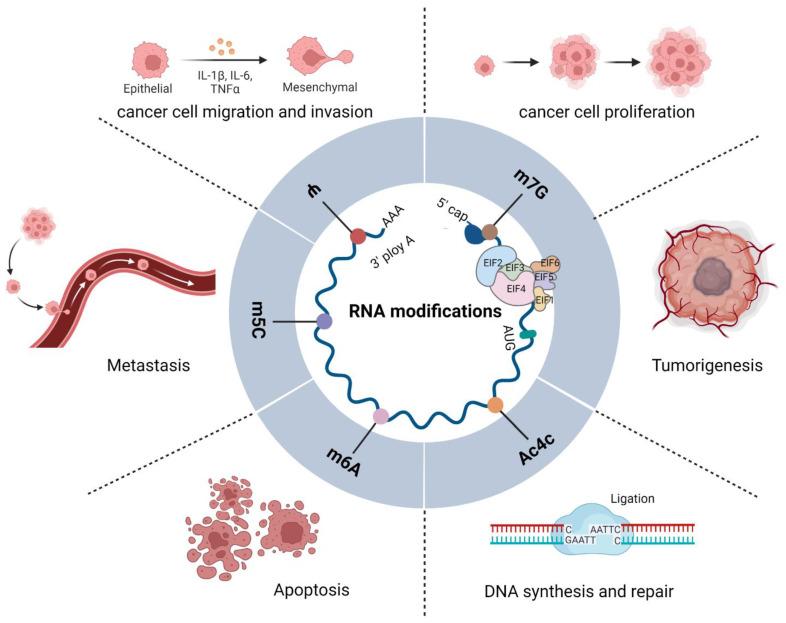
Translation is a fundamental process in all living organisms that involves the decoding of genetic information in mRNA by ribosomes and translation factors. The dysregulation of mRNA translation is a common feature of tumorigenesis. Protein expression reflects the total outcome of multiple regulatory mechanisms that change the metabolism of mRNA pathways from synthesis to degradation. Accumulated evidence has clarified the role of an increasing amount of mRNA modifications at each phase of the pathway, resulting in translational output. Translation machinery is directly affected by mRNA modifications, influencing translation initiation, elongation, and termination or altering mRNA abundance and subcellular localization. In this review, we focus on the translation initiation factors associated with cancer as well as several important RNA modifications, for which we describe their association with cancer.
翻译是所有生物体中的一个基本过程,涉及核糖体和翻译因子对 mRNA 中遗传信息的解码。mRNA 翻译的失调是肿瘤发生的一个常见特征。蛋白质表达反映了改变 mRNA 途径从合成到降解的代谢的多种调节机制的总结果。越来越多的证据阐明了在该途径的每个阶段,mRNA 修饰的作用导致翻译产物。翻译机制直接受 mRNA 修饰的影响,影响翻译起始、延伸和终止,或改变 mRNA 的丰度和亚细胞定位。在这篇综述中,我们重点介绍与癌症相关的翻译起始因子以及几种重要的 RNA 修饰,描述它们与癌症的关联。


 Zotero 插件