
与环境介导病原体所致人类负担相关的生态和社会经济因素:全球分析。
Ecological and socioeconomic factors associated with the human burden of environmentally mediated pathogens: a global analysis.
机构信息
Woods Institute for the Environment, Stanford University, Stanford, CA, USA; Marine Science Institute, University of California Santa Barbara, Santa Barbara, CA, USA.
Department of Biology, Stanford University, Stanford, CA, USA; High Meadows Environmental Institute, Princeton University, Princeton, NJ, USA.
出版信息
Lancet Planet Health. 2022 Nov;6(11):e870-e879. doi: 10.1016/S2542-5196(22)00248-0.
BACKGROUND
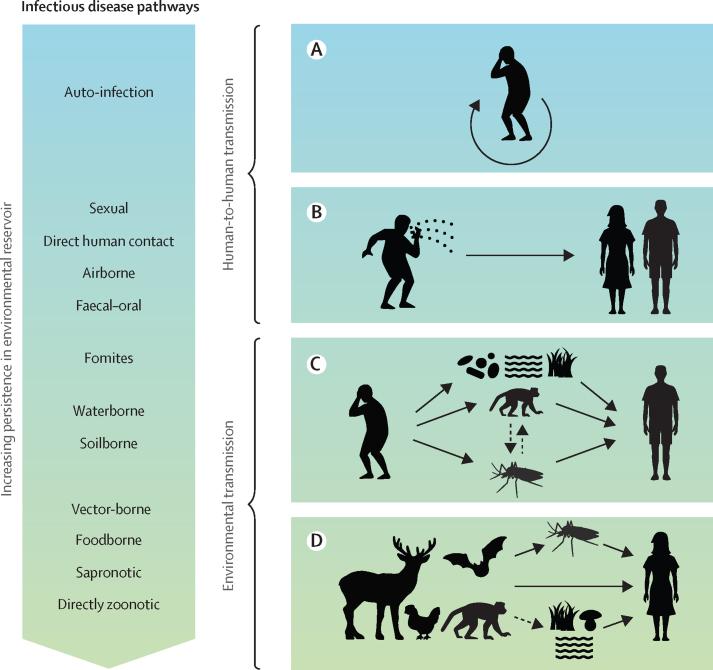
Billions of people living in poverty are at risk of environmentally mediated infectious diseases-that is, pathogens with environmental reservoirs that affect disease persistence and control and where environmental control of pathogens can reduce human risk. The complex ecology of these diseases creates a global health problem not easily solved with medical treatment alone.
METHODS
We quantified the current global disease burden caused by environmentally mediated infectious diseases and used a structural equation model to explore environmental and socioeconomic factors associated with the human burden of environmentally mediated pathogens across all countries.
FINDINGS
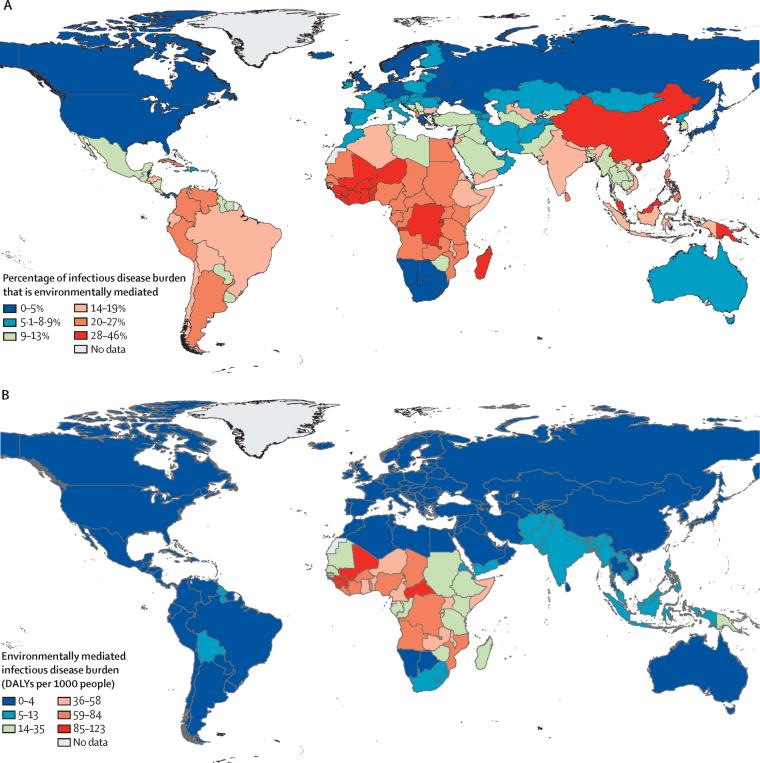
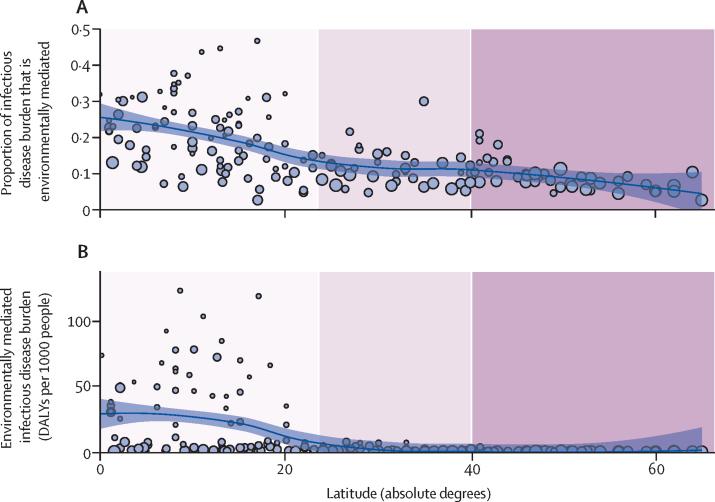
We found that around 80% (455 of 560) of WHO-tracked pathogen species known to infect humans are environmentally mediated, causing about 40% (129 488 of 359 341 disability-adjusted life years) of contemporary infectious disease burden (global loss of 130 million years of healthy life annually). The majority of this environmentally mediated disease burden occurs in tropical countries, and the poorest countries carry the highest burdens across all latitudes. We found weak associations between disease burden and biodiversity or agricultural land use at the global scale. In contrast, the proportion of people with rural poor livelihoods in a country was a strong proximate indicator of environmentally mediated infectious disease burden. Political stability and wealth were associated with improved sanitation, better health care, and lower proportions of rural poverty, indirectly resulting in lower burdens of environmentally mediated infections. Rarely, environmentally mediated pathogens can evolve into global pandemics (eg, HIV, COVID-19) affecting even the wealthiest communities.
INTERPRETATION
The high and uneven burden of environmentally mediated infections highlights the need for innovative social and ecological interventions to complement biomedical advances in the pursuit of global health and sustainability goals.
FUNDING
Bill & Melinda Gates Foundation, National Institutes of Health, National Science Foundation, Alfred P. Sloan Foundation, National Institute for Mathematical and Biological Synthesis, Stanford University, and the US Defense Advanced Research Projects Agency.
背景
数十亿生活在贫困中的人面临着环境介导的传染病的风险,即病原体具有环境储库,影响疾病的持续存在和控制,而对病原体的环境控制可以降低人类的风险。这些疾病的复杂生态系统造成了一个全球性的卫生问题,单凭医疗手段难以解决。
方法
我们量化了目前由环境介导的传染病造成的全球疾病负担,并使用结构方程模型探索了与所有国家环境介导病原体的人类负担相关的环境和社会经济因素。
发现
我们发现,约 80%(已知感染人类的 560 种病原体中有 455 种)是环境介导的,导致约 40%(359341 个残疾调整生命年中有 129488 个)的当代传染病负担(全球每年损失 1.3 亿健康生命年)。这种环境介导的疾病负担主要发生在热带国家,而最贫穷的国家在所有纬度上的负担都最高。我们发现,在全球范围内,疾病负担与生物多样性或农业土地利用之间的相关性很弱。相比之下,一个国家中农村贫困人口的比例是环境介导的传染病负担的一个强有力的近似指标。政治稳定和财富与改善卫生设施、更好的医疗保健以及农村贫困人口比例的降低有关,这间接导致环境介导的感染负担降低。罕见情况下,环境介导的病原体可进化成全球性大流行病(如 HIV、COVID-19),甚至影响到最富裕的社区。
解释
环境介导的传染病负担高且分布不均,这突出表明需要采取创新的社会和生态干预措施,以补充生物医学方面的进展,实现全球卫生和可持续性目标。
资助
比尔和梅琳达·盖茨基金会、美国国立卫生研究院、美国国家科学基金会、阿尔弗雷德·P·斯隆基金会、美国国家数学与生物合成研究所、斯坦福大学和美国国防高级研究计划局。

 Zotero 插件