
个体选择与蚊帐使用的进化博弈模型:阐明疟疾消除策略的关键方面
An evolutionary game model of individual choices and bed net use: elucidating key aspect in malaria elimination strategies.
作者信息
Ngonghala Calistus N, Bhattacharyya Samit
机构信息
Disease Modelling Lab, Department of Mathematics, School of Natural Sciences, Shiv Nadar University, Gautam Buddha Nagar, India.
Department of Mathematics and Emerging Pathogens Institute, University of Florida, Gainesville, FL 32611, USA.
出版信息
R Soc Open Sci. 2022 Nov 16;9(11):220685. doi: 10.1098/rsos.220685. eCollection 2022 Nov.
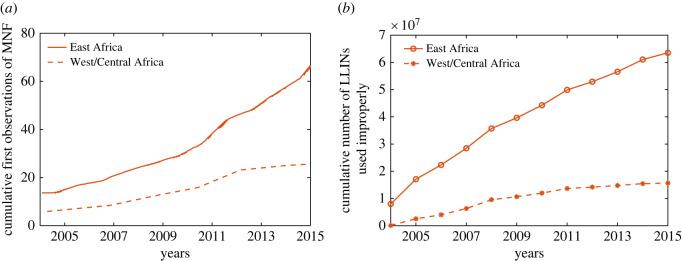
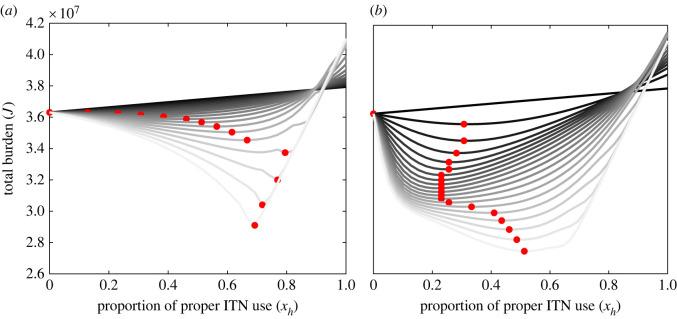
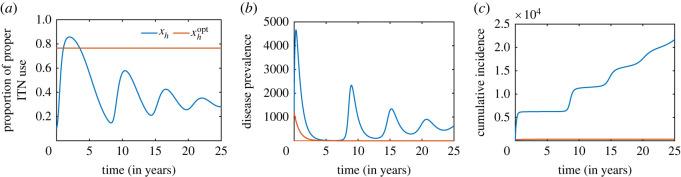
Insecticide-treated net (ITN) is the most applicable and cost-effective malaria intervention measure in sub-Saharan Africa and elsewhere. Although ITNs have been widely distributed to malaria-endemic regions in the past, their success has been threatened by misuses (in fishing, agriculture etc.) and decay in ITN efficacy. Decision-making in using the ITNs depends on multiple coevolving factors: malaria prevalence, mosquito density, ITN availability and its efficacy, and other socio-economic determinants. While ITN misuse increases as the efficacy of ITNs declines, high efficacy also impedes proper use due to free-riding. This irrational usage leads to increased malaria prevalence, thereby worsening malaria control efforts. It also remains unclear if the optimum ITN use for malaria elimination can be achieved under such an adaptive social learning process. Here, we incorporate evolutionary game theory into a disease transmission model to demonstrate these behavioural interactions and their impact on malaria prevalence. We show that social optimum usage is a function of transmission potential, ITN efficacy and mosquito demography. Under specific parameter regimes, our model exhibits patterns of ITN usage similar to observed data from parts of Africa. Our study suggests that the provision of financial incentives as prompt feedback to improper ITN use can reduce misuse and contribute positively towards malaria elimination efforts in Africa and elsewhere.
经杀虫剂处理的蚊帐(ITN)是撒哈拉以南非洲及其他地区最适用且具成本效益的疟疾干预措施。尽管过去ITN已广泛分发至疟疾流行地区,但其成功受到滥用(用于捕鱼、农业等)以及ITN效力下降的威胁。使用ITN的决策取决于多个共同演变的因素:疟疾流行率、蚊虫密度、ITN的可获得性及其效力,以及其他社会经济决定因素。随着ITN效力下降,ITN滥用情况增加,而高效力也因搭便车行为阻碍了正确使用。这种不合理使用导致疟疾流行率上升,从而使疟疾控制工作恶化。在这样一个适应性社会学习过程中,能否实现消除疟疾的最佳ITN使用方式也仍不明确。在此,我们将进化博弈论纳入疾病传播模型,以展示这些行为相互作用及其对疟疾流行率的影响。我们表明,社会最优使用是传播潜力、ITN效力和蚊虫人口统计学的函数。在特定参数范围内,我们的模型呈现出与非洲部分地区观测数据相似的ITN使用模式。我们的研究表明,提供经济激励作为对ITN不当使用的即时反馈,可以减少滥用,并对非洲及其他地区的疟疾消除工作做出积极贡献。



 Zotero 插件