
猪流行性腹泻病毒蛋白亚细胞定位的系统研究
A Systemic Study of Subcellular Localization of Porcine Epidemic Diarrhea Virus Proteins.
作者信息
Zhu Huixin, Li Zitong, Bai Juan, Jiang Ping, Wang Xianwei, Liu Xing
机构信息
Key Laboratory of Animal Disease Diagnostics and Immunology, Ministry of Agriculture, MOE International Joint Collaborative Research Laboratory for Animal Health & Food Safety, College of Veterinary Medicine, Nanjing Agricultural University, Nanjing 210095, China.
Jiangsu Co-Innovation Center for Prevention and Control of Important Animal Infectious Diseases and Zoonoses, Yangzhou 225000, China.
出版信息
Pathogens. 2022 Dec 17;11(12):1555. doi: 10.3390/pathogens11121555.
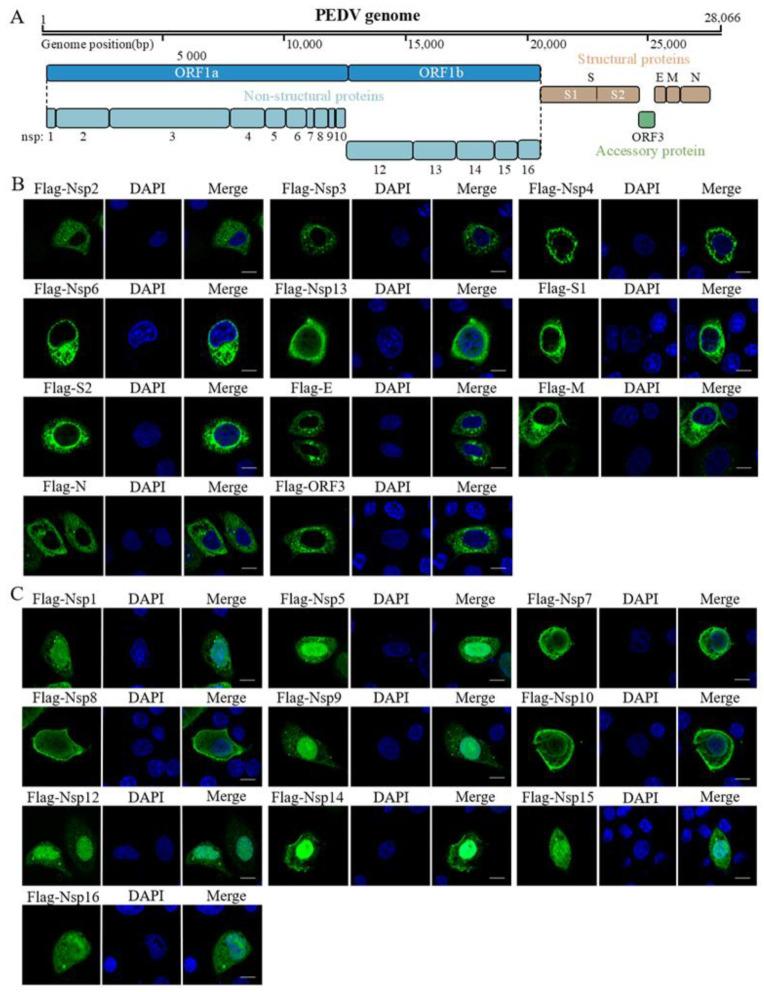
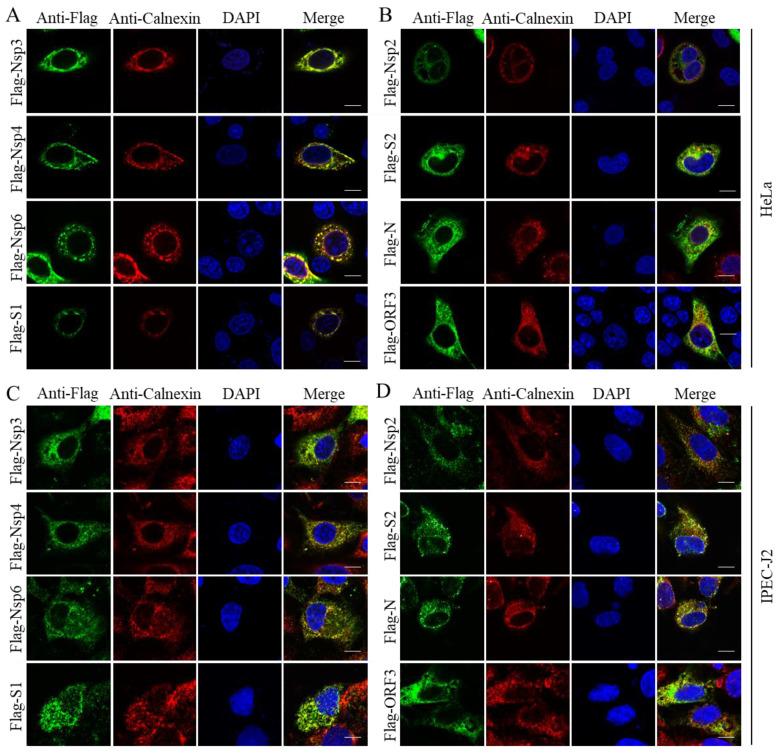
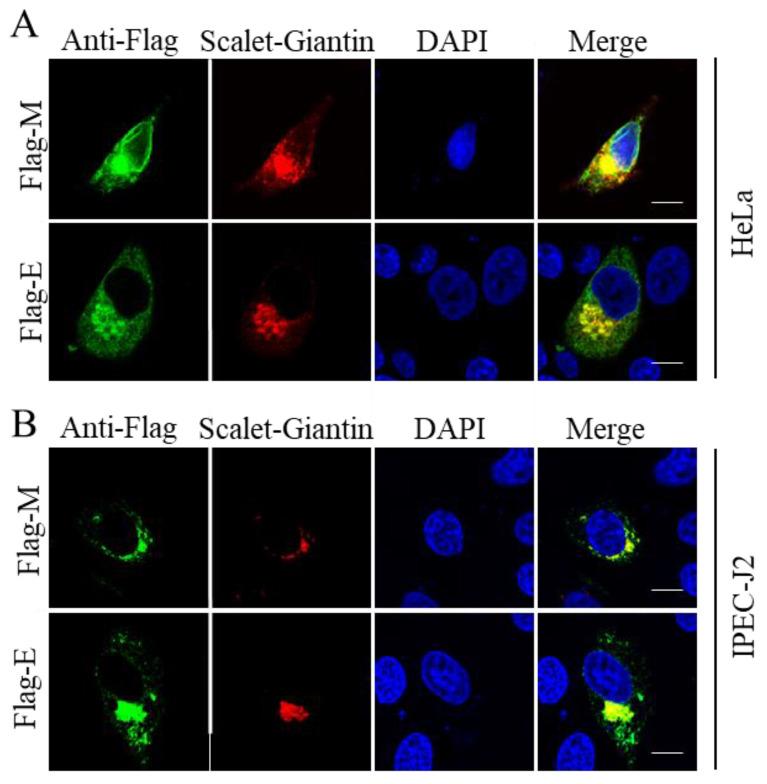
Porcine epidemic diarrhea virus (PEDV), a highly pathogenic enteric coronavirus, is regarded as one of the most severe porcine pathogens. To date, there are still no commercial vaccines or drugs that can provide full protection against the epidemic strains. A better understanding of the subcellular location of individual proteins could benefit from studying the protein functions and mechanisms of how the virus regulates key cellular processes, finally leading to the development of antiviral agents. In this study, we characterized the subcellular localization of PEDV proteins using multi-labeled fluorescent immunocytochemistry. As a result, 11 proteins showed cytoplasmic distribution and 10 proteins showed both cytoplasmic and nuclear distribution. Furthermore, we demonstrated that four proteins (Nsp3, Nsp4, Nsp6, and S1) were co-localized in the endoplasmic reticulum (ER), while four proteins (Nsp2, S2, N, and ORF3) were partially observed in the ER, two proteins (E and M) were co-localized in the Golgi apparatus, and two proteins (Nsp2 and E) were partially co-localized with the mitochondria. These viral proteins may perform specific functions at specific cellular locations. Together, these results describe a subcellular localization map of PEDV proteins, which will help to characterize the functions of these proteins in the future.
猪流行性腹泻病毒(PEDV)是一种高致病性肠道冠状病毒,被认为是最严重的猪病原体之一。迄今为止,仍然没有能够完全抵御流行毒株的商业疫苗或药物。更好地了解单个蛋白质的亚细胞定位有助于研究病毒调节关键细胞过程的蛋白质功能和机制,最终推动抗病毒药物的研发。在本研究中,我们使用多标记荧光免疫细胞化学方法对PEDV蛋白质的亚细胞定位进行了表征。结果显示,11种蛋白质呈细胞质分布,10种蛋白质呈细胞质和细胞核分布。此外,我们还证明,四种蛋白质(Nsp3、Nsp4、Nsp6和S1)在内质网(ER)中共定位,四种蛋白质(Nsp2、S2、N和ORF3)在内质网中部分可见,两种蛋白质(E和M)在高尔基体中共定位,两种蛋白质(Nsp2和E)与线粒体部分共定位。这些病毒蛋白可能在特定的细胞位置发挥特定功能。总之,这些结果描绘了PEDV蛋白质的亚细胞定位图谱,这将有助于未来对这些蛋白质的功能进行表征。

 Zotero 插件