
肌肉减少症患者的运动与线粒体机制
Exercise and mitochondrial mechanisms in patients with sarcopenia.
作者信息
Alizadeh Pahlavani Hamed, Laher Ismail, Knechtle Beat, Zouhal Hassane
机构信息
Department of Physical Education, Farhangian University, Tehran, Iran.
Department of Anesthesiology, Pharmacology, and Therapeutics, Faculty of Medicine, University of British Columbia, Vancouver, BC, Canada.
出版信息
Front Physiol. 2022 Dec 6;13:1040381. doi: 10.3389/fphys.2022.1040381. eCollection 2022.
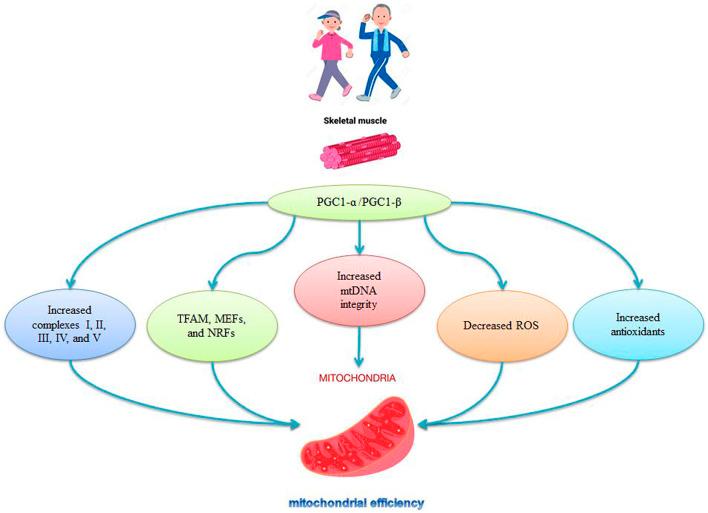
Sarcopenia is a severe loss of muscle mass and functional decline during aging that can lead to reduced quality of life, limited patient independence, and increased risk of falls. The causes of sarcopenia include inactivity, oxidant production, reduction of antioxidant defense, disruption of mitochondrial activity, disruption of mitophagy, and change in mitochondrial biogenesis. There is evidence that mitochondrial dysfunction is an important cause of sarcopenia. Oxidative stress and reduction of antioxidant defenses in mitochondria form a vicious cycle that leads to the intensification of mitochondrial separation, suppression of mitochondrial fusion/fission, inhibition of electron transport chain, reduction of ATP production, an increase of mitochondrial DNA damage, and mitochondrial biogenesis disorder. On the other hand, exercise adds to the healthy mitochondrial network by increasing markers of mitochondrial fusion and fission, and transforms defective mitochondria into efficient mitochondria. Sarcopenia also leads to a decrease in mitochondrial dynamics, mitophagy markers, and mitochondrial network efficiency by increasing the level of ROS and apoptosis. In contrast, exercise increases mitochondrial biogenesis by activating genes affected by PGC1-ɑ (such as CaMK, AMPK, MAPKs) and altering cellular calcium, ATP-AMP ratio, and cellular stress. Activation of PGC1-ɑ also regulates transcription factors (such as TFAM, MEFs, and NRFs) and leads to the formation of new mitochondrial networks. Hence, moderate-intensity exercise can be used as a non-invasive treatment for sarcopenia by activating pathways that regulate the mitochondrial network in skeletal muscle.
肌肉减少症是衰老过程中肌肉质量的严重丧失和功能衰退,可导致生活质量下降、患者独立性受限以及跌倒风险增加。肌肉减少症的病因包括缺乏运动、氧化剂产生、抗氧化防御能力降低、线粒体活性破坏、线粒体自噬破坏以及线粒体生物合成改变。有证据表明线粒体功能障碍是肌肉减少症的重要原因。线粒体中的氧化应激和抗氧化防御能力降低形成恶性循环,导致线粒体分裂加剧、线粒体融合/裂变受抑制、电子传递链受抑制、ATP生成减少、线粒体DNA损伤增加以及线粒体生物合成紊乱。另一方面,运动通过增加线粒体融合和裂变的标志物来增加健康的线粒体网络,并将有缺陷的线粒体转化为高效的线粒体。肌肉减少症还通过增加ROS水平和细胞凋亡导致线粒体动力学、线粒体自噬标志物和线粒体网络效率下降。相反,运动通过激活受PGC1-α影响的基因(如CaMK、AMPK、MAPKs)并改变细胞钙、ATP-AMP比值和细胞应激来增加线粒体生物合成。PGC1-α的激活还调节转录因子(如TFAM、MEFs和NRFs)并导致新的线粒体网络形成。因此,中等强度运动可通过激活调节骨骼肌线粒体网络的途径,作为肌肉减少症的非侵入性治疗方法。


 Zotero 插件