
中国新冠大流行期间猩红热发病率的流行病学趋势:时间序列分析。
Epidemiological trend in scarlet fever incidence in China during the COVID-19 pandemic: A time series analysis.
机构信息
Department of Social Medicine, Health Management College, Harbin Medical University, Harbin, China.
Department of Biostatistics, School of Public Health, Harbin Medical University, Harbin, China.
出版信息
Front Public Health. 2022 Dec 15;10:923318. doi: 10.3389/fpubh.2022.923318. eCollection 2022.
OBJECTIVE
Over the past decade, scarlet fever has caused a relatively high economic burden in various regions of China. Non-pharmaceutical interventions (NPIs) are necessary because of the absence of vaccines and specific drugs. This study aimed to characterize the demographics of patients with scarlet fever, describe its spatiotemporal distribution, and explore the impact of NPIs on the disease in the era of coronavirus disease 2019 (COVID-19) in China.
METHODS
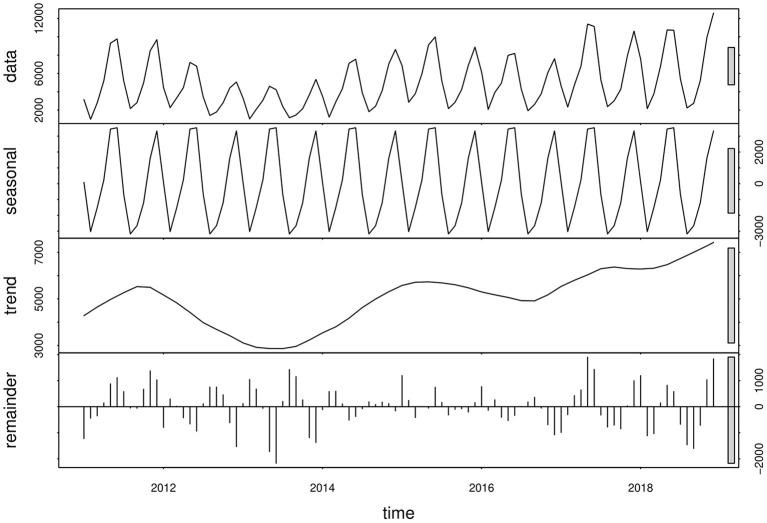
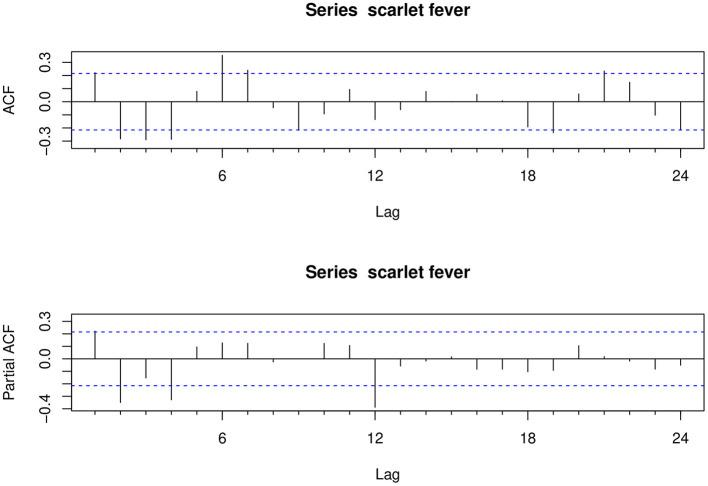
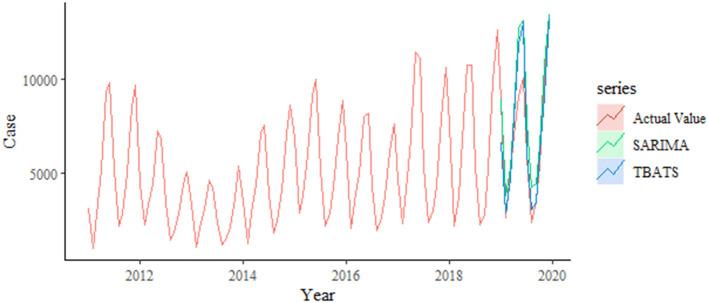
Using monthly scarlet fever data from January 2011 to December 2019, seasonal autoregressive integrated moving average (SARIMA), advanced innovation state-space modeling framework that combines Box-Cox transformations, Fourier series with time-varying coefficients, and autoregressive moving average error correction method (TBATS) models were developed to select the best model for comparing between the expected and actual incidence of scarlet fever in 2020. Interrupted time series analysis (ITSA) was used to explore whether NPIs have an effect on scarlet fever incidence, while the intervention effects of specific NPIs were explored using correlation analysis and ridge regression methods.
RESULTS
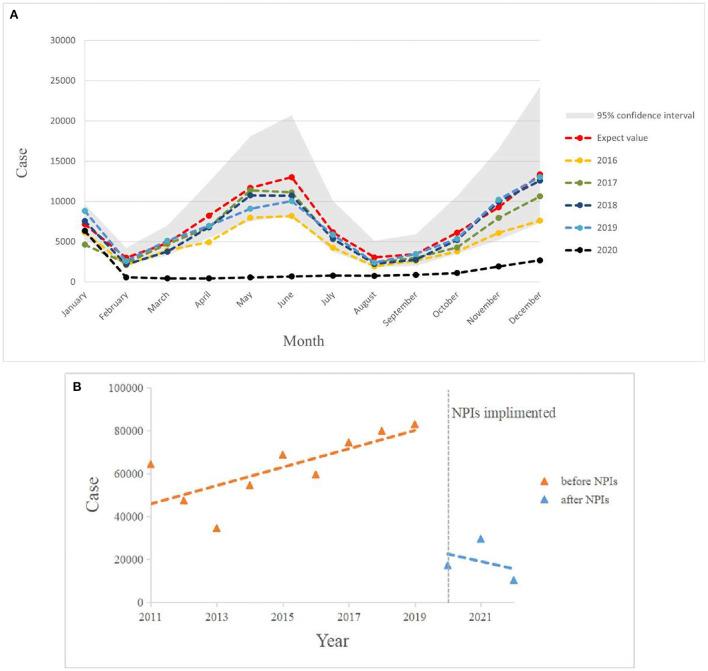
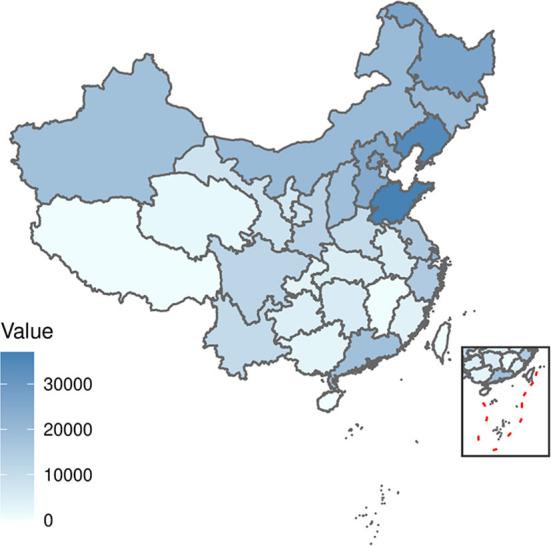
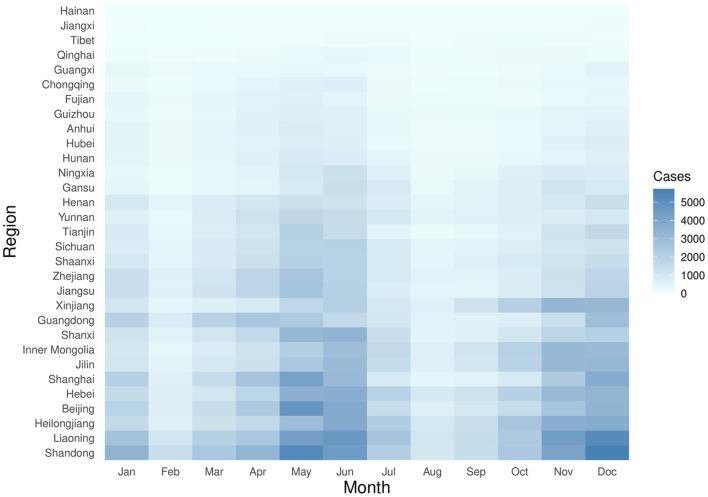
From 2011 to 2017, the total number of scarlet fever cases was 400,691, with children aged 0-9 years being the main group affected. There were two annual incidence peaks (May to June and November to December). According to the best prediction model TBATS (0.002, {0, 0}, 0.801, {<12, 5>}), the number of scarlet fever cases was 72,148 and dual seasonality was no longer prominent. ITSA showed a significant effect of NPIs of a reduction in the number of scarlet fever episodes (β2 = -61526, < 0.005), and the effect of canceling public events (c3) was the most significant ( = 0.0447).
CONCLUSIONS
The incidence of scarlet fever during COVID-19 was lower than expected, and the total incidence decreased by 80.74% in 2020. The results of this study indicate that strict NPIs may be of potential benefit in preventing scarlet fever occurrence, especially that related to public event cancellation. However, it is still important that vaccines and drugs are available in the future.
目的
在过去的十年中,猩红热在中国的各个地区造成了相对较高的经济负担。由于缺乏疫苗和特效药物,非药物干预(NPIs)是必要的。本研究旨在描述猩红热患者的人口统计学特征,描述其时空分布,并探讨在 2019 年冠状病毒病(COVID-19)时代 NPIs 对该病的影响。
方法
使用 2011 年 1 月至 2019 年 12 月的每月猩红热数据,采用季节性自回归综合移动平均(SARIMA)、先进的创新状态空间模型框架(将 Box-Cox 变换、具有时变系数的傅里叶级数和自回归移动平均误差校正方法相结合)(TBATS)模型进行比较,以选择最佳模型来比较 2020 年猩红热的预期和实际发病率。中断时间序列分析(ITSA)用于探讨 NPIs 是否对猩红热发病率有影响,同时采用相关分析和岭回归方法探讨特定 NPIs 的干预效果。
结果
2011 年至 2017 年,猩红热总病例数为 400691 例,主要为 0-9 岁儿童。有两个年度发病高峰(5 月至 6 月和 11 月至 12 月)。根据最佳预测模型 TBATS(0.002,{0,0},0.801,{<12,5>}),猩红热病例数为 72148 例,双季节性不再明显。ITSA 显示 NPIs 的减少猩红热发作次数的效果显著(β2=-61526,<0.005),取消公共活动的效果(c3)最为显著(=0.0447)。
结论
COVID-19 期间猩红热的发病率低于预期,2020 年总发病率下降 80.74%。本研究结果表明,严格的 NPIs 可能对预防猩红热的发生具有潜在的益处,尤其是与取消公共活动有关的猩红热。然而,未来仍需要疫苗和药物。
 Zotero 插件