
重新构想人类结核(TB)肉芽肿:从癌症领域学习。
Reinventing the human tuberculosis (TB) granuloma: Learning from the cancer field.
机构信息
Department of Medicine Huddinge, Center for Infectious Medicine (CIM), Karolinska Institutet, ANA Futura, Huddinge, Sweden.
Department of Pathology, School of Medicine, College of Health Sciences, Tikur Anbessa Specialized Hospital and Addis Ababa University, Addis Ababa, Ethiopia.
出版信息
Front Immunol. 2022 Dec 15;13:1059725. doi: 10.3389/fimmu.2022.1059725. eCollection 2022.
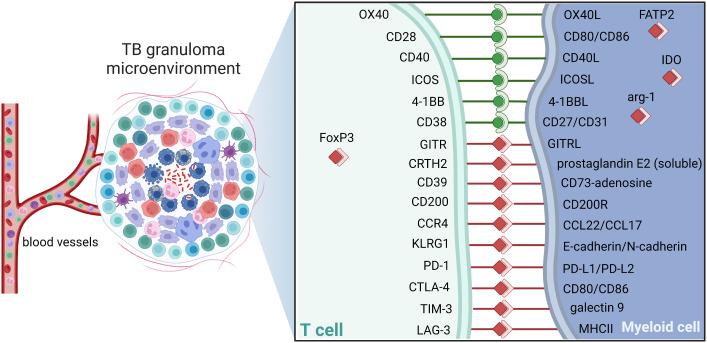
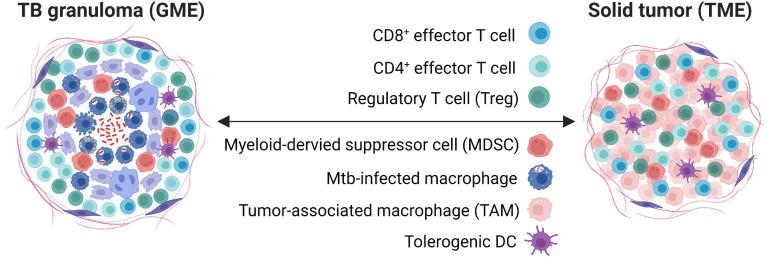
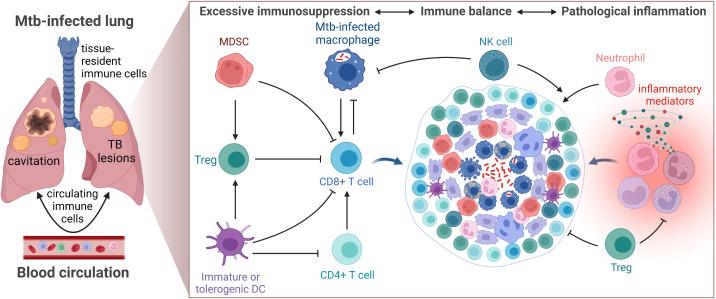
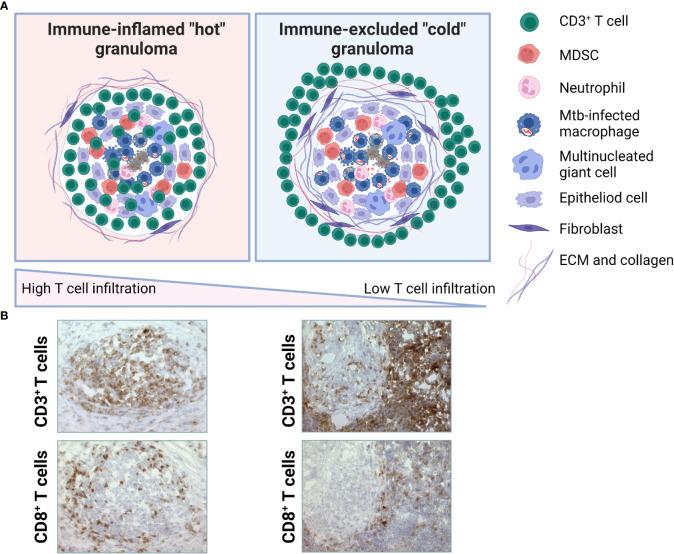
Tuberculosis (TB) remains one of the deadliest infectious diseases in the world and every 20 seconds a person dies from TB. An important attribute of human TB is induction of a granulomatous inflammation that creates a dynamic range of local microenvironments in infected organs, where the immune responses may be considerably different compared to the systemic circulation. New and improved technologies for quantification and multimodal imaging of mRNA transcripts and protein expression at the single-cell level have enabled significantly improved insights into the local TB granuloma microenvironment. Here, we review the most recent data on regulation of immunity in the TB granuloma with an enhanced focus on selected studies that enable spatial mapping of immune cell phenotypes and functions. We take advantage of the conceptual framework of the cancer-immunity cycle to speculate how local T cell responses may be enhanced in the granuloma microenvironment at the site of infection. This includes an exploratory definition of "hot", immune-inflamed, and "cold", immune-excluded TB granulomas that does not refer to the level of bacterial replication or metabolic activity, but to the relative infiltration of T cells into the infected lesions. Finally, we reflect on the current knowledge and controversy related to reactivation of active TB in cancer patients treated with immune checkpoint inhibitors such as PD-1/PD-L1 and CTLA-4. An understanding of the underlying mechanisms involved in the induction and maintenance or disruption of immunoregulation in the TB granuloma microenvironment may provide new avenues for host-directed therapies that can support standard antibiotic treatment of persistent TB disease.
结核病(TB)仍然是世界上最致命的传染病之一,每 20 秒就有一人死于结核病。人类结核病的一个重要特征是诱导肉芽肿炎症,在感染器官中产生动态范围的局部微环境,其中免疫反应可能与全身循环有很大不同。用于定量和对 mRNA 转录本和蛋白质表达进行多模态成像的新技术在单细胞水平上,使我们能够更深入地了解局部结核病肉芽肿微环境。在这里,我们回顾了关于结核病肉芽肿中免疫调节的最新数据,重点介绍了一些能够对免疫细胞表型和功能进行空间映射的选定研究。我们利用癌症-免疫循环的概念框架来推测局部 T 细胞反应如何在感染部位的肉芽肿微环境中增强。这包括对“热”,免疫炎症和“冷”,免疫排斥结核病肉芽肿的探索性定义,该定义不涉及细菌复制或代谢活性的水平,而是指 T 细胞相对浸润到感染病灶中。最后,我们反思了与癌症患者中使用免疫检查点抑制剂(如 PD-1/PD-L1 和 CTLA-4)治疗相关的活动性结核病复发的当前知识和争议。了解在结核病肉芽肿微环境中诱导和维持或破坏免疫调节的潜在机制可能为宿主导向治疗提供新途径,从而支持持续结核病疾病的标准抗生素治疗。

 Zotero 插件