
全球原发性肝癌负担及其与潜在病因、社会人口地位和性别差异的关系:基于残疾调整生命年的 2019 年全球疾病负担研究分析。
Global burden of primary liver cancer and its association with underlying aetiologies, sociodemographic status, and sex differences from 1990-2019: A DALY-based analysis of the Global Burden of Disease 2019 study.
机构信息
Yonsei University College of Medicine, Seoul, Korea.
Department of Internal Medicine, Yonsei University College of Medicine, Seoul, Korea.
出版信息
Clin Mol Hepatol. 2023 Apr;29(2):433-452. doi: 10.3350/cmh.2022.0316. Epub 2023 Jan 4.
BACKGROUND/AIMS: Global distribution of dominant liver cancer aetiologies has significantly changed over the past decades. This study analyzed the updated temporal trends of liver cancer aetiologies and sociodemographic status in 204 countries and territories from 1990 to 2019.
METHODS
The Global Burden of Disease 2019 report was used for statistical analysis. In addition, we performed stratification analysis to five quintiles using sociodemographic index and 21 geographic regions.
RESULTS
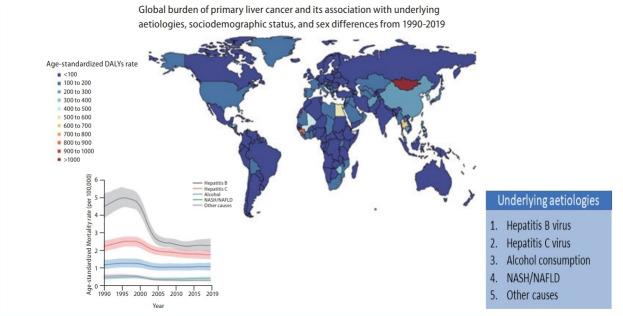
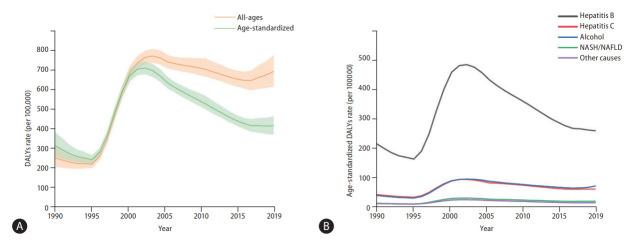
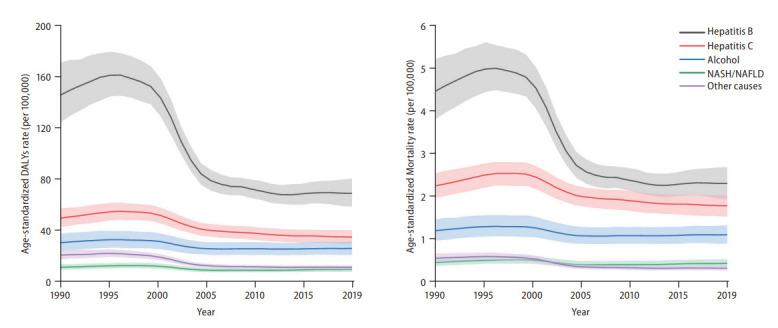
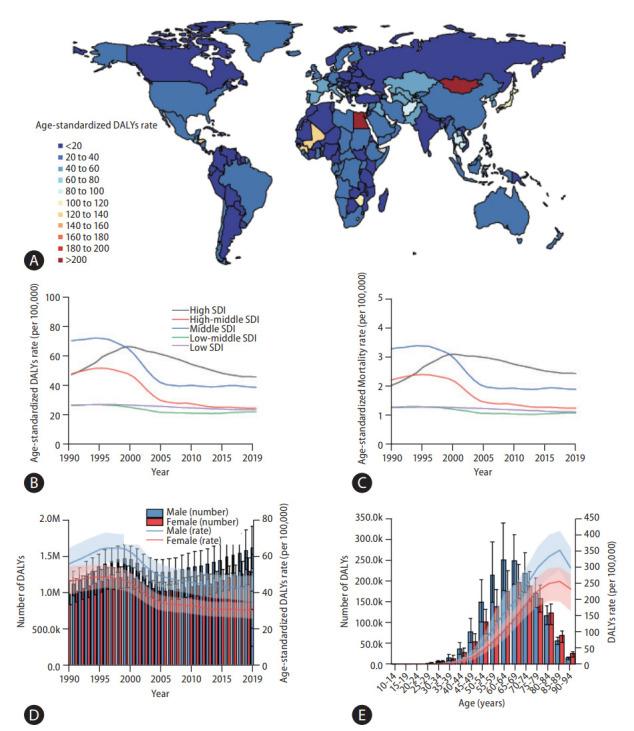
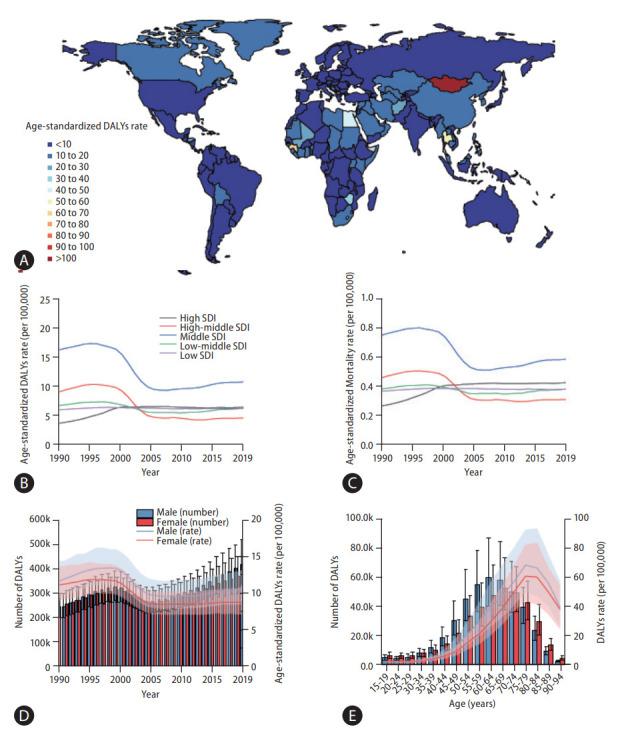
The crude numbers of liver cancer disease-adjusted life years (DALYs) and deaths significantly increased during the study period (DALYs; 11,278,630 in 1990 and 12,528,422 in 2019, deaths; 365,215 in 1990 and 484,577 in 2019). However, the Age-standardized DALY and mortality rates decreased. Hepatitis B virus (HBV) remains the leading cause of liver cancer DALYs and mortality, followed by hepatitis C virus (HCV), alcohol consumption, and non-alcoholic steatohepatitis/non-alcoholic fatty liver disease (NASH/NAFLD). Although Age-standardized DALY and mortality rates of liver cancer due to HBV and HCV have decreased, the rates due to alcohol consumption and NASH/NAFLD have increased. In 2019, the population of the East Asia region had the highest Age-standardized DALY and mortality rates, followed by high-income Asia-Pacific and Central Asia populations. Although East Asia and high-income Asia-Pacific regions showed a decrease during the study period, Age-standardized DALY rates increased in Central Asia. High-income North American and Australasian populations also showed a significant increase in Age-standardized DALY.
CONCLUSION
Liver cancer remains an ongoing global threat. The burden of liver cancer associated with alcohol consumption and NASH/NAFLD is markedly increasing and projected to continuously increase.
背景/目的:在过去几十年中,全球主要肝癌病因的分布发生了显著变化。本研究分析了 1990 年至 2019 年 204 个国家和地区肝癌病因和社会人口统计学状况的最新时间趋势。
方法
使用 2019 年全球疾病负担报告进行统计分析。此外,我们使用社会人口学指数和 21 个地理区域对五个五分位数进行了分层分析。
结果
研究期间,肝癌疾病调整生命年(DALY)和死亡的粗数量显著增加(DALY;1990 年为 11278630 例,2019 年为 12528422 例,死亡;1990 年为 365215 例,2019 年为 484577 例)。然而,年龄标准化 DALY 和死亡率下降。乙型肝炎病毒(HBV)仍然是肝癌 DALY 和死亡率的主要原因,其次是丙型肝炎病毒(HCV)、酒精消费和非酒精性脂肪性肝炎/非酒精性脂肪性肝病(NASH/NAFLD)。尽管 HBV 和 HCV 导致的肝癌年龄标准化 DALY 和死亡率有所下降,但由于酒精消费和 NASH/NAFLD 导致的肝癌年龄标准化 DALY 和死亡率有所上升。2019 年,东亚地区的人口年龄标准化 DALY 和死亡率最高,其次是高收入亚太地区和中亚地区。尽管东亚和高收入亚太地区在研究期间有所下降,但中亚地区的年龄标准化 DALY 率有所上升。高收入北美和澳大拉西亚地区的年龄标准化 DALY 也显著增加。
结论
肝癌仍然是全球持续存在的威胁。与酒精消费和 NASH/NAFLD 相关的肝癌负担显著增加,并预计将持续增加。



 Zotero 插件