
1990 年至 2019 年亚洲脑和中枢神经系统癌症负担及其未来 25 年的预测水平:亚洲中枢神经系统癌症负担和预测模型。
The burden of brain and central nervous system cancers in Asia from 1990 to 2019 and its predicted level in the next twenty-five years : Burden and prediction model of CNS cancers in Asia.
机构信息
Center for Evidence-Based Medicine and Clinical Research, Taihe Hospital, Hubei University of Medicine, No.32, Renmin South Road, Shiyan, 442000, China.
Department of Neurosurgery, Center for Evidence-Based Medicine and Clinical Research, Taihe Hospital, Hubei University of Medicine, No. 32, Renmin South Road, Shiyan, 442000, China.
出版信息
BMC Public Health. 2023 Dec 16;23(1):2522. doi: 10.1186/s12889-023-17467-w.
BACKGROUND
Primary brain and central nervous system cancer (collectively called CNS cancers) cause a significant burden to society. The purpose of this study was to evaluate the trends in the burden of CNS cancers from 1990 to 2019 and to predict the incidence and mortality rates and the corresponding numbers for the next 25 years to help countries to understand the trends in its incidence and mortality, and to make better adjustments or formulation of policies and allocation of resources thereby reducing the burden of the disease.
METHODS
The 2019 Global Burden of Disease Study provided incidence rates, death rates, and disability-adjusted life year (DALY) data in Asia from 1990 to 2019. To reflect the trends in the age-standardized incidence, mortality, and DALY rates, the estimated annual percentage change (EAPC) was determined. The Bayesian age-period cohort (BAPC) model was employed to predict the burden of CNS cancers in the next 25 years.
RESULTS
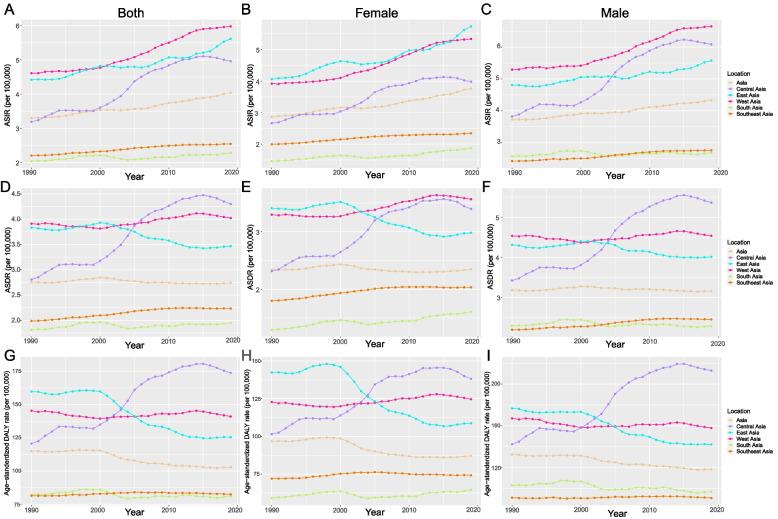
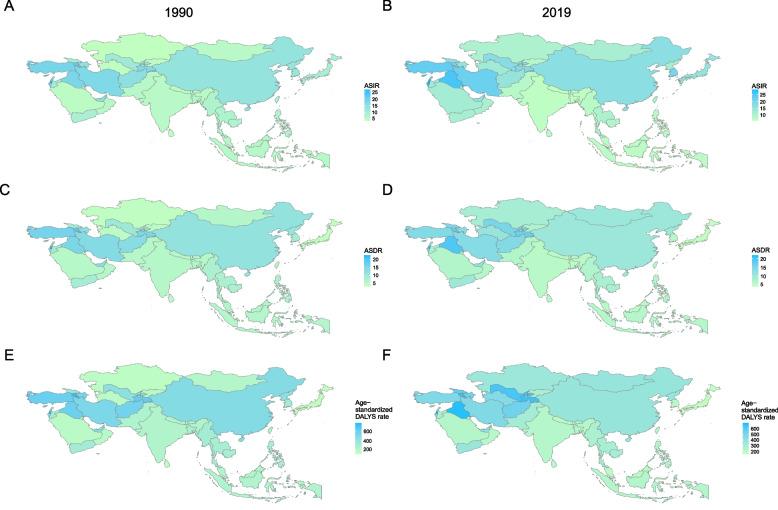
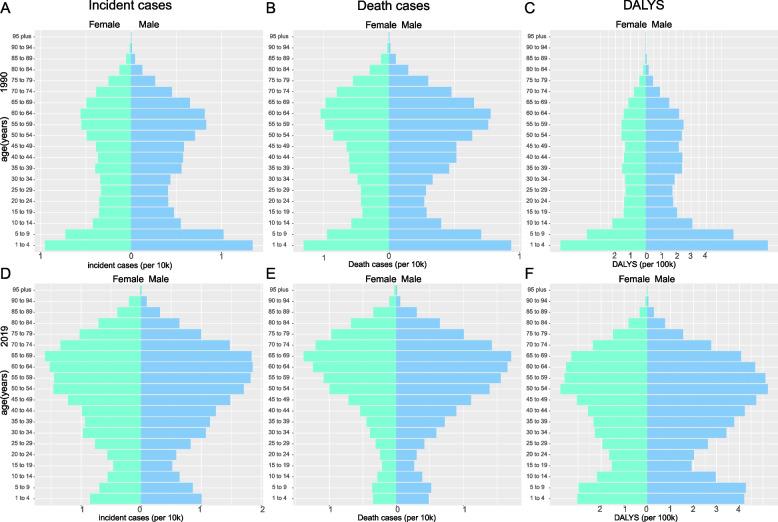
The incidence, death, and DALY rates of CNS cancers all increased from 1990 to 2019. The age-standardized incidence rate (ASIR) for CNS cancers increased from 9.89/100,000 in 1990 to 12.14/100,000 in 2019, with an EAPC of 0.69 (95% confidence interval (CI): 0.65, 0.73). The ASDR and the age-standardized DALY rate both decreased, with EAPCs of - 0.08 and - 0.52, respectively. Before 2005, the age-standardized DALY rate in East Asia was much greater in females than in males, while in Central Asia, the age-standardized death and DALY rates in males both increased sharply after 2000. In contrast to 1990, the caseload increased for the 55-70 years age group. The number of deaths decreased sharply among individuals aged younger than 20 years, especially in East Asia, accounting for only 5.41% of all deaths. The age group with the highest mortality rate was > 60 years, especially in Japan. The ASIR will continue to increase in Asia from 2020 to 2044, and the ASDR will gradually diminish. The incidence and number of deaths from CNS cancers in Asia are expected to increase over the next 25 years, especially among females.
CONCLUSIONS
The study identified an increasing trend in morbidity, mortality and disability-adjusted life-years (DALYs), with differences in age-standardized morbidity rates for different population groups. In addition, it is noteworthy that the burden of disease (as measured by disability-adjusted life-years (DALYs)) is higher among women in Central Asia compared with other regions. ASIR will continue to increase over the next 25 years, with the increase in female cases and mortality expected to be more pronounced. This may need to be further substantiated by additional research, on the basis of which health authorities and policymakers can better utilize limited resources and develop appropriate policies and preventive measures.
背景
原发性脑癌和中枢神经系统癌症(统称 CNS 癌症)给社会带来了重大负担。本研究旨在评估 1990 年至 2019 年期间 CNS 癌症负担的变化趋势,并预测未来 25 年的发病率、死亡率和相应人数,以帮助各国了解其发病率和死亡率的变化趋势,并做出更好的调整或制定政策和分配资源,从而减轻疾病负担。
方法
2019 年全球疾病负担研究提供了 1990 年至 2019 年亚洲的发病率、死亡率和残疾调整生命年(DALY)数据。为了反映年龄标准化发病率、死亡率和 DALY 率的变化趋势,确定了估计的年变化百分比(EAPC)。采用贝叶斯年龄-时期-队列(BAPC)模型预测未来 25 年 CNS 癌症的负担。
结果
CNS 癌症的发病率、死亡率和 DALY 率均从 1990 年至 2019 年增加。CNS 癌症的年龄标准化发病率(ASIR)从 1990 年的 9.89/100,000 上升至 2019 年的 12.14/100,000,EAPC 为 0.69(95%置信区间[CI]:0.65,0.73)。年龄标准化死亡率(ASDR)和年龄标准化 DALY 率均下降,EAPC 分别为-0.08 和-0.52。2005 年前,东亚女性的年龄标准化 DALY 率远高于男性,而中亚男性的年龄标准化死亡和 DALY 率在 2000 年后均急剧上升。与 1990 年相比,55-70 岁年龄组的病例数增加。20 岁以下人群的死亡人数急剧减少,尤其是在东亚,仅占所有死亡人数的 5.41%。死亡率最高的年龄组为>60 岁,尤其是在日本。2020 年至 2044 年,亚洲的 ASIR 将继续上升,ASDR 将逐渐下降。未来 25 年,亚洲 CNS 癌症的发病率和死亡人数预计将增加,尤其是女性。
结论
本研究发现发病率、死亡率和残疾调整生命年(DALYs)呈上升趋势,不同人群群体的年龄标准化发病率存在差异。此外,值得注意的是,中亚地区女性的疾病负担(以残疾调整生命年[DALYs]衡量)高于其他地区。未来 25 年,ASIR 将继续上升,女性病例和死亡率的增加预计更为明显。这可能需要进一步的研究来证实,在此基础上,卫生当局和政策制定者可以更好地利用有限的资源,并制定适当的政策和预防措施。




 Zotero 插件