
绿茶多酚(‒)-表没食子儿茶素没食子酸酯(EGCG)对控制炎症、氧化应激和细胞凋亡的分子途径的治疗作用。
Therapeutic Effects of Green Tea Polyphenol (‒)-Epigallocatechin-3-Gallate (EGCG) in Relation to Molecular Pathways Controlling Inflammation, Oxidative Stress, and Apoptosis.
机构信息
Department of Physiology, Jessenius Faculty of Medicine in Martin, Comenius University in Bratislava, SK-03601 Martin, Slovakia.
Department of Pharmacology, Jessenius Faculty of Medicine in Martin, Comenius University in Bratislava, SK-03601 Martin, Slovakia.
出版信息
Int J Mol Sci. 2022 Dec 25;24(1):340. doi: 10.3390/ijms24010340.
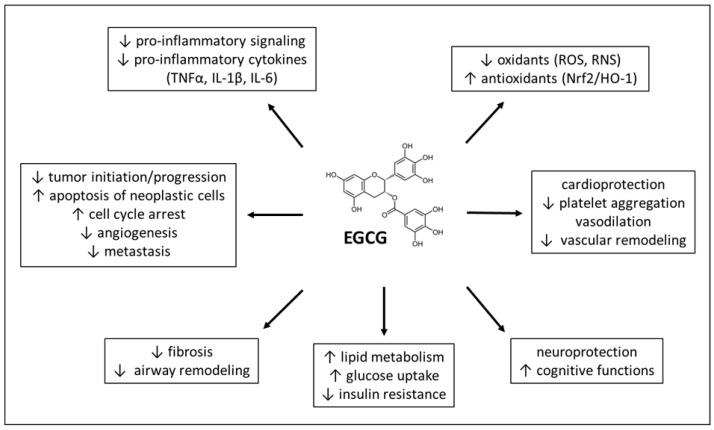
(‒)-Epigallocatechin-3-gallate (EGCG) is the most abundant polyphenol in green tea. Thanks to multiple interactions with cell surface receptors, intracellular signaling pathways, and nuclear transcription factors, EGCG possesses a wide variety of anti-inflammatory, antioxidant, antifibrotic, anti-remodelation, and tissue-protective properties which may be useful in the treatment of various diseases, particularly in cancer, and neurological, cardiovascular, respiratory, and metabolic disorders. This article reviews current information on the biological effects of EGCG in the above-mentioned disorders in relation to molecular pathways controlling inflammation, oxidative stress, and cell apoptosis.
(‒)-表没食子儿茶素没食子酸酯(EGCG)是绿茶中含量最丰富的多酚。由于与细胞表面受体、细胞内信号通路和核转录因子的多种相互作用,EGCG 具有广泛的抗炎、抗氧化、抗纤维化、抗重塑和组织保护特性,可能对治疗各种疾病有用,特别是癌症以及神经、心血管、呼吸和代谢紊乱。本文综述了 EGCG 在上述疾病中通过调控炎症、氧化应激和细胞凋亡的分子途径发挥生物学效应的最新信息。
 Zotero 插件