
基于铜死亡相关长链非编码RNA的肺腺癌分子分型及预后模型
Molecular typing and prognostic model of lung adenocarcinoma based on cuprotosis-related lncRNAs.
作者信息
Zheng Miaosen, Zhou Hao, Xie Jing, Zhang Haifeng, Shen Xiaojian, Zhu Dongbing
机构信息
Department of Pathology, The People's Hospital of Rugao, Rugao Hospital Affiliated to Nantong University, Rugao, China.
Department of Thoracic Surgery, Affiliated Hospital of Nantong University, Nantong, China.
出版信息
J Thorac Dis. 2022 Dec;14(12):4828-4845. doi: 10.21037/jtd-22-1534.
BACKGROUND
Previous research has shown the heterogeneity of lung adenocarcinoma (LUAD) accounts for the different effects and prognoses of the same treatment. Cuprotosis is a newly discovered form of programmed cell death involved in the development of tumors. Therefore, it is important to study the long non-coding RNAs (lncRNAs) that regulate cuprotosis to identify molecular subtypes and predict survival of LUAD.
METHODS
The expression profile, clinical, and mutation data of LUAD were downloaded from The Cancer Genome Atlas (TCGA), and the "ConsensusClusterPlus" package was used to cluster LUADs based on cuprotosis-related lncRNAs (CR-lncRNAs). The least absolute shrinkage and selection operator (LASSO) and multivariate Cox regression were used to construct a prognostic model. CIBERSORT and single-sample gene set enrichment analysis (ssGSEA) were used for assessing immune cells infiltration and immune function. The tumor microenvironment (TME) score was calculated by ESTIMATE, and the tumor mutational burden (TMB) and Tumor Immune Dysfunction and Exclusion (TIDE) were used to evaluate the efficacy of immunotherapy.
RESULTS
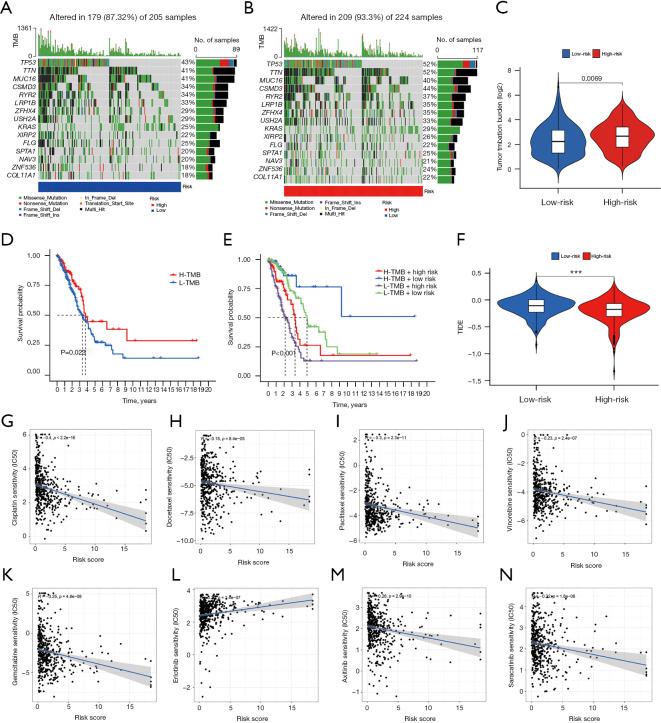
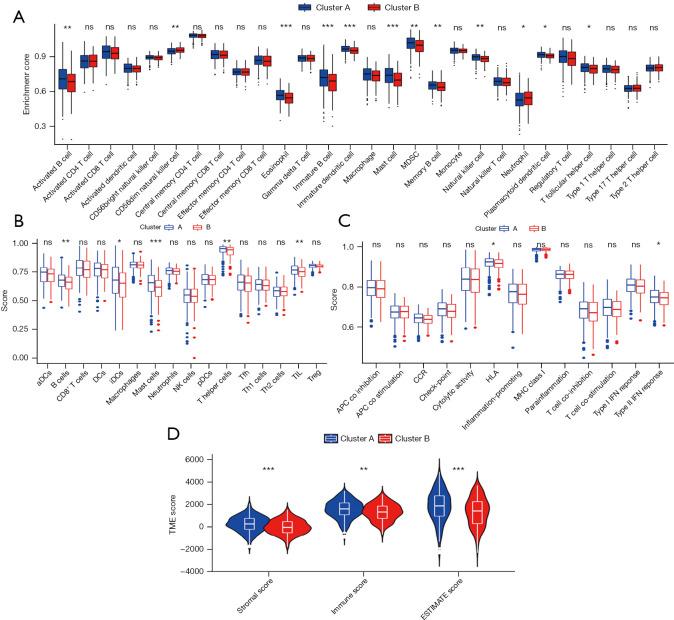
Firstly, 501 CR-lncRNAs were identified based on the co-expression relationship of 19 cuprotosis genes. And univariate Cox further obtained 34 prognosis-related CR-lncRNAs. The unsupervised consensus clustering divided LUAD samples into cluster A and cluster B, and showed cluster A had better prognosis, more immune cells infiltration, stronger immune function, and a higher TME score. Subsequently, we used Lasso Cox regression to construct a prognostic model, and univariate and multivariate Cox analyses showed the risk score could be an independent prognostic indicator. Immune cells infiltration, immune function, and TME score were increased markedly in the low-risk group, while TMB and TIDE suggested the efficacy of immunotherapy might be increased in high-risk group.
CONCLUSIONS
Our research identified two new molecular subtypes and constructed a novel prognostic model of LUAD which could provide new direction for its diagnosis, treatment, and prognosis.
背景
先前的研究表明,肺腺癌(LUAD)的异质性导致相同治疗产生不同的效果和预后。铜死亡是一种新发现的程序性细胞死亡形式,参与肿瘤的发生发展。因此,研究调控铜死亡的长链非编码RNA(lncRNA)对于识别LUAD的分子亚型和预测其生存情况具有重要意义。
方法
从癌症基因组图谱(TCGA)下载LUAD的表达谱、临床和突变数据,使用“ConsensusClusterPlus”软件包基于铜死亡相关lncRNA(CR-lncRNA)对LUAD进行聚类。采用最小绝对收缩和选择算子(LASSO)及多变量Cox回归构建预后模型。使用CIBERSORT和单样本基因集富集分析(ssGSEA)评估免疫细胞浸润和免疫功能。通过ESTIMATE计算肿瘤微环境(TME)评分,使用肿瘤突变负荷(TMB)和肿瘤免疫功能障碍与排除(TIDE)评估免疫治疗效果。
结果
首先,基于19个铜死亡基因的共表达关系鉴定出501个CR-lncRNA。单变量Cox分析进一步获得34个与预后相关的CR-lncRNA。无监督一致性聚类将LUAD样本分为A簇和B簇,结果显示A簇预后更好,免疫细胞浸润更多,免疫功能更强,TME评分更高。随后,我们使用Lasso Cox回归构建预后模型,单变量和多变量Cox分析表明风险评分可能是一个独立的预后指标。低风险组的免疫细胞浸润、免疫功能和TME评分显著增加,而TMB和TIDE提示高风险组免疫治疗效果可能增加。
结论
我们的研究识别出两种新的分子亚型,并构建了一种新的LUAD预后模型,可为其诊断、治疗和预后提供新的方向。




 Zotero 插件