
沉积和蛋白酶消化对抗菌肽涂层隐形眼镜体外活性的影响。
Effect of Deposition and Protease Digestion on the Ex Vivo Activity of Antimicrobial Peptide-Coated Contact Lenses.
作者信息
Kalaiselvan Parthasarathi, Dutta Debarun, Konda Nagaraju V, Sharma Savitri, Kumar Naresh, Stapleton Fiona, Willcox Mark D P
机构信息
School of Optometry and Vision Science, UNSW Sydney, Sydney, NSW 2052, Australia.
School of Optometry, Aston University, Birmingham B4 7ET, UK.
出版信息
Nanomaterials (Basel). 2023 Jan 14;13(2):349. doi: 10.3390/nano13020349.
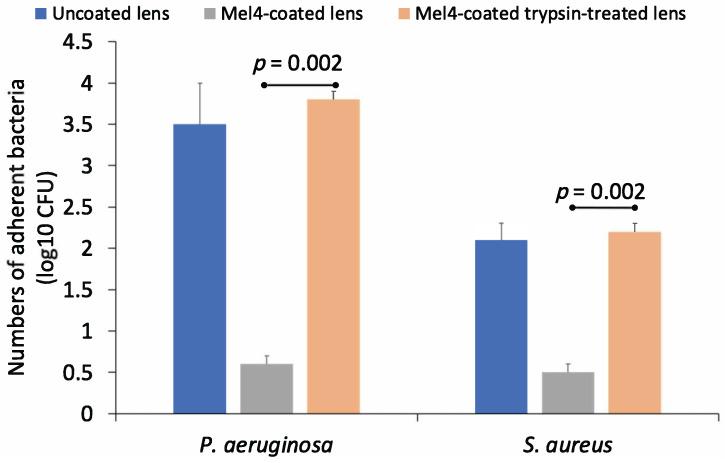
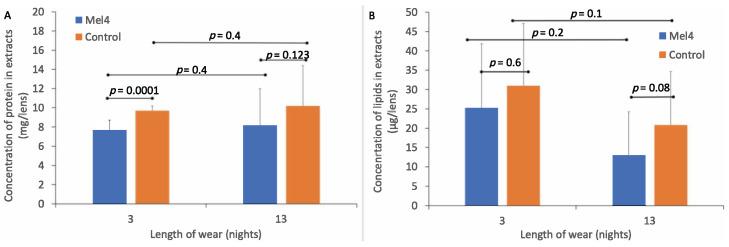
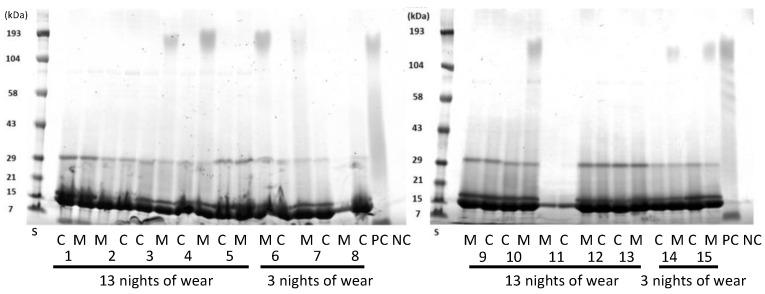
A clinical study of antimicrobial contact lenses containing the cationic peptide Mel4 was conducted. The few adverse events that occurred with this lens occurred on or after 13 nights of wear. The current study examined whether the Mel4 contact lenses lost activity during wear and the mechanism of this loss. Participants wore contact lenses for up to 13 nights. Lenses were tested for their ability to reduce the adhesion of and . The amount of protein and lipid extracted from lenses was measured. The ability of trypsin to affect the antimicrobial activity of Mel4-coated contact lenses was measured. Mel4-coated contact lenses lost their antimicrobial activity at six nights of wear for both bacteria. The amount of lipids (13 ± 11 vs. 21 ± 14 μg/lens at 13 nights wear) and proteins (8 ± 4 vs. 10 ± 3 mg/lens at 13 nights of wear) extracted from lenses was not different between Mel4-coated and uncoated lenses, and was not different after three nights when antimicrobial activity was maintained and thirteen nights when they had lost activity (lipid: 25 ± 17 vs. 13 ± 11, = 0.2; protein: 8 ± 1 vs. 8 ± 4 mg/lens, = 0.4). Trypsin digestion eliminated the antimicrobial activity of Mel4-coated lenses. In summary, Mel4-coated contact lenses lost antibacterial activity at six nights of wear, and the most likely reason was proteolytic digestion of the peptide. Future studies will design and test proteolytically stable peptide mimics as coatings for contact lenses.
开展了一项关于含有阳离子肽Mel4的抗菌隐形眼镜的临床研究。使用这种隐形眼镜时出现的少数不良事件发生在佩戴13晚及之后。本研究调查了Mel4隐形眼镜在佩戴过程中是否会丧失活性以及这种丧失的机制。参与者佩戴隐形眼镜长达13晚。测试镜片减少[具体细菌名称1]和[具体细菌名称2]黏附的能力。测量从镜片中提取的蛋白质和脂质的量。测定胰蛋白酶对Mel4涂层隐形眼镜抗菌活性的影响。对于两种细菌,Mel4涂层隐形眼镜在佩戴6晚时丧失其抗菌活性。从Mel4涂层镜片和未涂层镜片中提取的脂质量(佩戴13晚时为13±11 vs. 21±14μg/镜片)和蛋白质量(佩戴13晚时为8±4 vs. 10±3mg/镜片)没有差异,在抗菌活性保持的3晚后和活性丧失的13晚后也没有差异(脂质:25±17 vs. 13±11,P = 0.2;蛋白质:8±1 vs. 8±4mg/镜片,P = 0.4)。胰蛋白酶消化消除了Mel4涂层镜片的抗菌活性。总之,Mel4涂层隐形眼镜在佩戴6晚时丧失抗菌活性,最可能的原因是肽的蛋白水解消化。未来的研究将设计并测试蛋白水解稳定的肽模拟物作为隐形眼镜的涂层。

 Zotero 插件