
保护骨科植入物免受感染:抗菌肽 Mel4 与经等离子体离子注入 3D 打印 PAEK 聚合物结合时,对骨细胞无毒,且能减少细菌定植。
Protecting Orthopaedic Implants from Infection: Antimicrobial Peptide Mel4 Is Non-Toxic to Bone Cells and Reduces Bacterial Colonisation When Bound to Plasma Ion-Implanted 3D-Printed PAEK Polymers.
机构信息
Arto Hardy Family Biomedical Innovation Hub, Chris O'Brien Lifehouse, Missenden Road, Camperdown, Sydney, NSW 2050, Australia.
School of Physics, The University of Sydney, Sydney, NSW 2006, Australia.
出版信息
Cells. 2024 Apr 9;13(8):656. doi: 10.3390/cells13080656.
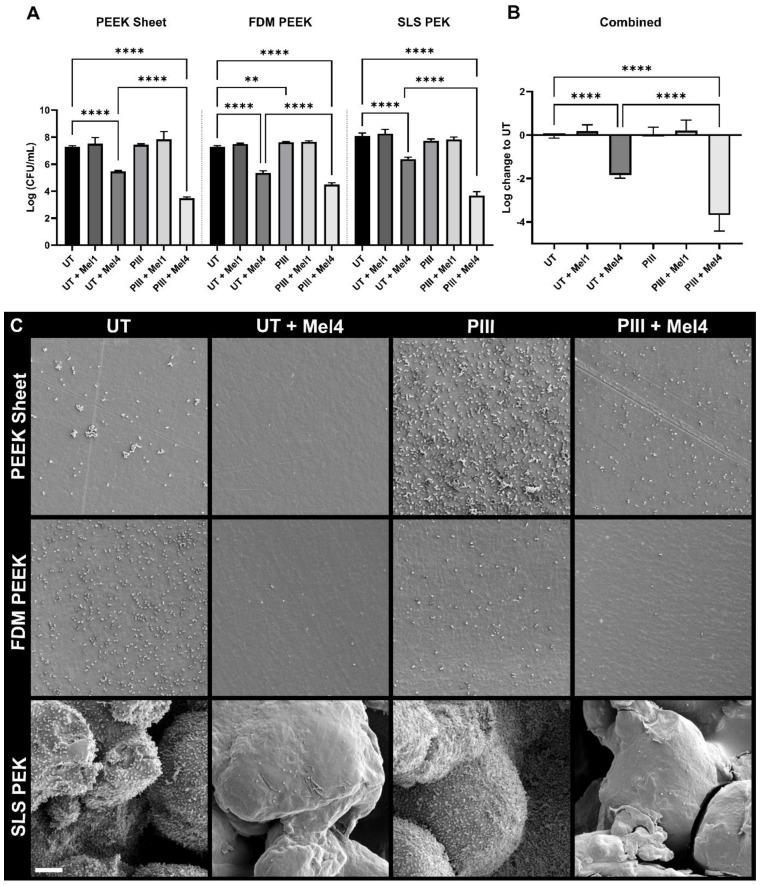
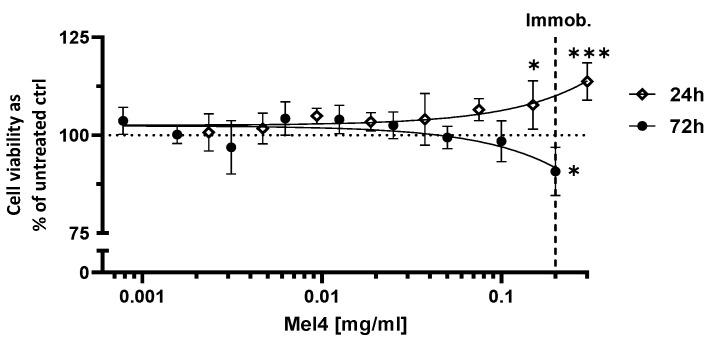
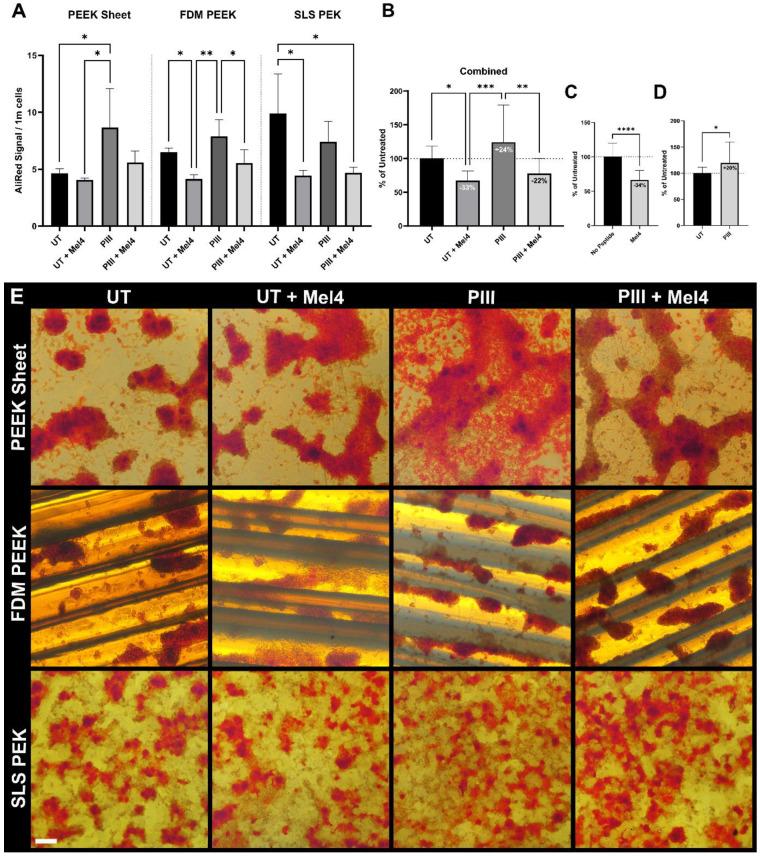
Even with the best infection control protocols in place, the risk of a hospital-acquired infection of the surface of an implanted device remains significant. A bacterial biofilm can form and has the potential to escape the host immune system and develop resistance to conventional antibiotics, ultimately causing the implant to fail, seriously impacting patient well-being. Here, we demonstrate a 4 log reduction in the infection rate by the common pathogen of 3D-printed polyaryl ether ketone (PAEK) polymeric surfaces by covalently binding the antimicrobial peptide Mel4 to the surface using plasma immersion ion implantation (PIII) treatment. The surfaces with added texture created by 3D-printed processes such as fused deposition-modelled polyether ether ketone (PEEK) and selective laser-sintered polyether ketone (PEK) can be equally well protected as conventionally manufactured materials. Unbound Mel4 in solution at relevant concentrations is non-cytotoxic to osteoblastic cell line Saos-2. Mel4 in combination with PIII aids Saos-2 cells to attach to the surface, increasing the adhesion by 88% compared to untreated materials without Mel4. A reduction in mineralisation on the Mel4-containing surfaces relative to surfaces without peptide was found, attributed to the acellular portion of mineral deposition.
即使采用了最好的感染控制方案,植入设备表面的医院获得性感染风险仍然很大。细菌生物膜可以形成,并且有可能逃避宿主免疫系统并对常规抗生素产生耐药性,最终导致植入物失效,严重影响患者的健康。在这里,我们通过等离子体浸没离子注入(PIII)处理,将抗菌肽 Mel4 共价结合到表面上,证明了常见病原体 3D 打印聚芳醚酮(PAEK)聚合物表面的感染率降低了 4 个对数级。通过 3D 打印工艺(如熔丝沉积成型聚醚醚酮(PEEK)和选择性激光烧结聚醚酮(PEK))创建的具有附加纹理的表面可以像传统制造材料一样得到同等保护。在相关浓度下,溶液中未结合的 Mel4 对成骨细胞系 Saos-2 无细胞毒性。Mel4 与 PIII 结合有助于 Saos-2 细胞附着到表面,与不含 Mel4 的未处理材料相比,粘附率增加了 88%。发现在含有 Mel4 的表面上的矿化减少相对于没有肽的表面,这归因于细胞外部分的矿化沉积。





 Zotero 插件