
基于网络的辅助生殖技术在线应用指导(myFertiCare):应用 HOT-fit 框架的定量评估。
Web-based Guidance for Assisted Reproductive Technology With an Online App (myFertiCare): Quantitative Evaluation With the HOT-fit Framework.
机构信息
Department of Obstetrics and Gynaecology, Radboud University Nijmegen Medical Centre, Nijmegen, Netherlands.
Department of Dermatology, Maastricht University Medical Center, Maastricht, Netherlands.
出版信息
J Med Internet Res. 2023 Jan 24;25:e38535. doi: 10.2196/38535.
BACKGROUND
Assisted reproductive technologies (ARTs) are considered to be physically and mentally stressful. During their treatment trajectory, couples express high information and communication needs. They appreciate using the internet to obtain fertility-related information. In a previous study, we developed myFertiCare, an eHealth tool providing personalized information and interactive functionalities for infertile couples in order to improve patient-centered care. The app has already been successful in qualitative evaluations of usability.
OBJECTIVE
The aim of the current study is to quantitatively evaluate the implementation of myFertiCare by using the human, organizational, and technology-fit (HOT-fit) framework and to study the effects of using myFertiCare on couples' knowledge about infertility, their experience of the burden of infertility, and their experience of patient-centered care. With these results, implementation can be further improved, and patient-centered care can be enhanced.
METHODS
A quantitative study was performed based on the HOT-fit framework using validated questionnaires focusing on the human, organizational, and technology domains. Questions were added on the effect of using myFertiCare on couples' knowledge about infertility and treatment. Questions regarding the burden of infertility, the burden of infertility treatment, and the experience of patient-centeredness were based on the main items of the validated fertility quality of life (FertiQoL) and Patient-Centredness Questionnaire-Infertility questionnaires, respectively. Also, nonusers of the app were included to explore motivations for not using the app and identify opportunities for improvement. Finally, user data were analyzed to provide insight into multiple variables concerning app use.
RESULTS
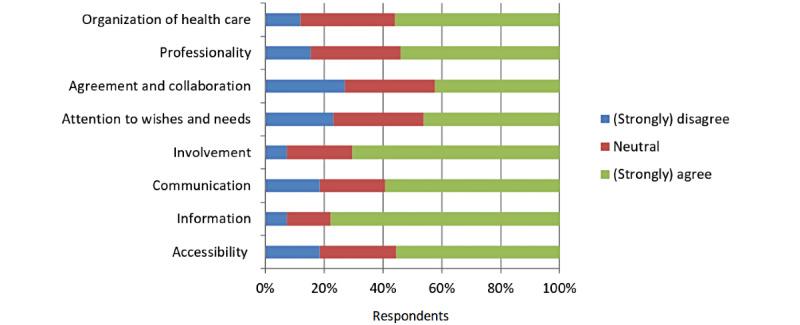
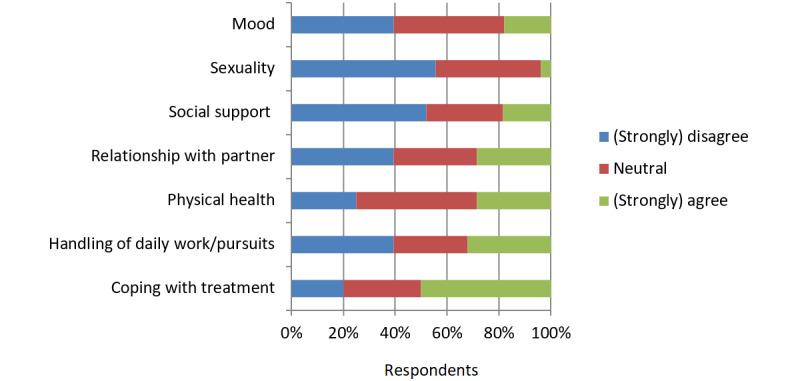
In the human and technology domains, myFertiCare showed good system usability, high user satisfaction, and high information and interface quality. In the organizational domain, implementation was considered to be sufficient by both patients and staff. Use of the app increased knowledge about the treatment, improved coping with the treatment, and enhanced the experience of patient-centeredness. User data showed that women were the main app users and that use of the app gradually declined during the treatment trajectory.
CONCLUSIONS
A multi-faceted online app, myFertiCare, has been successfully evaluated quantitatively for implementation by using the HOT-fit framework. Use of the app increased knowledge about the treatment, improved coping with the treatment, and enhanced the experience of patient-centeredness. App use could be improved by creating more publicity. By providing myFertiCare, professionals in fertility care are supported in guiding patients through their treatment trajectory and in delivering patient-centered care.
背景
辅助生殖技术(ART)被认为会给人带来身心压力。在治疗过程中,夫妇表达了对信息和沟通的高度需求。他们喜欢利用互联网获取与生育能力相关的信息。在之前的研究中,我们开发了 myFertiCare,这是一种电子健康工具,为不孕夫妇提供个性化信息和交互功能,以改善以患者为中心的护理。该应用程序已经在可用性的定性评估中取得了成功。
目的
本研究的目的是使用人类、组织和技术适配(HOT-fit)框架定量评估 myFertiCare 的实施情况,并研究使用 myFertiCare 对夫妇不孕知识、不孕负担体验以及以患者为中心的护理体验的影响。有了这些结果,可以进一步改进实施,并加强以患者为中心的护理。
方法
基于 HOT-fit 框架进行了一项定量研究,使用了针对人类、组织和技术领域的经过验证的问卷。问题集中在使用 myFertiCare 对夫妇不孕知识和治疗的影响上。关于不孕负担、不孕治疗负担和以患者为中心的体验的问题分别基于经过验证的生育质量(FertiQoL)和以患者为中心的不孕问卷的主要项目。此外,还包括非应用程序用户,以探索不使用应用程序的动机,并确定改进的机会。最后,对用户数据进行了分析,以提供有关应用程序使用的多个变量的见解。
结果
在人类和技术领域,myFertiCare 表现出良好的系统可用性、高用户满意度和高信息及界面质量。在组织领域,患者和工作人员都认为实施情况足够。使用该应用程序增加了对治疗的了解,改善了对治疗的应对能力,并增强了以患者为中心的体验。用户数据显示,女性是应用程序的主要使用者,并且在治疗过程中,应用程序的使用逐渐减少。
结论
一种多方面的在线应用程序 myFertiCare 已成功使用 HOT-fit 框架进行了定量实施评估。使用该应用程序增加了对治疗的了解,改善了对治疗的应对能力,并增强了以患者为中心的体验。通过增加更多宣传,可以改进应用程序的使用。通过提供 myFertiCare,生育护理专业人员可以在指导患者完成治疗过程和提供以患者为中心的护理方面得到支持。
 Zotero 插件