
即食谷物是一种经济实惠的早餐选择,在美国人群中,它与更好的营养摄入和饮食质量相关。
Ready-to-eat cereal is an affordable breakfast option associated with better nutrient intake and diet quality in the US population.
作者信息
Zhu Yong, Jain Neha, Normington James, Holschuh Norton, Sanders Lisa M
机构信息
Bell Institute of Health and Nutrition, General Mills, Golden Valley, MN, United States.
Statistics and Data Science, General Mills, Mississauga, ON, Canada.
出版信息
Front Nutr. 2023 Jan 9;9:1088080. doi: 10.3389/fnut.2022.1088080. eCollection 2022.
BACKGROUND
Results from observational studies have reported ready-to-eat cereal (RTEC) consumers have higher dietary quality and nutrient intake compared to consumers of non-RTEC breakfasts or those who do not eat breakfast. Yet, there have been few investigations on the relationship of RTEC to meal costs at breakfast and across the day, which may be one reason some consumers choose to not consume breakfast.
OBJECTIVE
The objective of this study is to evaluate the contribution of RTEC consumed at breakfast to nutrient intake and adequacy, diet quality and meal costs in a nationally representative sample of children and adults in the US.
METHODS
Dietary data from 2,259 children (2-18 years) and 4,776 adults (≥19 years) in the National Health and Nutrition Examination Survey (NHANES) 2017-2018 were evaluated to compare nutrient intake, adequacy, dietary quality, and food costs in RTEC breakfast consumers, non-RTEC breakfast consumers and those who did not consume breakfast.
RESULTS
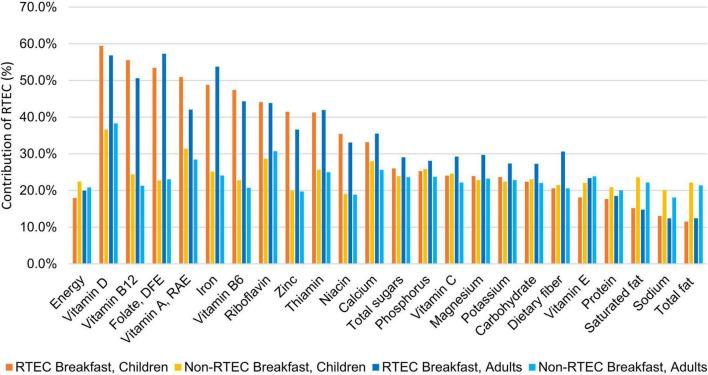
RTEC breakfast consumers made up 28% of children and 12% of adults. Children and adults consuming RTEC for breakfast had higher intakes of carbohydrate, dietary fiber, calcium, magnesium, iron, zinc, phosphorus, potassium, B vitamins, vitamins A and D, whole grains, and total dairy compared to consumers of non-RTEC breakfast or no breakfast. There were no differences by breakfast status for sodium, saturated fat, or added sugar, except adults consuming RTEC had lower added sugar intake compared to those who did not consume breakfast. RTEC breakfast consumers were also more likely to meet estimated average requirements (EAR) for intake of several nutrients and had overall higher dietary quality. For children, breakfast meal costs were less for RTEC breakfast compared to non-RTEC breakfast, but total daily meal costs were similar for consumers of RTEC and non-RTEC breakfasts.
CONCLUSION
RTEC breakfasts may contribute to greater nutrient intake and diet quality in children and adults in the US without increasing total daily meal costs.
背景
观察性研究结果表明,与非即食谷物早餐消费者或不吃早餐的人相比,即食谷物(RTEC)消费者的饮食质量和营养摄入量更高。然而,关于RTEC与早餐及全天餐食成本之间关系的研究较少,这可能是一些消费者选择不吃早餐的原因之一。
目的
本研究的目的是评估在美国具有全国代表性的儿童和成人样本中,早餐食用RTEC对营养摄入与充足性、饮食质量和餐食成本的贡献。
方法
对2017 - 2018年美国国家健康与营养检查调查(NHANES)中2259名儿童(2 - 18岁)和4776名成人(≥19岁)的饮食数据进行评估,以比较RTEC早餐消费者、非RTEC早餐消费者和不吃早餐者的营养摄入、充足性、饮食质量和食物成本。
结果
RTEC早餐消费者占儿童的28%,占成人的12%。与非RTEC早餐消费者或不吃早餐者相比,早餐食用RTEC的儿童和成人碳水化合物、膳食纤维、钙、镁、铁、锌、磷、钾、B族维生素、维生素A和D、全谷物以及总乳制品的摄入量更高。早餐状态对钠、饱和脂肪或添加糖的摄入量没有差异,不过与不吃早餐的成人相比,食用RTEC的成人添加糖摄入量更低。RTEC早餐消费者也更有可能满足几种营养素摄入的估计平均需求量(EAR),并且总体饮食质量更高。对于儿童,RTEC早餐的早餐餐食成本低于非RTEC早餐,但RTEC和非RTEC早餐消费者的每日总餐食成本相似。
结论
在美国,RTEC早餐可能有助于儿童和成人增加营养摄入和提高饮食质量,而不会增加每日总餐食成本。

 Zotero 插件