
即食谷物的消费与加拿大各收入水平的成年人和儿童改善营养素摄入量及饮食质量有关。
Ready-to-eat cereal consumption is associated with improved nutrient intakes and diet quality in Canadian adults and children across income levels.
作者信息
Sanders Lisa M, Zhu Yong, Jain Neha, Normington James, Holschuh Norton, Nechanicky Megan, Tucker Michelle, Garcia-Bailo Bibiana
机构信息
Cornerstone Nutrition, LLC, Battle Creek, MI, United States.
Bell Institute of Health and Nutrition, General Mills, Golden Valley, MN, United States.
出版信息
Front Nutr. 2024 Jan 8;10:1282252. doi: 10.3389/fnut.2023.1282252. eCollection 2023.
BACKGROUND
Results from observational studies suggest ready-to-eat cereal (RTEC) consumption is associated with higher diet quality. In the United States, studies have shown that RTEC is an important contributor to nutrient intakes across income levels. However, it is unknown if this association varies by income level in the Canadian population. Given its affordability, RTEC may represent an important source of nutrients for lower-income individuals.
OBJECTIVE
This study evaluated the association of RTEC consumption with nutrient intakes and diet quality across household income levels in Canadian adults and children.
METHODS
Income and dietary data from 24 h dietary recalls were obtained from the 2015 Canadian Community Health Survey (CCHS)-Nutrition in 6,181 children (2-18 years) and 13,908 adults (19+ years). Diet quality was assessed with a modified Nutrient Rich Food Index (NRF) 9.3. Income levels were stratified into low, middle, and high based on family size, and data were analyzed by RTEC consumption and income level using multivariate linear regression adjusted for energy, age, and sex.
RESULTS
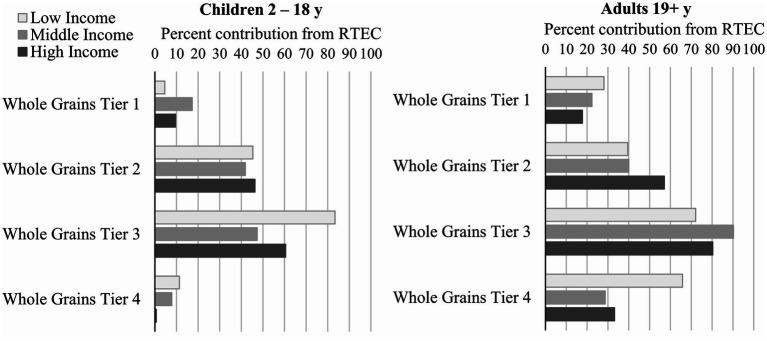
Diet quality was greater in adult and child RTEC consumers across all household income levels. Children and adults consuming RTEC also had higher nutrient intakes, including shortfall nutrients such as calcium, dietary fiber, iron, magnesium, and vitamin D. RTEC provided <10% of energy intake, <4% of saturated fat intake, and <9% of total sugar intake across all ages and income levels, while also providing one-third of daily iron intake and at least 10% of daily intake of dietary fiber, thiamin, folate, and vitamin B6.
CONCLUSION
RTEC consumption was associated with improved nutrient intakes and diet quality in adults and children across household income levels. Nutrient dense and affordable food choices, such as RTEC, may be a helpful strategy to improve the diet quality of Canadians, particularly those with a lower household income.
背景
观察性研究结果表明,食用即食谷物(RTEC)与更高的饮食质量相关。在美国,研究表明RTEC是不同收入水平人群营养素摄入的重要贡献者。然而,在加拿大人群中,这种关联是否因收入水平而异尚不清楚。鉴于其可承受性,RTEC可能是低收入个体重要的营养素来源。
目的
本研究评估了加拿大成年人和儿童中,食用RTEC与不同家庭收入水平下的营养素摄入和饮食质量之间的关联。
方法
通过2015年加拿大社区健康调查(CCHS)-营养模块中的24小时饮食回顾,获取了6181名儿童(2至18岁)和13908名成年人(19岁及以上)的收入和饮食数据。使用改良的营养丰富食物指数(NRF)9.3评估饮食质量。根据家庭规模将收入水平分为低、中、高三个层次,并通过多元线性回归分析食用RTEC和收入水平与能量、年龄和性别的关系。
结果
在所有家庭收入水平中,食用RTEC的成年人和儿童的饮食质量更高。食用RTEC的儿童和成年人也有更高的营养素摄入量,包括钙、膳食纤维、铁、镁和维生素D等缺乏的营养素。在所有年龄和收入水平中,RTEC提供的能量摄入量<10%,饱和脂肪摄入量<4%,总糖摄入量<9%,同时还提供了三分之一的每日铁摄入量以及至少10%的膳食纤维、硫胺素、叶酸和维生素B6的每日摄入量。
结论
在不同家庭收入水平的成年人和儿童中,食用RTEC与营养素摄入量增加和饮食质量改善相关。营养丰富且价格实惠的食物选择,如RTEC,可能是提高加拿大人饮食质量的有益策略,尤其是那些家庭收入较低的人群。


 Zotero 插件