
噬菌体鸡尾酒、双受体通才噬菌体和协同进化训练噬菌体对细菌抑制作用的比较。
Comparison of bacterial suppression by phage cocktails, dual-receptor generalists, and coevolutionarily trained phages.
作者信息
Borin Joshua M, Lee Justin J, Gerbino Krista R, Meyer Justin R
机构信息
Division of Biological Sciences University of California San Diego La Jolla California USA.
出版信息
Evol Appl. 2022 Dec 9;16(1):152-162. doi: 10.1111/eva.13518. eCollection 2023 Jan.
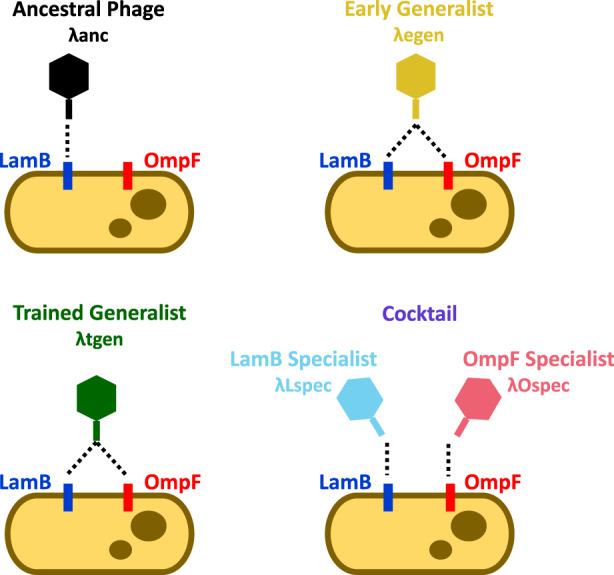
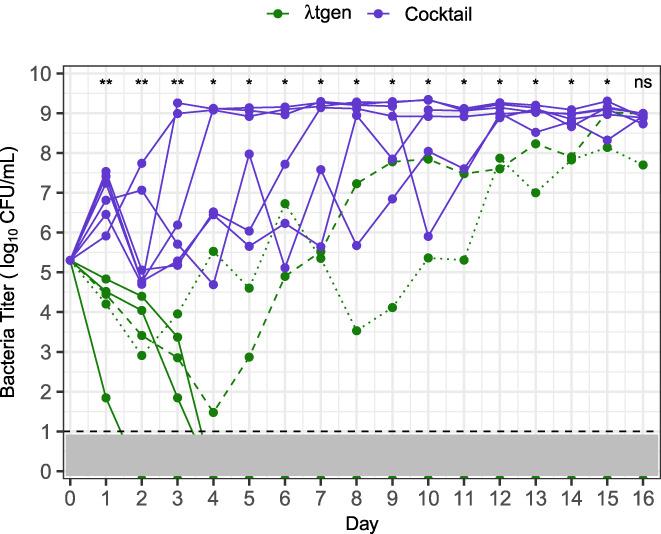
The evolution and spread of antibiotic-resistant bacteria have renewed interest in phage therapy, the use of bacterial viruses (phages) to combat bacterial infections. The delivery of phages in cocktails where constituent phages target different modalities (e.g., receptors) may improve treatment outcomes by making it more difficult for bacteria to evolve resistance. However, the multipartite nature of cocktails may lead to unintended evolutionary and ecological outcomes. Here, we compare a 2-phage cocktail with a largely unconsidered group of phages: generalists that can infect through multiple, independent receptors. We find that λ phage generalists and cocktails that target the same receptors (LamB and OmpF) suppress similarly for ~2 days. Yet, a "trained" generalist phage, which previously adapted to its host via 28 days of coevolution, demonstrated superior suppression. To understand why the trained generalist was more effective, we measured the resistance of bacteria against each of our phages. We find that, when bacteria were assailed by two phages in the cocktail, they evolved mutations in , a host inner-membrane transporter that λ uses to move its DNA across the periplasmic space and into the cell for infection. This provided cross-resistance against the cocktail and untrained generalist. However, these mutations were ineffective at blocking the trained generalist because, through coevolutionary training, it evolved to bypass resistance. The trained generalist's past experiences in training make it exceedingly difficult for bacteria to evolve resistance, further demonstrating the utility of coevolutionary phage training for improving the therapeutic properties of phages.
抗生素耐药细菌的演变和传播重新引发了人们对噬菌体疗法的兴趣,即利用细菌病毒(噬菌体)来对抗细菌感染。在组合疗法中递送噬菌体,其中组成噬菌体靶向不同的方式(例如受体),可能会使细菌更难产生耐药性,从而改善治疗效果。然而,组合疗法的多部分性质可能会导致意想不到的进化和生态结果。在这里,我们将一种双噬菌体组合疗法与一组很大程度上未被考虑的噬菌体进行比较:即能够通过多个独立受体进行感染的泛菌噬菌体。我们发现,λ泛菌噬菌体和靶向相同受体(LamB和OmpF)的组合疗法在约2天内的抑制效果相似。然而,一种“经过训练的”泛菌噬菌体,它之前通过28天的共同进化适应了其宿主,表现出了更强的抑制作用。为了理解为什么经过训练的泛菌噬菌体更有效,我们测量了细菌对我们每种噬菌体的抗性。我们发现,当细菌受到组合疗法中的两种噬菌体攻击时,它们在 中发生了突变, 是一种宿主内膜转运蛋白,λ噬菌体利用它将其DNA穿过周质空间并进入细胞进行感染。这提供了对组合疗法和未经训练的泛菌噬菌体的交叉抗性。然而,这些突变在阻断经过训练的泛菌噬菌体方面无效,因为通过共同进化训练,它进化出了绕过 抗性的能力。经过训练的泛菌噬菌体过去的训练经历使得细菌极难产生抗性,这进一步证明了共同进化噬菌体训练在改善噬菌体治疗特性方面的效用。




 Zotero 插件