
患有急性呼吸窘迫综合征的免疫功能低下儿童具有独特的循环炎症特征。
Immunocompromised Children With Acute Respiratory Distress Syndrome Possess a Distinct Circulating Inflammatory Profile.
作者信息
Nguyen John, Thompson Jill M, Balcarcel Daniel R, Alder Matthew N, McKeone Daniel J, Halstead E Scott, Rowan Courtney M, Lindell Robert B, Yehya Nadir
机构信息
Division of Critical Care Medicine, Department of Anesthesiology and Critical Care, Children's Hospital of Philadelphia and University of Pennsylvania, Philadelphia, PA.
Division of Critical Care Medicine, Department of Pediatrics, Cincinnati Children's Hospital Medical Center and University of Cincinnati College of Medicine, Cincinnati, OH.
出版信息
Crit Care Explor. 2023 Jan 6;5(1):e0844. doi: 10.1097/CCE.0000000000000844. eCollection 2023 Jan.
UNLABELLED
Immunocompromised status, with and without stem cell transplant, confers a worse prognosis in pediatric acute respiratory distress syndrome. An improved understanding of the biochemical profile of immunocompromised children with acute respiratory distress syndrome would inform whether specific pathways are targetable, or merely bystanders, in order to improve outcomes in this high-risk subgroup.
OBJECTIVES
We aimed to identify a biomarker profile of immunocompromised children, with and without stem cell transplant, independent of illness severity.
DESIGN SETTINGS AND PARTICIPANTS
This was a secondary analysis of a prospective cohort study of intubated children with Berlin-defined acute respiratory distress syndrome with existing biomarker measurements conducted in a large academic PICU between 2014 and 2019.
MAIN OUTCOMES AND MEASURES
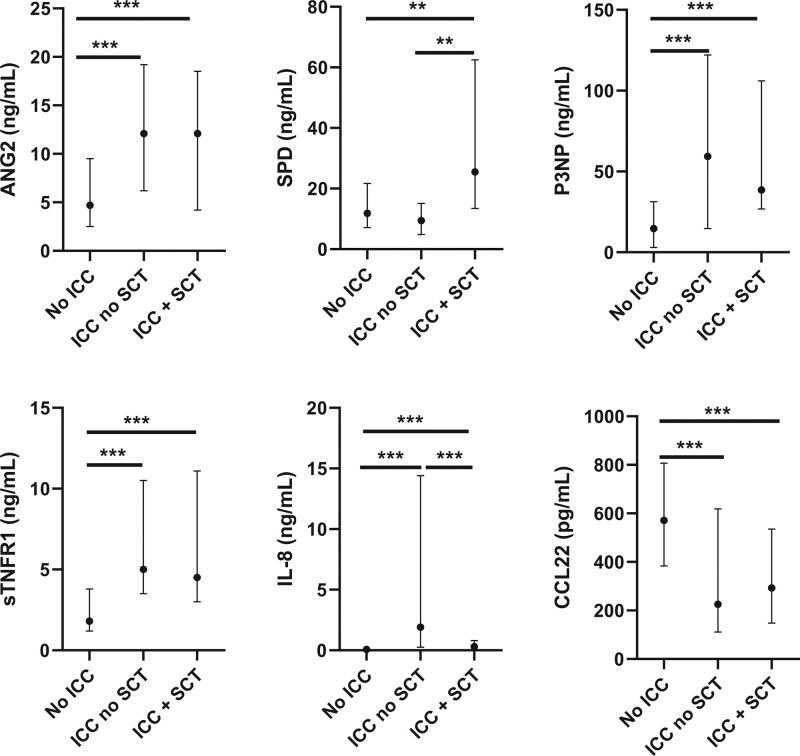
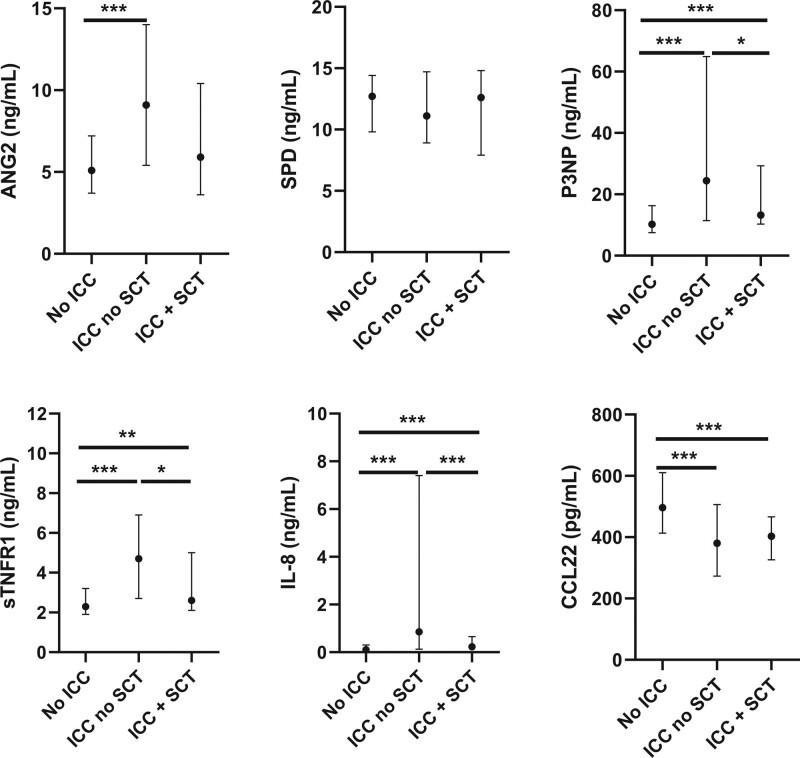
Biomarker levels were compared between immunocompetent and immunocompromised children, with and without stem cell transplant, both prior to and after adjusting for severity of illness.
RESULTS
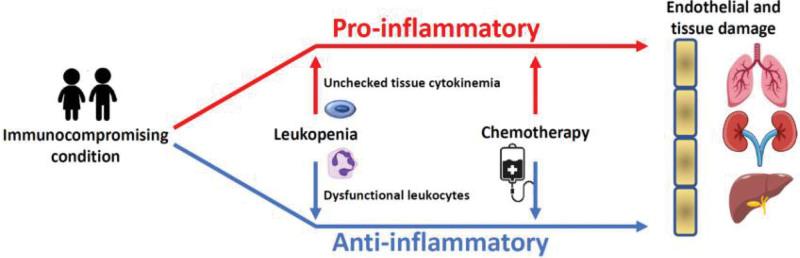
In 333 children with acute respiratory distress syndrome, 84 were immunocompromised, of whom 39 had a stem cell transplant. Circulating neutrophil levels were strongly correlated with biomarkers, with 14 of 18 measured proteins differentially expressed in patients with versus without neutropenia. In order to identify biomarker levels independent of severity of illness, acute respiratory distress syndrome etiology, and neutrophil levels, we computed predicted (log-transformed) biomarker levels after adjusting for confounders using linear regression and then compared these severity-adjusted levels between immunocompetent and immunocompromised (with and without stem cell transplant) subjects using analyses of variance and post hoc Bonferroni. After multivariable adjustment, 11 biomarkers were higher in immunocompromised subjects without stem cell transplant, relative to immunocompetent, implicating endotheliopathy (angiopoietin-2), tissue damage (procollagen type III N-terminal peptide), and innate immunity. A single biomarker, C-C motif chemokine ligand 22, was lower in immunocompromised subjects with and without stem cell transplant.
CONCLUSIONS AND RELEVANCE
Immunocompromised children with acute respiratory distress syndrome were characterized by elevations in pro-inflammatory and endothelial damage biomarkers. Our study provides insight into mechanisms underlying the molecular heterogeneity of this population and potentially identifies targetable pathways to mitigate their increased mortality risk.
未标注
免疫功能低下状态,无论是否进行干细胞移植,在儿童急性呼吸窘迫综合征中预后均较差。更好地了解免疫功能低下的急性呼吸窘迫综合征患儿的生化特征,将有助于明确特定途径是可靶向的,还是仅仅是旁观者,以改善这一高危亚组的预后。
目的
我们旨在确定免疫功能低下的儿童(无论是否进行干细胞移植)独立于疾病严重程度的生物标志物谱。
设计、设置和参与者:这是一项对2014年至2019年在一家大型学术性儿科重症监护病房对符合柏林定义的急性呼吸窘迫综合征且已有生物标志物测量值的插管儿童进行的前瞻性队列研究的二次分析。
主要结局和测量指标
在调整疾病严重程度之前和之后,比较免疫功能正常和免疫功能低下的儿童(无论是否进行干细胞移植)的生物标志物水平。
结果
在333例急性呼吸窘迫综合征患儿中,84例免疫功能低下,其中39例进行了干细胞移植。循环中性粒细胞水平与生物标志物密切相关,18种检测蛋白中有14种在有或无中性粒细胞减少症的患者中差异表达。为了确定独立于疾病严重程度、急性呼吸窘迫综合征病因和中性粒细胞水平的生物标志物水平,我们使用线性回归调整混杂因素后计算预测(对数转换)生物标志物水平,然后使用方差分析和事后Bonferroni比较免疫功能正常和免疫功能低下(无论是否进行干细胞移植)受试者之间这些经严重程度调整后的水平。多变量调整后,11种生物标志物在未进行干细胞移植的免疫功能低下受试者中相对于免疫功能正常者更高,提示存在内皮病变(血管生成素-2)、组织损伤(III型前胶原N端肽)和固有免疫。单一生物标志物C-C基序趋化因子配体22在有和没有干细胞移植的免疫功能低下受试者中均较低。
结论及相关性
免疫功能低下的急性呼吸窘迫综合征患儿的特征是促炎和内皮损伤生物标志物升高。我们的研究深入了解了该人群分子异质性的潜在机制,并可能确定可减轻其增加的死亡风险的靶向途径。
 Zotero 插件