
实验性自身免疫性脑脊髓炎小鼠中具有过氧化氢酶活性的自身抗体-Abzymes。
Autoantibody-Abzymes with Catalase Activity in Experimental Autoimmune Encephalomyelitis Mice.
机构信息
Institute of Chemical Biology and Fundamental Medicine, SB of the Russian Academy of Sciences, Lavrentiev Ave., 8, Novosibirsk 630090, Russia.
出版信息
Molecules. 2023 Jan 30;28(3):1330. doi: 10.3390/molecules28031330.
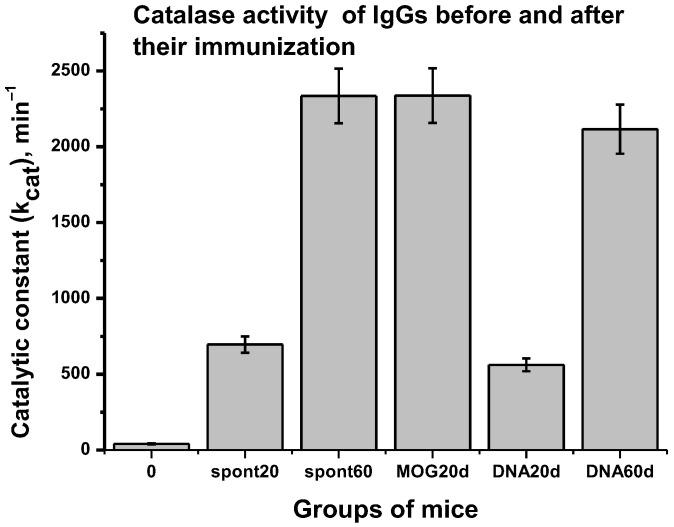
The exact mechanisms of the evolution of multiple sclerosis are still unknown. At the same time, the development in C57BL/6 mice of experimental autoimmune encephalomyelitis (EAE, simulating human multiple sclerosis) happens as a result of the violation of bone marrow hematopoietic stem cell differentiation profiles integrated with the production of toxic auto-antibodies splitting the basic myelin protein, myelin oligodendrocyte glycoprotein (MOG), histones, and DNA. It has been shown that IgGs from the plasma of healthy humans and autoimmune patients oxidize many different compounds due to their peroxidase (HO-dependent) and oxidoreductase (HO-independent) activities. Here, we first analyzed the changes in the relative catalase activity of IgGs from C57BL/6 mice blood plasma over time at different stages of the EAE development (onset, acute, and remission phases). It was shown that the catalase activity of IgGs of 3-month-old mice is, on average, relatively low ( = 40.7 min), but it increases during 60 days of spontaneous development of EAE 57.4-fold ( = 2.3 × 10 min). The catalase activity of antibodies increases by a factor of 57.4 by 20 days after the immunization of mice with MOG ( = 2.3 × 10 min), corresponding to the acute phase of EAE development, and 52.7-fold by 60 days after the treatment of mice with a DNA-histone complex ( = 2.1 × 10 min). It is the acceleration of the EAE development after the treatment of mice with MOG that leads to the increased production of lymphocytes synthesizing antibodies with catalase activity. All data show that the IgGs' catalase activity can play an essential role in reducing the HO concentration and protecting mice from oxidative stress.
多发性硬化症的确切发病机制尚不清楚。与此同时,C57BL/6 小鼠实验性自身免疫性脑脊髓炎(EAE,模拟人类多发性硬化症)的发展是由于骨髓造血干细胞分化谱的破坏,与产生毒性自身抗体分裂基本髓鞘蛋白、髓鞘少突胶质细胞糖蛋白(MOG)、组蛋白和 DNA 有关。已经表明,来自健康人类和自身免疫性疾病患者的血浆 IgGs 由于其过氧化物酶(HO 依赖性)和氧化还原酶(HO 非依赖性)活性而氧化许多不同的化合物。在这里,我们首先分析了 EAE 发展不同阶段(发病期、急性期和缓解期)C57BL/6 小鼠血浆中 IgG 的相对过氧化氢酶活性随时间的变化。结果表明,3 个月大的小鼠 IgG 的过氧化氢酶活性平均相对较低(=40.7min),但在 EAE 自发发展的 60 天内增加了 57.4 倍(=2.3×10min)。用 MOG 免疫小鼠后 20 天,抗体的过氧化氢酶活性增加了 57.4 倍(=2.3×10min),与 EAE 发展的急性期相对应,用 DNA-组蛋白复合物治疗小鼠 60 天后增加了 52.7 倍(=2.1×10min)。正是用 MOG 治疗小鼠后 EAE 发展的加速导致了产生具有过氧化氢酶活性的合成抗体的淋巴细胞数量增加。所有数据表明,IgG 的过氧化氢酶活性在降低 HO 浓度和保护小鼠免受氧化应激方面可以发挥重要作用。


 Zotero 插件