
花色苷通过微生物-肠道-脑轴防治神经退行性疾病的作用:一项关键性综述。
Protective Effect of Anthocyanins against Neurodegenerative Diseases through the Microbial-Intestinal-Brain Axis: A Critical Review.
机构信息
College of Food Science and Technology, Zhejiang University of Technology, Hangzhou 310014, China.
College of Biosystems Engineering and Food Science, Zhejiang University, Hangzhou 310058, China.
出版信息
Nutrients. 2023 Jan 18;15(3):496. doi: 10.3390/nu15030496.
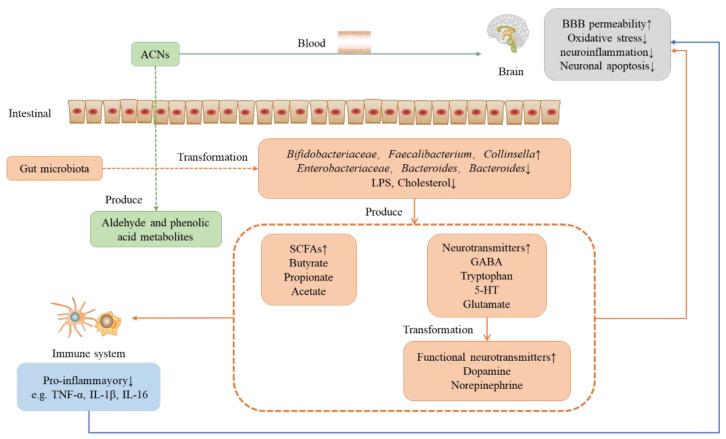
With the increase in human mean age, the prevalence of neurodegenerative diseases (NDs) also rises. This negatively affects mental and physiological health. In recent years, evidence has revealed that anthocyanins could regulate the functioning of the central nervous system (CNS) through the microbiome-gut-brain axis, which provides a new perspective for treating NDs. In this review, the protective effects and mechanisms of anthocyanins against NDs are summarized, especially the interaction between anthocyanins and the intestinal microbiota, and the microbial-intestinal-brain axis system is comprehensively discussed. Moreover, anthocyanins achieve the therapeutic purpose of NDs by regulating intestinal microflora and certain metabolites (protocateic acid, vanillic acid, etc.). In particular, the inhibitory effect of tryptophan metabolism on some neurotransmitters and the induction of blood-brain barrier permeability by butyrate production has a preventive effect on NDs. Overall, it is suggested that microbial-intestinal-brain axis may be a novel mechanism for the protective effect of anthocyanins against NDs.
随着人类平均年龄的增长,神经退行性疾病(NDs)的患病率也随之上升。这对精神和生理健康产生负面影响。近年来,有证据表明,花色苷可通过微生物群-肠-脑轴调节中枢神经系统(CNS)的功能,为治疗 NDs 提供了新视角。在这篇综述中,总结了花色苷对 NDs 的保护作用及其机制,特别是花色苷与肠道微生物群的相互作用以及微生物-肠-脑轴系统的综合讨论。此外,花色苷通过调节肠道微生物群和某些代谢物(原儿茶酸、香草酸等)来实现 NDs 的治疗目的。特别是色氨酸代谢对某些神经递质的抑制作用和丁酸盐产生诱导血脑屏障通透性对 NDs 具有预防作用。总的来说,微生物-肠-脑轴可能是花色苷对 NDs 保护作用的新机制。


 Zotero 插件