
重度抑郁症的功能连接特征:两项多中心神经影像学研究的机器学习分析。
Functional connectivity signatures of major depressive disorder: machine learning analysis of two multicenter neuroimaging studies.
机构信息
Amsterdam UMC location University of Amsterdam, Department of Psychiatry, Meibergdreef 9, Amsterdam, The Netherlands.
Amsterdam Neuroscience, Amsterdam, The Netherlands.
出版信息
Mol Psychiatry. 2023 Jul;28(7):3013-3022. doi: 10.1038/s41380-023-01977-5. Epub 2023 Feb 15.
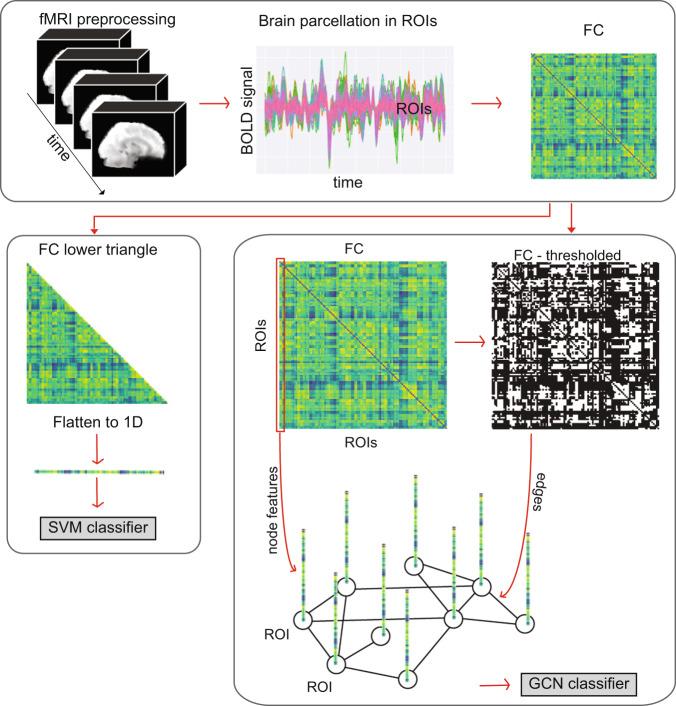
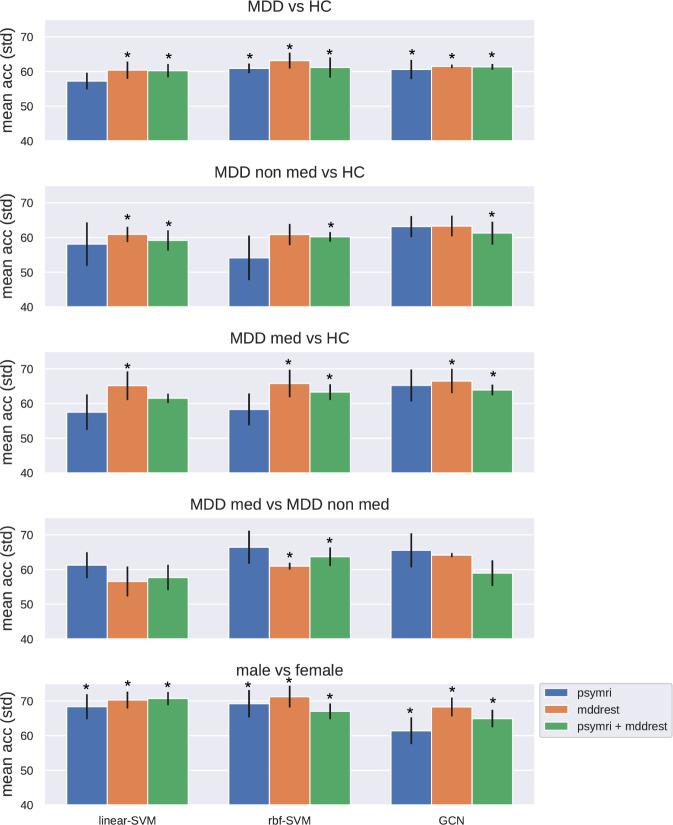
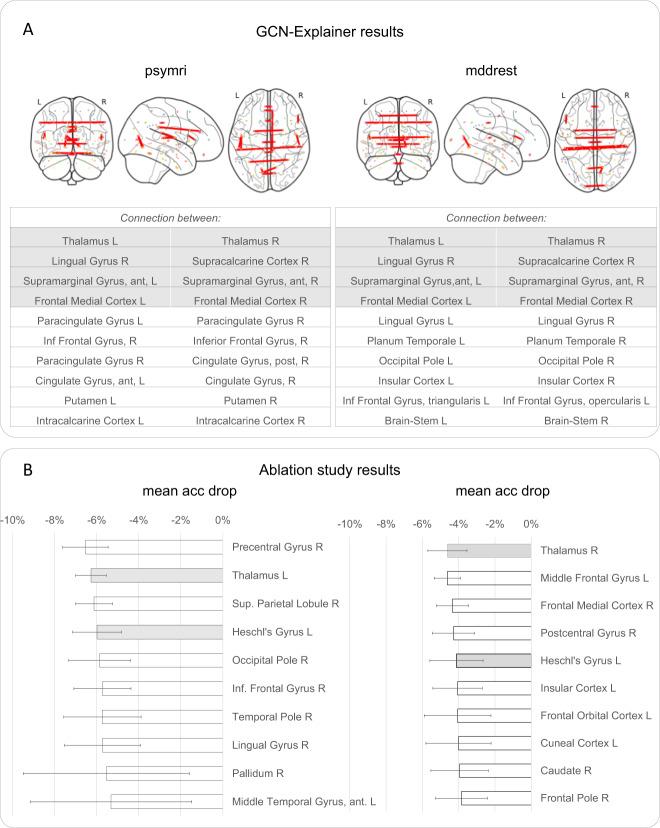
The promise of machine learning has fueled the hope for developing diagnostic tools for psychiatry. Initial studies showed high accuracy for the identification of major depressive disorder (MDD) with resting-state connectivity, but progress has been hampered by the absence of large datasets. Here we used regular machine learning and advanced deep learning algorithms to differentiate patients with MDD from healthy controls and identify neurophysiological signatures of depression in two of the largest resting-state datasets for MDD. We obtained resting-state functional magnetic resonance imaging data from the REST-meta-MDD (N = 2338) and PsyMRI (N = 1039) consortia. Classification of functional connectivity matrices was done using support vector machines (SVM) and graph convolutional neural networks (GCN), and performance was evaluated using 5-fold cross-validation. Features were visualized using GCN-Explainer, an ablation study and univariate t-testing. The results showed a mean classification accuracy of 61% for MDD versus controls. Mean accuracy for classifying (non-)medicated subgroups was 62%. Sex classification accuracy was substantially better across datasets (73-81%). Visualization of the results showed that classifications were driven by stronger thalamic connections in both datasets, while nearly all other connections were weaker with small univariate effect sizes. These results suggest that whole brain resting-state connectivity is a reliable though poor biomarker for MDD, presumably due to disease heterogeneity as further supported by the higher accuracy for sex classification using the same methods. Deep learning revealed thalamic hyperconnectivity as a prominent neurophysiological signature of depression in both multicenter studies, which may guide the development of biomarkers in future studies.
机器学习的前景激发了人们开发精神科诊断工具的希望。初步研究表明,基于静息态连接的方法对识别重度抑郁症(MDD)具有较高的准确性,但由于缺乏大型数据集,研究进展受到了阻碍。在这里,我们使用常规机器学习和先进的深度学习算法,从两个最大的 MDD 静息态数据集区分 MDD 患者和健康对照组,并识别抑郁的神经生理特征。我们从 REST-meta-MDD(N=2338)和 PsyMRI(N=1039)联盟获得了静息态功能磁共振成像数据。使用支持向量机(SVM)和图卷积神经网络(GCN)对功能连接矩阵进行分类,并使用 5 折交叉验证评估性能。使用 GCN-Explainer、消融研究和单变量 t 检验可视化特征。结果显示,MDD 与对照组的平均分类准确率为 61%。分类(非)用药亚组的平均准确率为 62%。跨数据集的性别分类准确率明显更高(73-81%)。结果可视化表明,两种数据集的分类都由更强的丘脑连接驱动,而几乎所有其他连接都较弱,单变量效应大小较小。这些结果表明,全脑静息态连接是 MDD 的可靠但较差的生物标志物,这可能是由于疾病异质性所致,使用相同方法对性别进行分类的更高准确性进一步支持了这一点。深度学习揭示了丘脑过度连接是这两项多中心研究中抑郁的一个突出神经生理特征,这可能为未来研究中生物标志物的开发提供指导。

 Zotero 插件