
与C57Bl/6J和BALB/c小鼠相比,C57Bl/6N小鼠对双链RNA的肺部炎症反应减弱。
C57Bl/6N mice have an attenuated lung inflammatory response to dsRNA compared to C57Bl/6J and BALB/c mice.
作者信息
Malm Tillgren Sofia, Nieto-Fontarigo Juan José, Cerps Samuel, Ramu Sangeetha, Menzel Mandy, Mahmutovic Persson Irma, Meissner Anja, Akbarshahi Hamid, Uller Lena
机构信息
Department of Experimental Medical Science, Unit of Respiratory immunopharmacology, Lund University, Lund, Sweden.
Wallenberg Center for Molecular Medicine, Lund University, Lund, Sweden.
出版信息
J Inflamm (Lond). 2023 Feb 21;20(1):6. doi: 10.1186/s12950-023-00331-4.
BACKGROUND
Lower respiratory infections caused by ssRNA viruses are a major health burden globally. Translational mouse models are a valuable tool for medical research, including research on respiratory viral infections. In in vivo mouse models, synthetic dsRNA can be used as a surrogate for ssRNA virus replication. However, studies investigating how genetic background of mice impacts the murine lung inflammatory response to dsRNA is lacking. Hence, we have compared lung immunological responses of BALB/c, C57Bl/6N and C57Bl/6J mice to synthetic dsRNA.
METHODS
dsRNA was administered intranasally to BALB/c, C57Bl/6N and C57Bl/6J mice once/day for three consecutive days. Lactate dehydrogenase (LDH) activity, inflammatory cells, and total protein concentration were analyzed in bronchoalveolar lavage fluid (BALF). Pattern recognition receptors levels (TLR3, MDA5 and RIG-I) were measured in lung homogenates using RT-qPCR and western blot. Gene expression of IFN-β, TNF-α, IL-1β and CXCL1 was assessed in lung homogenates by RT-qPCR. ELISA was used to analyze protein concentrations of CXCL1 and IL-1β in BALF and lung homogenates.
RESULTS
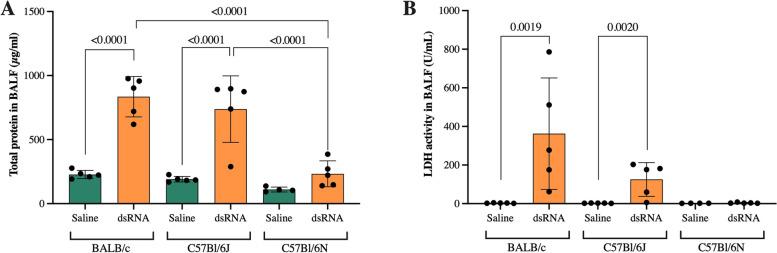
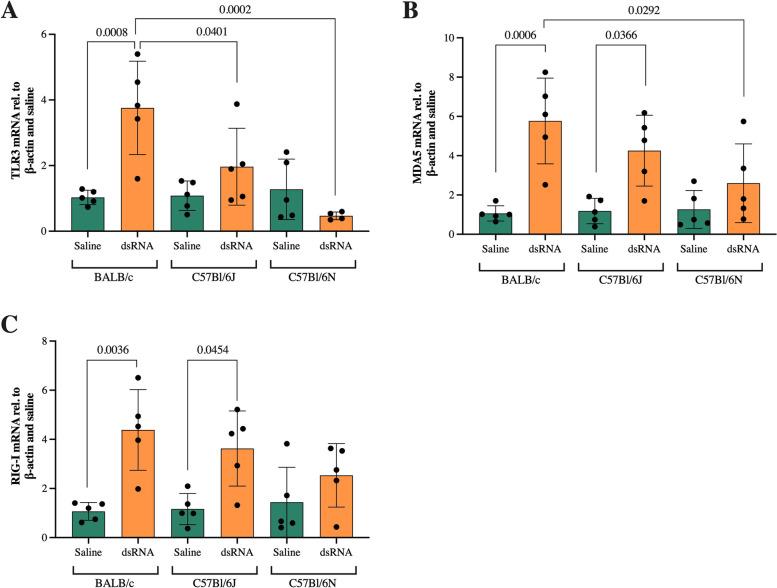
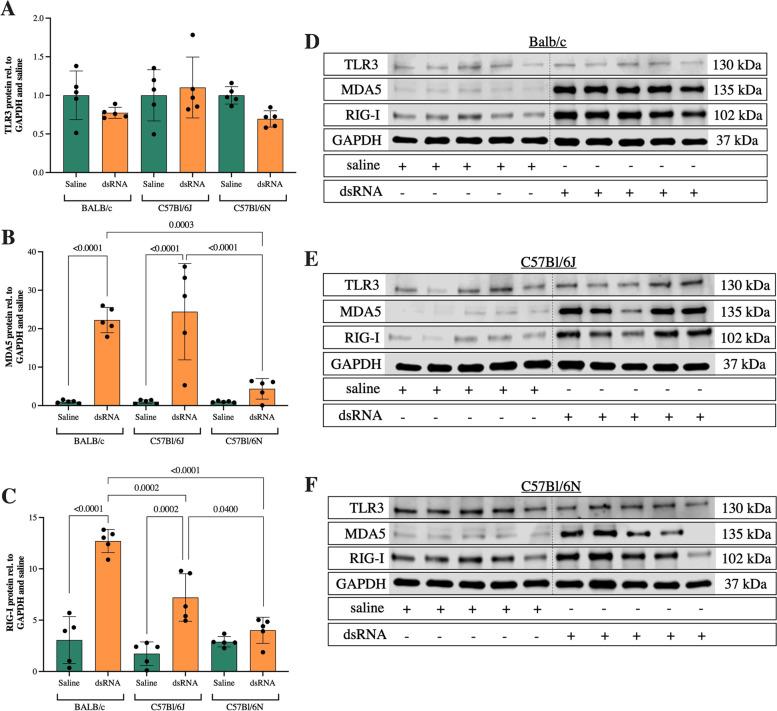
BALB/c and C57Bl/6J mice showed infiltration of neutrophils to the lung, and an increase in total protein concentration and LDH activity in response to dsRNA administration. Only modest increases in these parameters were observed for C57Bl/6N mice. Similarly, dsRNA administration evoked an upregulation of MDA5 and RIG-I gene and protein expression in BALB/c and C57Bl/6J, but not C57Bl/6N, mice. Further, dsRNA provoked an increase in gene expression of TNF-α in BALB/c and C57Bl/6J mice, IL-1β only in C57Bl/6N mice and CXCL1 exclusively in BALB/c mice. BALF levels of CXCL1 and IL-1β were increased in BALB/c and C57Bl/6J mice in response to dsRNA, whereas the response of C57Bl/6N was blunt. Overall, inter-strain comparisons of the lung reactivity to dsRNA revealed that BALB/c, followed by C57Bl/6J, had the most pronounced respiratory inflammatory responses, while the responses of C57Bl/6N mice were attenuated.
CONCLUSIONS
We report clear differences of the lung innate inflammatory response to dsRNA between BALB/c, C57Bl/6J and C57Bl/6N mice. Of particular note, the highlighted differences in the inflammatory response of C57Bl/6J and C57Bl/6N substrains underscore the value of strain selection in mouse models of respiratory viral infections.
背景
单链RNA病毒引起的下呼吸道感染是全球主要的健康负担。转化小鼠模型是医学研究的宝贵工具,包括呼吸道病毒感染研究。在体内小鼠模型中,合成双链RNA可作为单链RNA病毒复制的替代物。然而,缺乏关于小鼠遗传背景如何影响小鼠肺部对双链RNA炎症反应的研究。因此,我们比较了BALB/c、C57Bl/6N和C57Bl/6J小鼠对合成双链RNA的肺部免疫反应。
方法
连续三天每天一次经鼻向BALB/c、C57Bl/6N和C57Bl/6J小鼠给予双链RNA。分析支气管肺泡灌洗液(BALF)中的乳酸脱氢酶(LDH)活性、炎症细胞和总蛋白浓度。使用RT-qPCR和蛋白质印迹法测量肺匀浆中模式识别受体水平(TLR3、MDA5和RIG-I)。通过RT-qPCR评估肺匀浆中IFN-β、TNF-α、IL-1β和CXCL1的基因表达。ELISA用于分析BALF和肺匀浆中CXCL1和IL-1β的蛋白质浓度。
结果
BALB/c和C57Bl/6J小鼠在给予双链RNA后出现中性粒细胞浸润到肺部,总蛋白浓度和LDH活性增加。C57Bl/6N小鼠仅观察到这些参数有适度增加。同样,给予双链RNA后,BALB/c和C57Bl/6J小鼠而非C57Bl/6N小鼠的MDA5和RIG-I基因及蛋白表达上调。此外,双链RNA在BALB/c和C57Bl/6J小鼠中引起TNF-α基因表达增加,仅在C57Bl/6N小鼠中引起IL-1β基因表达增加,仅在BALB/c小鼠中引起CXCL1基因表达增加。BALB/c和C57Bl/6J小鼠中,双链RNA使BALF中CXCL1和IL-1β水平升高,而C57Bl/6N小鼠的反应不明显。总体而言,对双链RNA的肺部反应性的品系间比较显示,BALB/c其次是C57Bl/6J具有最明显的呼吸道炎症反应,而C57Bl/



 Zotero 插件