
印度尼西亚医院抗生素使用合理化的努力:实践及其影响
The Effort to Rationalize Antibiotic Use in Indonesian Hospitals: Practice and Its Implication.
作者信息
Siahaan Selma, Rukmini Rukmini, Roosihermiatie Betty, Andarwati Pramita, Handayani Rini S, Tarigan Ingan U, Rosita Tita, Rustika Rustika, Usman Yuslely, Kristiana Lusi
机构信息
Organization Research for Health, The National Research and Innovation Agency-Indonesia, Jakarta, Indonesia.
Centre for Health Financing and Decentralization Policy, Ministry of Health-Indonesia, Jakarta, Indonesia.
出版信息
J Trop Med. 2023 Feb 25;2023:7701712. doi: 10.1155/2023/7701712. eCollection 2023.
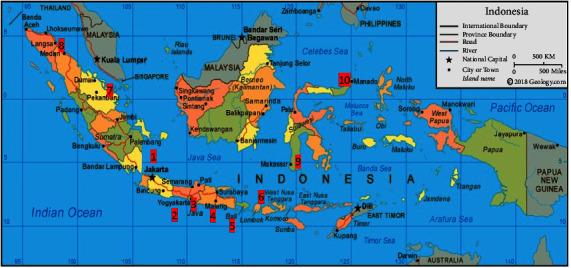
An effective strategy for combatting AMR in Indonesia is to make the use of antibiotics in hospitals more rational with the help of an Antimicrobial Resistance Control Program (AMR-CP). This study aims to analyze the implementation of the AMR-CP in hospitals by conducting in-depth interviews with health professionals from ten hospitals and health officers of ten provincial health offices in ten different provinces and observation towards its documents. The sample location was selected by purposive sampling. Informants at the hospitals were hospital directors, chairmen of the AMR-CP team, chairmen of the medical committee, persons in charge of the microbiology laboratory, clinicians, nurses, clinical pharmacists, and those program managers at the provincial health offices who are responsible for administering antibiotics. Information is first collected and then a thematic analysis is applied along with triangulation to confirm the validity of information from multiple sources, including document observation results. The analysis is adapted to the framework of the system (i.e., input, process, and output). Results show that hospitals in Indonesia already have the resources to implement AMR-CP, including AMR-CP team and microbiology laboratories. Six hospitals examined also have clinicians trained in microbiology. Though hospital leadership and its commitment to implementing AMR-CP are favorable, there is room for improvement. AMR-CP teams organize routine activities for socialization and training, develop standard operating procedures (SOPs) for antibiotic use, antibiotic patterns surveillance, and bacterial mapping. Some obstacles to implementing AMR-CP policies are posed by the human resources, facilities, budget, antibiotics and reagent shortages, and clinician compliance with SOPs. The study concludes that there was an improvement in antibiotic sensitivity patterns, rational use of antibiotics, use of microbiological laboratories, and cost-efficiency. It recommends the government and healthcare providers continue to improve AMR-CP in hospitals and promote AMR-CP policy by making the regional health office of the hospital a representative of the regional government.
在印度尼西亚,对抗抗菌药物耐药性(AMR)的一项有效策略是,在抗菌药物耐药性控制计划(AMR-CP)的帮助下,使医院内抗生素的使用更加合理。本研究旨在通过对来自十个不同省份的十家医院的卫生专业人员和十个省级卫生办公室的卫生官员进行深入访谈,并观察其相关文件,来分析AMR-CP在医院中的实施情况。样本地点采用目的抽样法选取。医院的受访者包括医院院长、AMR-CP团队主席、医学委员会主席、微生物实验室负责人、临床医生、护士、临床药剂师,以及省级卫生办公室中负责管理抗生素的项目管理人员。首先收集信息,然后进行主题分析,并采用三角测量法来确认来自多个来源(包括文件观察结果)的信息的有效性。分析过程采用系统框架(即输入、过程和输出)。结果表明,印度尼西亚的医院已经具备实施AMR-CP的资源,包括AMR-CP团队和微生物实验室。接受检查的六家医院也有经过微生物学培训的临床医生。虽然医院领导及其对实施AMR-CP的承诺是积极的,但仍有改进空间。AMR-CP团队组织了关于宣传和培训的常规活动,制定了抗生素使用、抗生素模式监测和细菌图谱绘制的标准操作程序(SOP)。实施AMR-CP政策面临的一些障碍包括人力资源、设施、预算、抗生素和试剂短缺,以及临床医生对SOP的遵守情况。该研究得出结论,抗生素敏感性模式、抗生素的合理使用、微生物实验室的使用以及成本效益都有所改善。研究建议政府和医疗服务提供者继续改进医院的AMR-CP,并通过使医院的地区卫生办公室成为地区政府的代表来推广AMR-CP政策。
 Zotero 插件