
脂滴作为与分枝杆菌感染逃避机制相关的多功能细胞器。
Lipid droplets as multifunctional organelles related to the mechanism of evasion during mycobacterial infection.
机构信息
Laboratory of Cellular Biology, Department of Biology, Federal University of Juiz de Fora (UFJF), Juiz de Fora, Minas Gerais, Brazil.
Laboratory of Microscopy and Microanalysis, Department of Cell Biology, University of Brasilia, Brasilia, DF, Brazil.
出版信息
Front Cell Infect Microbiol. 2023 Feb 23;13:1102643. doi: 10.3389/fcimb.2023.1102643. eCollection 2023.
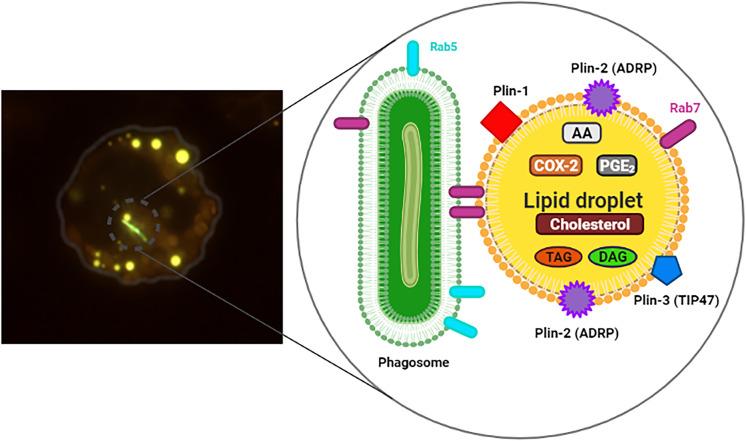
Tuberculosis (TB) is an infectious disease caused by the bacteria of the () complex. The modulation of the lipid metabolism has been implicated in the immune response regulation, including the formation of lipid droplets (LD)s, LD-phagosome association and eicosanoid synthesis. , BCG and other pathogenic mycobacteria, as well as wall components, such as LAM, can induce LDs formation in a mechanism involving surface receptors, for instance TLRs, CD36, CD14, CD11b/CD18 and others. In addition, the activation of the lipid-activated nuclear receptor PPARγ is involved in the mechanisms of LD biogenesis, as well as in the modulation of the synthesis of lipid mediators. In infected cells, LDs are sites of compartmentalized prostaglandin E synthesis involved in macrophage deactivation, bacterial replication and regulation of the host cytokine profile. LDs also have a function in vesicle traffic during infection. Rab7 and RILP, but not Rab5, are located on LDs of infected macrophages, suggesting that LDs and phagosomes could exchange essential proteins for phagosomal maturation, interfering in mycobacterial survival. The pharmacological inhibition of LDs biogenesis affects the bacterial replication and the synthesis of lipid mediators and cytokines, suggesting that LDs may be new targets for antimicrobial therapies. However, it is still controversial if the accumulation of LDs favors the mycobacterial survival acting as an escape mechanism, or promotes the host resistance to infection. Thus, in this mini-review we discuss recent advances in understanding the important role of LDs in the course of infections and the implications for the pathophysiology of mycobacteriosis.
结核病(TB)是一种由 ()复合体细菌引起的传染病。脂质代谢的调节与免疫反应的调节有关,包括脂滴(LD)的形成、LD-吞噬体的关联和类二十烷酸的合成。卡介苗(BCG)和其他致病性分枝杆菌以及细胞壁成分,如 LAM,能够通过涉及表面受体(如 TLRs、CD36、CD14、CD11b/CD18 等)的机制诱导 LD 的形成。此外,脂质激活核受体 PPARγ 的激活参与了 LD 生物发生的机制,以及脂质介质合成的调节。在感染细胞中,LD 是参与巨噬细胞失活、细菌复制和宿主细胞因子谱调节的局部前列腺素 E 合成的部位。LD 在感染过程中的囊泡运输中也具有功能。Rab7 和 RILP,但不是 Rab5,位于感染巨噬细胞的 LD 上,这表明 LD 和吞噬体可以交换成熟所需的必需蛋白,干扰分枝杆菌的存活。LD 生物发生的药理学抑制影响细菌复制和脂质介质和细胞因子的合成,这表明 LD 可能是抗微生物治疗的新靶点。然而,LD 的积累是否有利于分枝杆菌的生存,作为一种逃避机制,或者促进宿主对感染的抵抗力,这仍然存在争议。因此,在这篇小型综述中,我们讨论了关于 LD 在感染过程中的重要作用的最新进展及其对分枝杆菌病病理生理学的影响。

 Zotero 插件