
未加工红肉和加工肉类消费、血浆代谢组与缺血性心脏病风险:英国生物库的前瞻性队列研究。
Unprocessed Red Meat and Processed Meat Consumption, Plasma Metabolome, and Risk of Ischemic Heart Disease: A Prospective Cohort Study of UK Biobank.
机构信息
Department of Epidemiology and Biostatics, School of Public Health Peking University Beijing China.
Department of Biostatics, School of Public Health Peking University Beijing China.
出版信息
J Am Heart Assoc. 2023 Apr 4;12(7):e027934. doi: 10.1161/JAHA.122.027934. Epub 2023 Mar 28.
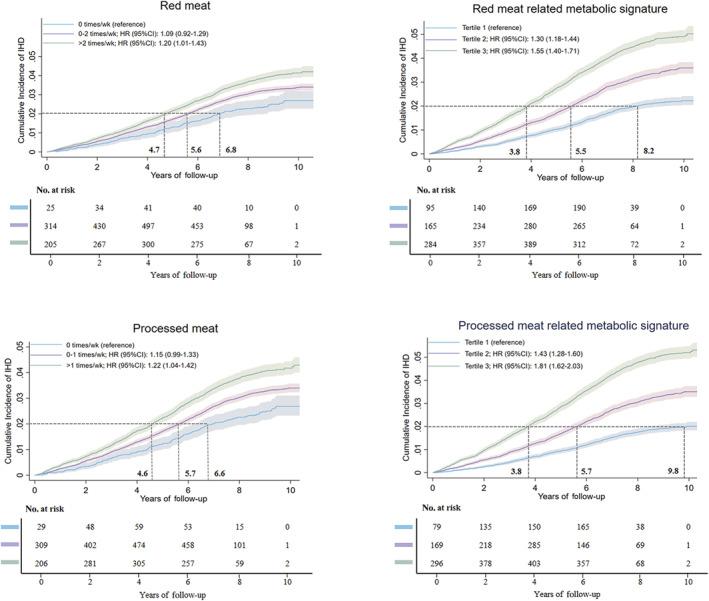
Background The evidence is equivocal on the association between meat consumption and ischemic heart disease (IHD) risk. To what extent the variation of individuals' metabolic responses to the same diet may account for this association is not fully understood. We aim to identify metabolomic signatures characterizing consumption of unprocessed red meat and processed meat and whether such signatures are associated with IHD risk. Methods and Results We conducted a cohort study of 92 246 individuals (mean age, 56.1 years; 55.1% women) using the UK Biobank. During the median follow-up of 8.74 years, 3059 incident IHD events were documented. Unprocessed red meat and processed meat consumption was assessed using a touchscreen dietary questionnaire. Plasma metabolome was profiled by high-throughput nuclear magnetic resonance spectroscopy. Cox proportional hazards regression model was used to test the association of meat consumption with IHD. Genome-wide association analysis and 1-sample Mendelian randomization were performed for metabolomic signatures and causal association of signatures with IHD. Using elastic net regularized regressions, we constructed metabolomic signatures consisting of 157 and 142 metabolites for unprocessed red meat (Spearman correlation coefficient []=0.223) and processed meat (=0.329), respectively. These signatures showed positive associations with incident IHD (red meat related signature: hazard ratio [HR] per SD increment=1.11 [95% CI, 1.06-1.16], <0.001; processed meat related signature: HR, 1.16 [95% CI, 1.11-1.21], <0.001). Genome-wide association studies identified 45 and 4 loci, involved in lipid and lipoprotein metabolism, for red and processed meat related signatures. Mendelian randomization showed that there were casual associations of signatures with risk of incident IHD. Conclusions We identify metabolomic signatures that reflect consumption of unprocessed red meat and processed meat, and these signatures are associated with an increased risk of IHD.
背景 关于肉类消费与缺血性心脏病(IHD)风险之间的关联,证据尚无定论。个体对同一饮食的代谢反应差异在多大程度上可以解释这种关联尚不清楚。我们旨在确定表征未加工红肉和加工肉消费的代谢组学特征,以及这些特征是否与 IHD 风险相关。
方法和结果 我们对英国生物库中的 92246 名参与者(平均年龄 56.1 岁,55.1%为女性)进行了队列研究。在 8.74 年的中位随访期间,记录了 3059 例 IHD 事件。使用触摸屏膳食问卷评估未加工红肉和加工肉的消费情况。通过高通量核磁共振光谱法对血浆代谢组进行了分析。Cox 比例风险回归模型用于检验肉类消费与 IHD 的关联。进行了全基因组关联分析和 1 样本孟德尔随机化,以检验代谢组学特征与 IHD 的因果关联。使用弹性网络正则化回归,我们构建了由 157 个和 142 个代谢物组成的代谢组学特征,分别用于未加工红肉(Spearman 相关系数 []=0.223)和加工肉(=0.329)。这些特征与 IHD 发病呈正相关(与未加工红肉相关的特征:每标准差增量的危险比 [HR] =1.11 [95%CI,1.06-1.16],<0.001;与加工肉相关的特征:HR,1.16 [95%CI,1.11-1.21],<0.001)。全基因组关联研究确定了 45 个和 4 个与红肉类和加工肉类相关特征相关的基因座,这些基因座涉及脂质和脂蛋白代谢。孟德尔随机化表明,这些特征与 IHD 发病风险存在因果关系。
结论 我们确定了反映未加工红肉和加工肉消费的代谢组学特征,这些特征与 IHD 风险增加有关。


 Zotero 插件